Seeing red and blue emergency lights appear in the rearview mirror can immediately make a driver nervous. Even someone who believes they have done nothing seriously wrong may experience a faster heartbeat and start wondering why an officer wants them to stop. A traffic stop, however, does not automatically mean that a driver has committed a major offense or is in serious trouble. Officers conduct stops for many reasons, ranging from observed traffic violations to equipment problems or matters that require clarification.
Understanding the general process can make an unfamiliar situation easier to interpret while helping drivers respond calmly and safely. When an officer signals a vehicle to stop, the driver’s first responsibility is generally to acknowledge the signal and look for an appropriate place to pull over safely. Sudden braking or unpredictable movements can create additional hazards for the officer, the driver and surrounding traffic. Drivers should reduce speed, use their turn signal when appropriate and move toward a safe stopping location.
The precise requirements can vary depending on local traffic laws and road conditions, so drivers should follow the rules applicable where they are driving. Once stopped, remaining calm and avoiding unnecessary movements can help keep the interaction straightforward. Something that drivers may not immediately realize is that an officer is considering safety before the conversation even begins.
Traffic stops often take place only a short distance from moving vehicles, sometimes at night or in poor weather. The officer must pay attention not only to the stopped vehicle but also to approaching traffic and the surrounding environment. Where a patrol vehicle is positioned and where an officer chooses to stand can therefore have practical safety purposes. Actions that appear unusual from inside the stopped vehicle may simply reflect procedures intended to reduce risk during an unpredictable roadside interaction.
The position of the patrol vehicle is one example. Officers may stop behind the vehicle rather than immediately alongside it, leaving room that helps them observe the situation and approach safely. Depending on training, roadway design and circumstances, a patrol vehicle may also be positioned in a particular way to improve visibility or provide some protection from passing traffic. There is no single arrangement used in every traffic stop, because road conditions and law-enforcement procedures differ between jurisdictions. For that reason, drivers should avoid assuming that a particular vehicle position necessarily carries a hidden meaning.
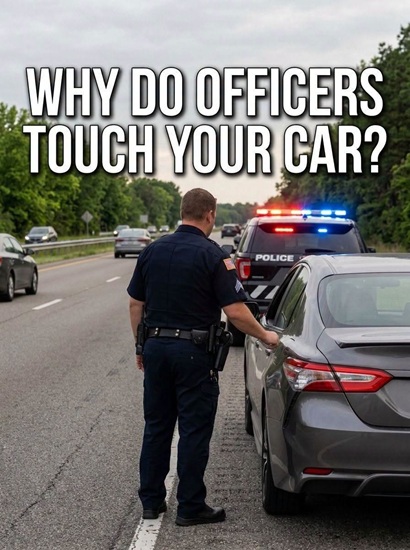
Another detail that sometimes attracts attention is an officer touching the rear portion of a vehicle while approaching. This practice has been widely discussed, and historically some officers were trained to touch a vehicle as part of their approach. Explanations commonly associated with the practice include checking that a trunk is closed and leaving physical evidence that the officer approached the vehicle. However, policing procedures have changed significantly as body-worn cameras, dashboard cameras and other technologies have become common. Not every officer performs this action, and observing or not observing it should not be treated as evidence about the driver’s situation.
The officer’s approach to the vehicle may also vary. A driver might expect an officer to walk directly toward the driver’s window, but circumstances can lead to a different approach. Traffic conditions, the width of the shoulder, visibility and other safety considerations may influence which side of the vehicle an officer approaches. In some circumstances, approaching from the passenger side can provide greater separation from passing traffic. What looks unexpected to the driver can therefore be a simple response to the physical environment rather than an indication that something unusual is happening.
Once the officer reaches the vehicle, the interaction commonly begins with communication about the stop and requests for relevant documentation. Depending on the jurisdiction and circumstances, drivers may be asked to provide a driver’s license, vehicle registration or proof of insurance. Requirements are governed by applicable laws, which are not identical everywhere. Drivers should therefore rely on official guidance from the jurisdiction in which they are driving rather than assuming that procedures described online apply universally. Keeping commonly required documents accessible can make an ordinary traffic stop easier to manage.
The officer may then return to the patrol vehicle for a period of time. To someone already feeling anxious, even a few minutes can seem much longer. The delay does not necessarily indicate that something serious has been discovered. Officers may need time to verify information, complete records, check documentation or carry out other routine administrative tasks associated with the stop. The circumstances of each interaction are different, and it is usually unhelpful to interpret a short wait as proof that the situation is becoming more serious.
Drivers sometimes become concerned when an officer appears to spend time looking at the vehicle before approaching. Observation is a normal part of assessing a roadside environment. Officers may be paying attention to traffic, vehicle condition, occupants or other visible circumstances relevant to the stop. It is important, however, not to turn ordinary observations into dramatic claims about secret signals or hidden procedures. Many viral explanations of traffic stops combine genuine practices with speculation, and law-enforcement methods can vary considerably between agencies.
The same caution applies to claims about an officer’s body position. During a roadside conversation, an officer may choose a position that allows communication with the driver while maintaining awareness of passing vehicles and the surrounding area. Safety training can influence these choices, but no single posture should automatically be interpreted as evidence that the officer considers a driver dangerous. Every traffic stop involves different road conditions, vehicles and individuals. Understanding that variation provides a more accurate picture than trying to decode every movement as though it were a universal signal.
For drivers, one of the most useful responses is simply to avoid making the situation more confusing. After stopping safely, minimizing unnecessary movement can reduce misunderstandings. If important documents are stored somewhere that requires reaching or searching, communicating before making an unexpected movement can help clarify what is happening. Instructions from officers should be considered in light of applicable law, and drivers who have questions about their legal rights should consult authoritative legal information for their jurisdiction rather than relying solely on generalized social-media advice.
It is equally important to understand that being stopped does not automatically establish guilt. An officer may investigate an observed traffic issue, and the interaction can end in different ways depending on the circumstances and local law. A driver might receive a warning, citation or another lawful instruction, or the matter may be resolved without further action. The specific outcome depends on facts that cannot be determined merely from seeing emergency lights. Treating every traffic stop as either a harmless conversation or an inevitable confrontation oversimplifies a process that can involve many different circumstances.
Drivers should also remember that officers cannot know everything about a vehicle or its occupants before approaching. From the officer’s perspective, even an apparently routine stop contains uncertainties. From the driver’s perspective, the sudden appearance of emergency lights can create uncertainty of a different kind. Recognizing that both sides are operating with incomplete information helps explain why clear communication and predictable behavior can be valuable. It does not determine the legal rights or responsibilities of either party, but it helps explain why established procedures exist.
Technology has changed traffic stops substantially over time. Dashboard cameras, body-worn cameras, computerized records and improved communications systems can now document or support parts of an interaction that once depended more heavily on physical procedures. This technological evolution is one reason older explanations of police practices should not automatically be treated as universal descriptions of what officers do today. An action that may have been widely taught in one period or department may be uncommon somewhere else. Police agencies also update their procedures according to local policy, legislation, technology and training.
That context is particularly important when discussing the familiar claim about officers touching the back of a stopped vehicle. The practice is real enough to have historical explanations, but it should not be transformed into a sensational claim that every officer always taps every vehicle for one specific reason. Some may do it because of training or habit, while others may not do it at all. Modern recording technology has also reduced the importance of some older explanations for the practice. A responsible description therefore acknowledges both the historical practice and the considerable variation that exists today.
Traffic stops at night can feel especially intimidating because flashing emergency lights are visually intense and visibility is limited. Drivers may find it harder to understand what an officer is doing outside the vehicle, while officers must assess the same dark environment from their perspective. Remaining attentive and avoiding sudden, unexplained movements can help keep communication clear. The goal should not be to guess what every movement means but to respond appropriately to what is actually happening.
Weather and road design can make the situation even more complicated. A stop on a quiet, wide shoulder is different from one beside a busy multilane highway. Heavy rain, snow, poor lighting, construction zones or narrow roads can influence how both vehicles are positioned and how an officer approaches. This is another reason there is no universal visual formula for interpreting a traffic stop. Procedures that make sense in one environment may be inappropriate in another.
A useful distinction should also be made between general safety information and legal advice. Traffic laws and the rules governing interactions with law enforcement vary by country, state, province and other jurisdictions. Questions about whether a driver must provide a particular document, answer a particular question or follow a particular instruction can depend on those laws and on the circumstances of the stop. General educational information cannot replace advice from a qualified legal professional or official government guidance relevant to the location where the stop occurs.
This is also why dramatic online posts promising to reveal what officers are “really doing” should be approached carefully. A headline may suggest that every movement has a secret meaning when the reality is usually more ordinary and more complicated. Vehicle placement, approach direction, observation and communication are often connected to safety, training and practical roadside conditions. There does not need to be a hidden explanation behind every action. Reliable information should distinguish documented practices from assumptions and should acknowledge when procedures differ between agencies.
For most drivers, the central lesson is therefore much simpler than the dramatic stories circulating online suggest. Seeing emergency lights can be stressful, but panic does not provide useful information about why the stop is occurring. Pulling over appropriately, paying attention to instructions and communicating clearly can help prevent an already stressful interaction from becoming unnecessarily confusing. If a driver later believes something about the stop was improper, there are established legal and administrative avenues for addressing those concerns rather than attempting to resolve every disagreement at the roadside.
Traffic stops involve two different perspectives meeting in an environment that can contain genuine physical hazards. The driver may be worried about a ticket, legal consequences or simply the uncertainty of the encounter. The officer is simultaneously dealing with moving traffic, limited information and the responsibilities associated with conducting the stop. Neither perspective should be replaced by assumptions about the intentions of the other person. Clear facts are more useful than speculation, particularly when discussing situations involving law enforcement and public safety.
The flashing lights in the mirror may always produce an uncomfortable moment, but understanding the basic process can remove some of the mystery surrounding it. The patrol vehicle’s position, an officer’s route toward the vehicle, a brief wait and even a touch on the rear of the car can have practical or historical explanations. None of these details should automatically be interpreted as a secret warning or proof that something serious is about to happen. Context, agency policy and individual circumstances matter.
Ultimately, the safest educational takeaway is not to memorize supposed hidden signals but to understand the broader principles involved. Traffic stops are structured interactions shaped by road safety, law, training, technology and the particular circumstances officers and drivers encounter. Staying calm enough to listen and communicate clearly can make those circumstances easier to navigate. And when questions concern specific legal rights or obligations, the most reliable answer comes from official information or qualified legal guidance for the relevant jurisdiction rather than from viral claims presented as universal rules.
