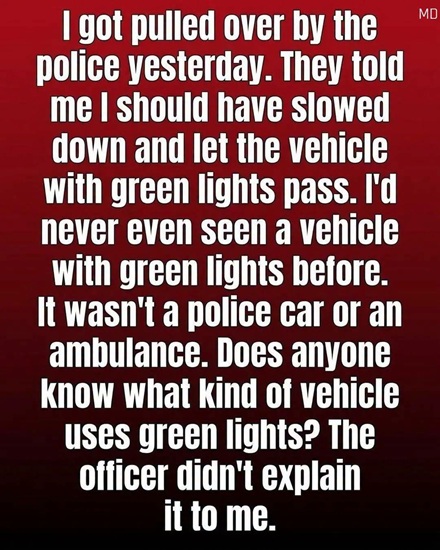
Seeing an unfamiliar light on a vehicle can easily catch a driver’s attention, especially when the light is a color that is not commonly associated with ordinary passenger cars. Green warning or identification lights are used on certain vehicles in some jurisdictions, but their meaning is not universal. Depending on the country, state, province, or local authority, a green light may identify a particular type of authorized vehicle or person. For that reason, drivers should avoid assuming that a green light carries exactly the same meaning everywhere.
Understanding the distinction is important because emergency-light regulations are established by the relevant transportation and public-safety authorities. In some jurisdictions, green lights have been associated with volunteer firefighters or other authorized emergency-service personnel. They can serve primarily as identification or as a request for consideration from surrounding motorists rather than automatically granting the vehicle the same legal privileges as a police car, ambulance, or fire engine using legally authorized emergency signals.
However, this distinction varies considerably between jurisdictions. A green light that has one legal meaning in one location may have a different purpose somewhere else. Drivers therefore need to follow the traffic laws that apply where they are actually driving rather than relying on something they have seen online. This is particularly important because the appearance of a warning light does not by itself establish what legal authority a vehicle has.
Emergency vehicles are normally regulated through specific laws defining which vehicles qualify, what colors and combinations of lights they may display, and under what circumstances those signals may be activated. Some places distinguish between professional emergency vehicles and vehicles operated by volunteers responding to emergencies. Other jurisdictions may reserve particular colors for entirely different purposes. The safest general principle is therefore to recognize an unusual light, remain attentive, and respond according to local traffic rules.
A driver who encounters an unfamiliar green light should first continue operating the vehicle safely and predictably. Sudden braking, swerving, or making an abrupt lane change can create a new hazard even when someone is trying to make room for another vehicle. Drivers should observe surrounding traffic, check mirrors, use signals when appropriate, and avoid blocking intersections or making movements that could endanger pedestrians, cyclists, or other motorists. If local law requires yielding to the vehicle displaying the signal, drivers should follow that requirement. If the light is only a courtesy or identification signal, the legal obligations may be different.
It is also important to distinguish green lights from the more familiar combinations used by emergency responders in many places. Police vehicles, ambulances, fire engines, and other authorized emergency vehicles often use highly visible flashing lights together with sirens when responding to urgent incidents, although the permitted colors differ internationally. When an authorized emergency vehicle approaches using emergency signals, motorists should follow the applicable rules governing yielding and right of way. Those requirements can specify whether drivers must move toward a particular side of the road, stop, remain stopped, or avoid entering an intersection.
Green lights can create confusion precisely because drivers may encounter them infrequently. A motorist might recognize flashing red or blue lights immediately while being uncertain about green. That uncertainty is one reason motorists should be cautious about relying on social-media posts that present a single explanation as though it applied everywhere. Traffic-light and vehicle-light regulations are jurisdiction-specific. An explanation written for one U.S. state, for example, should not automatically be treated as guidance for another state, Canada, the United Kingdom, Australia, or another country.
The same caution applies when a green light appears on a privately owned vehicle. In places where volunteer emergency personnel are permitted to display special lights on their personal vehicles, the vehicle may still look like an ordinary car, pickup truck, or SUV. The light can help other road users recognize that the driver has an emergency-related role. Nevertheless, the precise privileges associated with that signal depend on legislation. In some locations, motorists may be encouraged to allow the vehicle to pass when it can be done safely, while the green light itself may not provide the volunteer driver with unrestricted emergency-vehicle privileges.
Drivers should therefore avoid interpreting a special light as permission for unsafe behavior by either vehicle. Even emergency responders operate within legal frameworks governing emergency driving. Likewise, an ordinary motorist should not run a red light, enter an unsafe intersection, mount a curb, or make another dangerous maneuver merely because a vehicle displaying an unusual light appears behind them. Creating another collision would make the situation worse. Safe, controlled, and lawful movements remain essential whenever motorists encounter emergency or special-purpose vehicles.
Another useful principle is to avoid competing with a vehicle that appears to be responding to an emergency. Accelerating to prevent it from passing, following closely behind it to move through traffic, or attempting to take advantage of the space created by other motorists can be dangerous. Emergency scenes may involve additional responding vehicles, pedestrians, blocked lanes, equipment, or personnel working near the roadway. Maintaining adequate distance gives everyone more time to recognize hazards and react appropriately.
If a driver regularly encounters green lights and is uncertain about their legal meaning, the best source is the relevant government authority. Official transportation departments, police services, motor-vehicle agencies, fire services, or published traffic legislation can explain which colors are authorized and what motorists are legally required to do. This is more reliable than assuming that a viral photograph, short video, or social-media caption accurately describes the law. Online information can be useful for raising awareness, but legal driving requirements should ultimately be verified through authoritative sources.
Drivers traveling between jurisdictions should be especially aware of these differences. Road rules that feel familiar at home may change after crossing a state, provincial, or national boundary. Requirements concerning emergency vehicles, school buses, roadside assistance vehicles, construction vehicles, and special warning lights can all vary. A short review of official road rules before driving in an unfamiliar jurisdiction can prevent confusion and help motorists respond correctly when they encounter signals they have not seen before.
There is also a broader road-safety lesson behind the subject. Unfamiliar signals should encourage attention rather than panic. A driver does not need to identify every possible vehicle immediately in order to make a responsible initial decision. Maintaining control of the vehicle, reducing distractions, observing the surrounding road environment, and avoiding sudden movements provide valuable time to understand what is happening. When another vehicle clearly needs to pass and local rules permit or require motorists to facilitate that movement, creating space safely can help without introducing unnecessary danger.
Special vehicle lights exist because visibility and recognition matter on busy roads. Emergency responders and other authorized personnel may need to communicate their presence quickly to drivers who have only seconds to react. Colors, flashing patterns, sirens, reflective markings, and vehicle markings can all contribute to that communication. But those signals only work effectively when road users understand that different signals can have different legal meanings. Treating every flashing light as identical can be just as misleading as ignoring an unfamiliar signal altogether.
For social-media users, this subject also illustrates why context matters when sharing road-safety information. A headline claiming that a green light always means one specific thing may sound useful, but it can become inaccurate when distributed internationally. A more responsible explanation identifies the jurisdiction to which a rule applies or clearly states when meanings vary by location. This approach does not make the information less useful. Instead, it helps readers understand which facts they need to verify before applying the advice to their own circumstances.
Ultimately, seeing a green light on a vehicle should prompt awareness, not assumptions. In some jurisdictions it may identify volunteer emergency personnel or another authorized category of road user, while elsewhere the rules may be different. Drivers should remain calm, maintain control of their vehicles, avoid obstructing clearly authorized emergency operations, and comply with the laws of the jurisdiction in which they are driving. When uncertainty remains, official transportation or public-safety guidance is the appropriate place to confirm the meaning of a particular signal.
The most important takeaway is straightforward: vehicle-light colors do not have one universal meaning worldwide. A green light can carry a specific purpose under local law, but that purpose must be understood within its proper jurisdiction. Responsible driving means recognizing unusual signals without making unsupported assumptions, giving emergency operations appropriate space, and never sacrificing basic road safety in an attempt to react quickly. Checking authoritative local rules is ultimately the most reliable way to know exactly what a green light means and what the law expects a driver to do.
