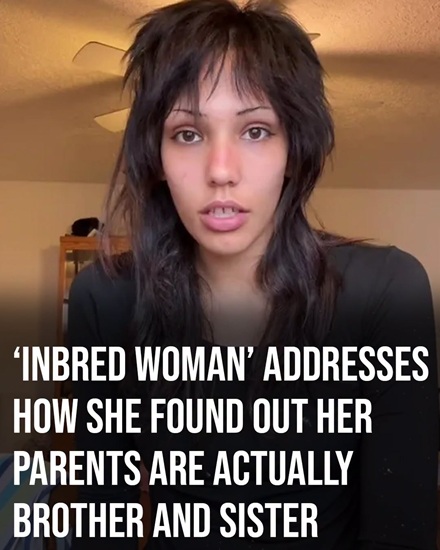
A woman who identifies herself online as Cameron has attracted widespread attention after posting TikTok videos about an exceptionally unusual and deeply personal part of her family history. According to Cameron’s own account, her biological parents are siblings, something she says she knew throughout childhood but did not initially understand as socially unusual. Her videos describe how growing older, attending school, and eventually gaining wider access to information changed the way she interpreted the family environment in which she had been raised.
Because the central details come primarily from Cameron’s social-media testimony, they should be attributed to her rather than presented as independently verified facts about her parents. Cameron has said she grew up in a small community in New Mexico where her parents’ biological relationship was apparently known among people around her. She described the information as something that was not hidden from her during childhood.
Instead of learning it through a dramatic revelation later in life, she says she simply grew up knowing that her mother and father were biologically related. That familiarity significantly shaped her childhood understanding of the situation. When children encounter something regularly within their home environment, they may naturally assume it is ordinary. Cameron said this was essentially what happened to her. She did not initially understand why other people might react strongly to the information because, from her perspective, it was simply another fact about her family.

She even recalled discussing it openly with classmates while she was in elementary school. According to Cameron, she sometimes told other children that her parents were siblings because she thought the fact was interesting rather than something she should conceal. Her childhood reaction illustrates an important point: young children generally interpret family circumstances through the environment available to them. They do not automatically possess an adult understanding of genetics, laws, social norms, or complicated family relationships.
Cameron recalled that the first significant challenge to that understanding came from a teacher. She said that when she was around fifth grade, a teacher privately suggested that she should probably stop sharing the information so freely. The conversation apparently did not provide Cameron with an immediate, complete understanding of the issue, but it introduced the idea that other people viewed her family circumstances very differently.
As she became older, her perspective continued changing. Cameron has said that increased access to the internet allowed her to encounter information and experiences outside the small community where she had grown up. That broader context reportedly helped her understand that a relationship between biological siblings was not considered ordinary in most families and carried serious ethical, social, legal, and genetic implications.

Her description is important because it challenges the assumption that she must always have understood the situation in the same way an adult outsider would. Children learn what is considered normal partly through their immediate environment. If a family structure is openly accepted around them, they may have little reason to question it until they encounter different information.
In another video, Cameron compared the way she learned about her parents’ relationship with how some adopted children describe always knowing they were adopted. Her point was not that adoption and sibling relationships between parents are equivalent. Instead, she was explaining that there was apparently no single dramatic moment when someone sat her down and revealed a secret. According to her, the information had simply always existed within her understanding of her family.
Cameron has also said the situation was relatively normalized within the small community where she lived. That claim represents her personal description of the environment and should not be expanded into a general characterization of New Mexico communities or rural areas. Her family’s circumstances are highly unusual and should not be used to stereotype people living in a particular town, state, economic setting, or region.
That distinction is particularly important when stories involving uncommon family relationships go viral. A single person’s account cannot establish anything meaningful about an entire geographic community. Cameron is describing what she says happened within her own family and immediate surroundings, not providing evidence that such relationships are common where she lives.

According to Cameron, her parents did not initially realize they were biologically related when they began seeing each other. She said their relationship began before they discovered that connection. The precise family circumstances that allegedly resulted in siblings growing up without knowing their biological relationship have not been independently documented in the material available here.
Cameron described one story about how they supposedly met romantically. According to her recollection, her father encountered her mother while she was working at a diner after he had been hunting. They began dating, Cameron said, before discovering their biological connection.
Again, this account should remain attributed to Cameron. Without documentation or direct statements from both parents, it would be inappropriate to present every detail of their early relationship as independently established history.
Cameron has indicated that her parents remained together even after learning they were related. She has also described their current relationship as difficult and said they frequently argue. Those descriptions represent her own perspective on her family and should not be converted into psychological diagnoses or broader conclusions about people in similar circumstances.
She has further said that she no longer maintains a close relationship with them. Her videos contain blunt and sometimes humorous descriptions of their current lives, but those remarks should be understood as comments made by an adult daughter discussing her personal family experience.
The popularity of Cameron’s videos inevitably generated questions about genetics. This is an area where accurate information is particularly important because online discussions of consanguinity frequently contain oversimplifications.
Children inherit genetic material from both biological parents. Everyone carries some genetic variants that could potentially contribute to recessive conditions, usually without experiencing any effects because they have another functioning copy of the relevant gene.
When biological parents are closely related, they are more likely to share genetic variants inherited from common ancestors. This increases the probability that a child could inherit two copies of the same harmful recessive variant.
The closer the biological relationship between the parents, the greater this concern generally becomes. Biological siblings share a substantial proportion of their genetic material, making reproduction between siblings associated with considerably higher genetic risks than reproduction between unrelated individuals.
However, increased risk does not mean that every child born to biologically related parents will necessarily have an obvious disability or medical condition. Genetics works through probabilities rather than guarantees.
This distinction is often lost in social-media comments. Some users assume that a person born to closely related parents must have a particular appearance or intellectual disability. That is not scientifically justified.
A person’s face, body, behavior, or performance in a TikTok video cannot establish whether they have inherited a genetic condition. Diagnosing someone from photographs or social-media clips is inappropriate.
Likewise, the absence of obvious health problems does not mean close-relative reproduction carries no additional genetic risk. Someone can appear healthy while still having a particular genetic background, just as increased statistical risk does not guarantee a visible outcome.
Another common online claim is that harmful effects appear only after “several generations” of close-relative reproduction. That statement is too simplistic. Repeated consanguinity across generations can increase certain risks further, but reproduction between very close biological relatives can carry elevated genetic risk even without a long multigenerational pattern.
Historical royal families are frequently mentioned in these conversations. Some European dynasties repeatedly arranged marriages among relatives for political, territorial, or financial reasons. Certain inherited disorders consequently became prominent within particular royal lineages.
One well-known example is hemophilia among descendants of Britain’s Queen Victoria, although that history involves inheritance of a particular genetic variant rather than serving as a simple illustration of every consequence associated with consanguinity.
The Habsburg dynasty is another frequently discussed example because generations of marriages among relatives have been studied in relation to distinctive physical traits and reduced reproductive fitness in some branches.
Historical examples can help explain genetic principles, but they should not be used to mock modern individuals who had no control over the circumstances of their conception.
Cameron did not choose who her parents were. Whatever the verified details of her family history may ultimately be, children are not responsible for decisions made by their parents.
This principle is especially important because viral discussions can quickly become cruel. People may treat someone with an unusual family history as entertainment, make comments about their appearance, or suggest that they must have intellectual or medical problems.
None of those reactions contributes to understanding the issue.
A person’s family background does not determine their dignity.
The legal questions surrounding sexual relationships between close relatives are also complicated and jurisdiction-specific. Laws differ between states and countries, and legal definitions can distinguish between marriage, sexual activity, age, consent, and degrees of biological relationship.
For that reason, broad statements such as “it is illegal everywhere except two states” should be treated cautiously unless checked against current statutes and their precise definitions.
Laws can change, and criminal statutes do not necessarily use identical terminology from one jurisdiction to another.
The ethical and genetic concerns can be discussed accurately without presenting an oversimplified legal map.
Cameron’s videos are ultimately more revealing as an account of how a person’s understanding of childhood can change with age.
When she was young, the situation reportedly seemed ordinary because it was what she knew.
School introduced the first suggestion that other people viewed it differently.
Later access to broader information provided context that she had not possessed as a child.
As an adult, she could revisit childhood experiences using knowledge that had not been available to her at the time.
That process is not unique to unusual family relationships.
People frequently reach adulthood and reinterpret things that seemed normal during childhood.
A family communication style, financial situation, parenting practice, cultural tradition, or relationship dynamic may appear completely ordinary to a child because there is no alternative reference point.
Only later does comparison provide context.
That does not automatically mean everything unusual in childhood was harmful.
It simply means understanding changes as knowledge expands.
For Cameron, according to her own account, the change in understanding was significant.
Information she once shared casually became something she recognized as socially and biologically serious.
That shift may also explain why she is now willing to discuss the experience publicly.
Social media provides people with the ability to tell unusual personal stories directly rather than having those experiences interpreted entirely by journalists or outsiders.
At the same time, personal testimony has limitations.
A TikTok video can establish what someone claims about their experience.
It does not automatically verify every claim about other people mentioned in the story.
That distinction is essential when relatives who are not participating in the videos are discussed.
Cameron has reportedly said her parents do not use social media and may therefore be unaware of the attention her videos have generated.
If that is accurate, their absence means the public is hearing primarily one family member’s version of events.
That does not mean Cameron’s account is false.
It simply means responsible reporting should identify the source of the information.
Statements such as “Cameron says her parents are siblings” are more accurate than presenting unverified details as though genetic records or court documents have independently confirmed them.
The same care applies to descriptions of her parents’ behavior and living circumstances.
Her comments about arguments, animals, housing, and family relationships are her own observations.
They should not be embellished into claims about neglect, mental illness, criminal behavior, or other matters she has not established.
This careful attribution becomes even more important when a story attracts millions of views.
Viral popularity can create the illusion of verification.
A claim repeated across hundreds of websites may still originate from one TikTok video.
Repetition is not independent confirmation.
The responsible approach is to trace the information back to its source and explain what that source actually establishes.
In Cameron’s case, the primary story is that a woman has publicly described growing up believing her parents were biological siblings.
She says the information was normalized within her childhood environment.
She says she openly discussed it when she was young.
She recalls a teacher eventually warning her against sharing it casually.
She says her understanding changed as she grew older and gained access to broader information.
Those points can be reported as Cameron’s testimony without needing to speculate about details she has not established.
The genetics surrounding close biological relationships can then be explained independently using established scientific principles.
That separation keeps the article informative without treating speculation as fact.
There is another important issue involving language.
Terms such as “inbred woman” may appear in viral headlines because they attract attention, but they can reduce a person to circumstances they did not choose.
A more accurate description focuses on what Cameron herself has claimed: that she was born to parents she says are biological siblings.
That wording communicates the relevant information without turning ancestry into a label for the person.
People cannot choose their biological parents.
They should not be treated as responsible for reproductive decisions made before they were born.
This remains true regardless of whether the family history involves consanguinity, adoption, donor conception, unknown parentage, or another unusual circumstance.
Cameron’s childhood comments are similarly best understood within her age at the time.
A young child telling classmates that her parents were siblings does not indicate that she understood adult sexual relationships or genetic risks.
According to her account, she thought the information was interesting because nobody had taught her to interpret it differently.
The teacher’s intervention appears to have been one of the first moments when she encountered an outside perspective.
That does not mean the teacher necessarily explained every issue involved.
It simply introduced the possibility that this was not information other families considered ordinary.
The internet later expanded that perspective considerably.
For people growing up in isolated environments, online access can expose them to experiences and information beyond what exists in their immediate community.
That can be educational, but online information also varies enormously in quality.
Scientific claims should still be checked against credible medical or academic sources rather than accepted because they appear repeatedly in comments.
Cameron’s story generated exactly the kind of comment section where accurate genetics can become mixed with myths.
Some users offered historical comparisons.
Others speculated about her appearance.
Some attempted to estimate genetic risk without knowing anything about her medical history.
Those conclusions go beyond what viewers can reasonably determine.
Only appropriate medical evaluation and, where relevant, genetic testing could provide meaningful information about an individual’s health.
A social-media audience cannot diagnose someone from facial features.
This is true even when the person’s ancestry is unusual.
The story also raises questions about identity.
Learning more about family history can affect how people understand themselves, particularly when the information conflicts with what society considers ordinary.
But ancestry is only one part of identity.
Cameron’s parents’ alleged biological relationship does not define her personality, abilities, interests, or future.
Her willingness to speak publicly about it suggests she is attempting to interpret the experience on her own terms.
Whether she continues sharing that story is her decision.
Audiences can engage with the subject without turning her into a curiosity.
That requires distinguishing interest from ridicule.
It also means avoiding assumptions about entire communities based on one person’s experience.
Cameron describes growing up in a small New Mexico town.
Her account should not be used to imply that sibling relationships, close-relative reproduction, or similar circumstances are normal features of rural New Mexico.
There is no evidence supporting such a generalization.
Doing so would unfairly stereotype people who have nothing to do with her family.
The geographic detail provides context to Cameron’s description of isolation and community familiarity.
It does not establish a regional pattern.
The same principle applies to socioeconomic circumstances.
Descriptions involving trailer parks or rural housing should not be used as shorthand for intelligence, morality, or family dysfunction.
Housing status does not explain biological relationships.
Responsible reporting separates those subjects rather than using one to stigmatize the other.
Cameron’s relationship with her parents is also hers to describe.
She says they are still together.
She says she currently has limited contact with them.
She has described frequent arguments within their relationship.
Those statements provide insight into her perspective but do not give outsiders enough information to diagnose the family dynamic.
There may also be details about her parents’ histories that Cameron herself does not know completely.
Family stories can be complicated, particularly when biological relationships were initially unknown.
Without documentation, the exact circumstances should remain uncertain.
That uncertainty does not prevent the broader story from being meaningful.
What makes Cameron’s account interesting is not merely the shocking headline.
It is the process by which a child understands something as normal and an adult later reevaluates it.
Her experience demonstrates how strongly immediate surroundings influence childhood assumptions.
It also demonstrates why education and access to reliable information matter.
Children generally do not have enough context to evaluate every aspect of their family structure.
Adults around them provide much of that context.
When important information is missing or normalized, understanding may come much later.
Cameron says that happened to her.
The resulting realization appears to have changed the way she viewed both her childhood and her parents’ relationship.
That kind of reinterpretation can be emotionally complicated.
People can love relatives while disagreeing strongly with their choices.
They can recognize that something about their upbringing was unusual without rejecting every memory associated with it.
They can also establish boundaries with family members when adult relationships become difficult.
Cameron says she now maintains distance from her parents.
The precise reasons belong to her personal circumstances.
Her unusual parentage may form part of that story, but outsiders should not assume it explains every aspect of their relationship.
Families can experience conflict for many reasons.
Ultimately, the strongest way to report Cameron’s story is also the simplest.
A New Mexico woman using the name Cameron has posted videos saying that her biological parents are siblings.
She says she knew this throughout childhood but initially considered it normal.
She remembers openly telling classmates about it.
According to her, a teacher eventually suggested she should stop sharing the information so casually.
As she became older and gained access to broader information, she says she came to understand the unusual and serious nature of the relationship.
She has also claimed that her parents began dating before realizing they were biologically related and later remained together.
Those details remain her account unless independently documented.
The established scientific context is that reproduction between close biological relatives increases the risk of certain recessive genetic conditions because close relatives are more likely to carry the same inherited variants.
That increased risk does not justify diagnosing Cameron or anyone else based on appearance.
Nor does it mean every child born under such circumstances will necessarily have an obvious medical condition.
The legal context varies by jurisdiction and should be checked against current law rather than simplified through viral claims.
And the human context is equally important.
Cameron did not choose the circumstances into which she was born.
Her story can be discussed without insulting her appearance, intelligence, family background, community, or economic circumstances.
The internet may have given her the information that changed her understanding of childhood.
Now it has also given her a platform to explain that experience publicly.
What audiences do with that information matters.
It can become another opportunity for ridicule and sensationalism.
Or it can become an opportunity to understand genetics, childhood normalization, family identity, and the importance of distinguishing personal testimony from independently verified fact.
Cameron’s videos may have attracted attention because the headline is extraordinary.
But the more meaningful part of her account is considerably more familiar.
People grow up accepting the world they are given.
Then they learn more.
Sometimes that new information confirms what they always believed.
Sometimes it forces them to reconsider almost everything.
For Cameron, according to her own telling, understanding the biological relationship between her parents was one of those moments.
And by speaking about it now, she is attempting to explain not simply what she says happened, but how her understanding of it changed as she grew from a child who saw nothing unusual into an adult capable of placing that childhood within a much wider context.
