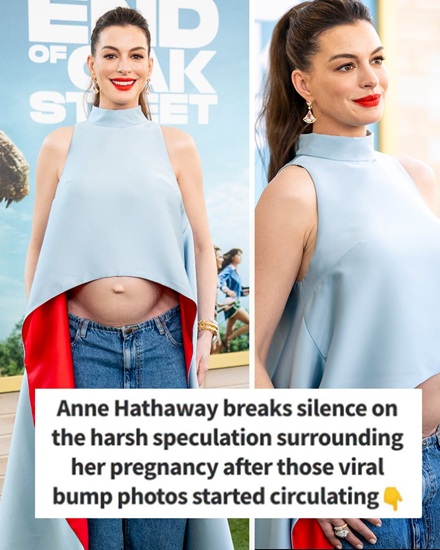
Anne Hathaway has spent much of 2026 balancing a remarkably busy professional schedule with an important new chapter in her personal life. The Oscar-winning actor, 43, is expecting her third child with her husband, actor and jewelry designer Adam Shulman. The couple, who married in 2012, are already parents to sons Jonathan, 10, and Jack, 6. Hathaway publicly announced the pregnancy in June, and since then she has spoken openly about how grateful she feels to be expanding her family again.
The announcement arrived through a playful social-media video on June 19. Hathaway appeared in a flowing white outfit before revealing and affectionately holding her baby bump. Barbara Lewis’s classic song “Baby I’m Yours” accompanied the clip, while Hathaway used the same phrase in her caption. It was a relatively simple announcement, but it quickly attracted enormous attention because the actor and Shulman generally keep their children and private family life away from constant public exposure.
For Hathaway, the pregnancy also carried personal significance because she has previously discussed the difficulties and uncertainty that can accompany trying to conceive. When announcing her second pregnancy in 2019, she acknowledged that the path to both of her pregnancies had not been straightforward. Her comments were intended in part as a message of compassion for people dealing with infertility or difficulty conceiving, rather than suggesting that pregnancy happens easily for everyone.
As her third pregnancy progressed, Hathaway continued working and appearing publicly while promoting several projects. Her 2026 schedule has included major films and high-profile appearances, making her pregnancy increasingly visible during interviews and premieres. Instead of disappearing from public view, she has incorporated maternity fashion into her professional appearances while continuing to discuss her work.

That combination of pregnancy, celebrity and fashion inevitably generated considerable online discussion. The attention became especially intense when Hathaway attended the Los Angeles world premiere of The End of Oak Street on August 9. The science-fiction survival film, written and directed by David Robert Mitchell, stars Hathaway opposite Ewan McGregor and is scheduled for its North American theatrical release on August 14.
For the premiere, Hathaway chose an unconventional maternity look that deliberately left her stomach visible. She wore a dramatic two-tone blue-and-red satin Prabal Gurung top together with low-rise jeans. The flowing top created a striking silhouette while leaving her baby bump exposed, and she completed the ensemble with red heels, matching lipstick and Bulgari jewelry.
Photographs from the event quickly circulated online. Some viewers focused on the fashion itself, debating the unusual combination of an elaborate satin top and casual denim. Others complimented Hathaway for confidently displaying her pregnancy. As often happens when celebrity photographs spread widely across social media, however, some comments moved beyond fashion and began scrutinizing her body.
A small number of commenters questioned whether Hathaway’s visible pregnancy bump looked genuine. The speculation was based largely on photographs and videos taken from different angles rather than any credible evidence contradicting her pregnancy. Other online users pushed back against those comments and pointed out the obvious problem with attempting to determine something as personal as pregnancy simply by examining the shape of someone’s body in a photograph.

Pregnancy bodies can also look substantially different depending on posture, clothing, camera angle, lighting and the baby’s position. There is no single appearance that a pregnant abdomen is required to have. For that reason, visual speculation based on isolated photographs is not a reliable method of determining whether someone is pregnant.
In Hathaway’s case, there was already extensive public evidence that she was expecting. She had personally announced her third pregnancy weeks earlier, discussed it publicly and subsequently appeared at numerous events while visibly pregnant. Contemporary coverage of the End of Oak Street premiere likewise described Hathaway as proudly displaying her baby bump.
Rather than becoming involved in a prolonged debate over the comments, Hathaway responded with humor. Her message was brief and drew a distinction between parts of her appearance that were enhanced for a glamorous public event and the pregnancy itself. It was a lighthearted way of addressing the speculation without allowing the discussion to dominate attention surrounding her work.
The episode also illustrates a broader issue surrounding celebrity culture. Public figures routinely have their clothes, hairstyles and performances discussed because those elements are part of their professional public appearances. But discussions can become considerably more intrusive when strangers begin making unsupported conclusions about someone’s health, fertility, pregnancy or body based only on photographs.
Hathaway has previously approached discussions about fertility with particular sensitivity. Her earlier acknowledgment that becoming pregnant had not been a straightforward experience gave additional context to her excitement about expecting another child. Rather than presenting pregnancy as something guaranteed, she has recognized publicly that people’s experiences with conception can be very different.
That perspective helps explain why Hathaway has spoken about her current pregnancy with gratitude. At 43, she is preparing to welcome her third child while continuing an unusually active period in her career. Recent interviews have emphasized that she and Shulman are excited about the addition to their family and that their two sons are also looking forward to welcoming their new sibling.
Hathaway has nevertheless continued to protect many details about her children. She and Shulman have generally kept Jonathan and Jack away from extensive media exposure, and the actor rarely turns her children’s private lives into promotional material. That approach has allowed her to speak about motherhood while maintaining boundaries around the children themselves.
The couple’s relationship stretches back many years. Hathaway and Shulman married in California in September 2012, and their first son, Jonathan, arrived in 2016. Jack followed in 2019. Their third child will therefore arrive more than six years after their younger son’s birth, creating another significant chapter for a family that has largely remained outside the celebrity spotlight despite Hathaway’s international fame.
Professionally, the timing comes during an exceptionally productive period for Hathaway. Among her current projects is The End of Oak Street, in which she stars alongside McGregor, Maisy Stella and Christian Convery. The film follows the Platt family after a mysterious cosmic event tears their suburban street from its familiar surroundings and transports the neighborhood somewhere unknown. Survival ultimately depends on the family remaining together while navigating the extraordinary environment around them.
Hathaway’s premiere appearance therefore had a clear professional purpose: she was promoting the film ahead of its theatrical release. Her maternity outfit became an unexpected secondary story after photographs circulated online, demonstrating how quickly attention surrounding a celebrity event can move away from the project being promoted and toward personal appearance.
The reaction also demonstrates why viral photographs should be interpreted cautiously. A single frame captures only a fraction of a moment. Clothing can fold or stretch unexpectedly, camera lenses can alter proportions, and someone’s posture can substantially change how their body appears. Drawing medical or personal conclusions from those visual details can easily produce misinformation.
There is also an important distinction between discussing publicly confirmed information and presenting speculation as fact. Hathaway herself has confirmed that she is expecting her third child. That is established information. Claims questioning the authenticity of her pregnancy based solely on the appearance of her abdomen are unsupported speculation and should be described as such rather than repeated as though they represent competing factual accounts.
Her continuing public appearances have made the situation even clearer. On August 10, Hathaway appeared in Los Angeles wearing another maternity look while promoting her work. Coverage of that appearance reported that she spoke positively about the pregnancy and about her family’s excitement over the new baby.
The episode ultimately became less about proving anything and more about Hathaway declining to let internet commentary dictate how she presented herself. She had already announced her pregnancy publicly and had repeatedly discussed it. She therefore had little reason to provide strangers with a detailed defense simply because certain photographs generated skeptical comments.
That response fits with Hathaway’s broader approach to celebrity attention. Throughout a career stretching from The Princess Diaries and The Devil Wears Prada to her Academy Award-winning performance in Les Misérables, she has experienced multiple periods of unusually intense public scrutiny. At different stages, everything from her personality and clothing to her acceptance speeches has become a subject of online debate.
The current conversation is considerably more personal because it concerns pregnancy. Bodies naturally change throughout pregnancy, and those changes do not occur identically for every person. Even the same person’s pregnancies can look different from one another. Photographs therefore cannot provide the kind of certainty that some social-media commentary implies.
For publishers and social-media users, the responsible approach is straightforward: distinguish confirmed information from online reaction. It is accurate to report that some commenters questioned Hathaway’s appearance after premiere photographs circulated. It would not be accurate to imply that those comments provide credible evidence that her pregnancy was fabricated.
Likewise, there is no need to turn an unconventional maternity outfit into a medical claim. Hathaway chose clothing that prominently displayed her abdomen, making it a visible component of the red-carpet look. People can reasonably have different opinions about the fashion without converting those opinions into unsupported conclusions about her body.
Her pregnancy also comes at a moment when maternity fashion has become increasingly varied. Celebrities no longer universally rely on loose gowns designed to conceal pregnancy. Cropped tops, fitted dresses, exposed bellies and unconventional silhouettes have all become common choices on major red carpets. Hathaway’s premiere outfit was another example of someone treating a pregnant body as something that does not necessarily need to be hidden.
Behind the fashion discussion, however, is a much simpler family story. Hathaway and Shulman are preparing to welcome another child. They already share two sons, and Hathaway has publicly expressed gratitude about having the opportunity to experience pregnancy again. Her previous comments about fertility provide important context for why she does not appear to take that experience for granted.
The viral speculation surrounding one set of photographs did not change those facts. It simply created another example of how quickly social media can transform an ordinary celebrity appearance into a debate built around assumptions.
Hathaway’s response avoided turning that debate into something larger. Instead of publishing a lengthy statement, arguing with individual commenters or sharing private medical information, she addressed the chatter briefly and continued promoting her work.
That may ultimately be the most useful takeaway from the episode. Celebrity photographs can generate enormous engagement, but popularity does not transform speculation into evidence. When the person involved has already provided clear information about something as personal as pregnancy, unsupported interpretations of individual photographs should not be treated as equally credible.
For Hathaway, attention is now returning to both her expanding family and her work. The End of Oak Street opens in North American theaters on August 14, with international distribution beginning August 12, according to Warner Bros. The film places Hathaway at the center of a family survival story alongside McGregor and continues a particularly busy professional year for the actor.
At the same time, she is approaching another major change away from the screen. Her third child will join Jonathan and Jack, and Hathaway has made clear that the pregnancy is something she and Shulman deeply appreciate. Whatever strangers may conclude from isolated red-carpet photographs, the actor’s own announcement and subsequent public comments leave no factual basis for presenting the online “fake bump” speculation as anything more than unsupported social-media chatter.
The story therefore does not require sensational claims to be interesting. It is about a well-known actor continuing to work during pregnancy, experimenting with maternity fashion, encountering predictable internet scrutiny and choosing not to provide an elaborate defense of her body. Hathaway’s brief response made her position clear, while the larger episode serves as another reminder that viral commentary should never be confused with verified information.
