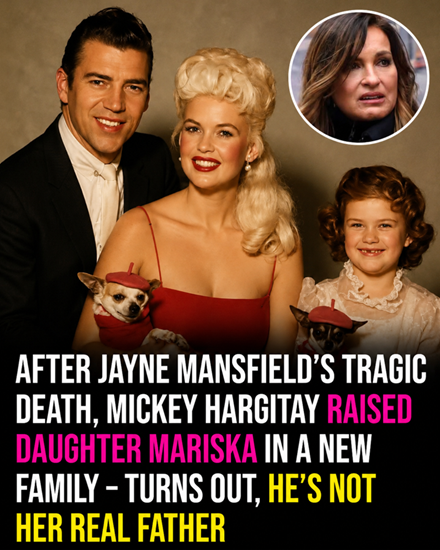
For most of her childhood and early adulthood, Mariska Hargitay understood herself as the daughter of Hollywood star Jayne Mansfield and actor and former Mr. Universe Mickey Hargitay. Mickey was not simply a famous name attached to her childhood; he was the father who raised her and, by Mariska’s own account, one of the people she loved most deeply. That understanding changed dramatically when she was 25 and unexpectedly saw a photograph of entertainer Nelson Sardelli. Decades later, Hargitay publicly revealed in her 2025 documentary My Mom Jayne that Sardelli, not Mickey, was her biological father.
The revelation became one of the most personal elements of My Mom Jayne, Hargitay’s feature documentary directorial debut. The film premiered at the Cannes Film Festival in May 2025 before arriving on HBO and Max the following month. Although the documentary explores the public and private life of Mansfield, it also became a way for Hargitay to examine her own identity and family history. She had known about Sardelli for more than three decades before deciding to make the information public.
Hargitay was only three years old when Mansfield died at age 34 in a 1967 automobile crash. Mariska and two of her brothers were in the vehicle and survived. Because she lost her mother so young, Mickey became an especially important figure in her upbringing. Hargitay has described him as her “everything” and her idol, emphasizing that she never doubted the depth of his love for her. That emotional bond later made discovering the truth about her biological parentage considerably more complicated than simply learning a new genealogical fact.

The circumstances dated back to the early 1960s. In 1963, Mansfield filed for divorce from Mickey Hargitay and became romantically involved with Nelson Sardelli, an Italian-born entertainer associated with Las Vegas. Mansfield later reconciled with Mickey several months before Mariska was born in January 1964. For years, Mariska grew up believing Mickey was her biological father as well as the man raising her.
Everything shifted when Hargitay was 25. According to her account, she was visiting someone who had extensive knowledge and memorabilia connected to Mansfield when she was shown a photograph of Sardelli. She had not understood who he was beforehand, but seeing his face produced an immediate and overwhelming reaction. Hargitay later described feeling instinctively that she understood the connection, even before receiving a detailed explanation. PEOPLE confirms that she first learned about Sardelli at age 25.
The discovery destabilized more than her understanding of biology. Hargitay had spent her life identifying with the Hargitay family, including its Hungarian heritage. Suddenly, she was confronting the possibility that an important part of her ancestry and personal history was different from what she had always believed. She later described the realization as though the foundation beneath her life had disappeared, and she struggled with questions about whether she was Hungarian, Italian, or somehow caught between two family histories.
Hargitay eventually confronted Mickey about Sardelli. According to her recollection, Mickey rejected the suggestion that someone else was her biological father. For Mariska, the conversation created an extraordinary emotional conflict. On one side was the shock of discovering information that seemed to contradict everything she had been told. On the other was the man who had loved, protected, and raised her throughout her childhood.

Rather than continue pressing Mickey, Hargitay chose not to pursue the subject with him again. She later explained that her loyalty to Mickey remained extremely strong. Whatever biology might eventually establish, he was still the person she understood as her father in every practical and emotional sense. The two did not revisit the subject before Mickey died in 2006.
The unanswered questions did not disappear simply because the conversation ended. Hargitay has spoken about struggling privately with what the discovery meant for her identity. One especially painful question concerned Sardelli himself. If he was her biological father, she wondered why he had not openly acknowledged that relationship earlier. Such questions contributed to feelings of rejection and uncertainty that she would spend years trying to understand.
When Hargitay was 30, she decided to meet Sardelli directly. She traveled to see him perform in Atlantic City and introduced herself. According to Hargitay, Sardelli became emotional and told her that he had been waiting decades for that moment. Yet the reunion was not an immediate fairy-tale reconciliation. Hargitay said she responded defensively and made clear that, from her perspective, she already had a father: Mickey.

That reaction reflected the loyalty conflict at the center of her experience. Accepting Sardelli as her biological father initially seemed as though it might diminish Mickey’s importance, something Hargitay was unwilling to do. Biology and parenthood appeared to be competing truths. Over time, however, she began to understand that they did not necessarily have to cancel each other out.
Hargitay gradually developed a relationship with Sardelli and with his daughters, who are her biological half-sisters. For years, however, she did not publicly explain the nature of those relationships. She sometimes introduced the women as family friends while continuing to keep the larger truth private. When she eventually made My Mom Jayne, she described revealing that history as a way of releasing everyone involved from a secret they had carried for decades.
The process also changed the way Hargitay viewed her mother. Mansfield had frequently been reduced in popular culture to the image of a platinum-blonde 1950s sex symbol, something Hargitay herself found difficult when she was younger. In developing the documentary, she tried to look beyond that public persona and understand Mansfield as a complicated woman, mother, performer, and ambitious professional. Hargitay told the Los Angeles Times that making the film helped her reconsider both her mother and the two men who occupied different roles in her understanding of fatherhood.
One conclusion became especially important to her: learning that Sardelli was her biological father did not make her relationship with Mickey false. Hargitay has emphasized that she remains Mickey Hargitay’s daughter because parenthood, in her experience, was also created through love, presence, protection, and years of shared life. She has described My Mom Jayne partly as a love letter to Mickey and said there was nobody on earth to whom she had been closer.

Her perspective was also influenced by her own experience as a parent. Hargitay and her husband, actor Peter Hermann, have three children, two of whom were adopted. Hargitay has pointed to that experience when discussing what she learned about the meaning of family. For her, biological connection and genuine parenthood are not interchangeable concepts, nor does recognizing one invalidate the other.
The documentary required cooperation from members of both sides of her family. Sardelli participated, as did his daughters, while members of the Hargitay and Mansfield families also appeared. Hargitay said some relatives were initially hesitant about making such private information public, but she eventually received their support. A private screening for her Sardelli relatives became particularly emotional because the women she had loved privately were finally being acknowledged openly as family.
Her relationship with Sardelli has continued to evolve since the documentary was released. In May 2026, Hargitay told PEOPLE that the two had become very close and that important conversations between them had finally taken place. She described their relationship as deep and complicated but said they had reached a positive place in which significant issues had been openly discussed. She also said she sees him whenever possible, usually several times each year.
That development adds another chapter to a story that once felt unbearable to Hargitay. The photograph she encountered at 25 initially seemed to divide her identity into incompatible pieces: the family she knew and the biological history she had just discovered. With time, however, she found a way to recognize both without erasing either.
The experience also shaped the central purpose of My Mom Jayne. Hargitay did not make the documentary simply to reveal a surprising celebrity family secret. She said she wanted to understand a mother she had barely known and examine aspects of herself that she had previously avoided. She told the Los Angeles Times that she waited until she felt emotionally prepared to approach the material with openness and curiosity rather than only pain.
That approach matters because the story involves real people and complicated family decisions made more than six decades ago. It is easy to turn such revelations into simple narratives involving betrayal, abandonment, or deception. Hargitay’s own account ultimately became more nuanced. She came to believe that Mansfield and the adults around her were navigating complicated circumstances and that Mickey provided the stable, loving childhood she needed.
Hargitay has therefore resisted the idea that discovering Sardelli somehow erased the father who raised her. Instead, the revelation expanded her understanding of her family. Mickey remained her father through love and upbringing, while Sardelli became another genuine part of her biological identity and, eventually, her adult life.
The story also demonstrates why identity can involve more than genetics alone. Biological ancestry can answer important questions about where a person comes from, but relationships are also shaped by years of care, responsibility, shared experiences, and emotional attachment. Hargitay’s journey forced her to confront both forms of connection at once.
For decades, she carried that complicated truth privately while becoming internationally known as Olivia Benson on Law & Order: Special Victims Unit. The public knew one version of her famous family history while Hargitay quietly lived with another. By finally addressing it in My Mom Jayne, she chose to stop separating those two realities.
What began with an unexpected photograph ultimately became a much longer process involving shock, loyalty, grief, acceptance, and reconciliation. Hargitay did not simply discover that Mickey Hargitay was not her biological father. She eventually learned that acknowledging Nelson Sardelli did not require rejecting the man who raised her.
More than 30 years after first learning the secret, Hargitay has publicly embraced a broader understanding of her family. Her relationship with Sardelli is now close, while her descriptions of Mickey remain filled with affection and gratitude. The discovery that once seemed to threaten her entire sense of identity ultimately became part of a more complete version of it.
In that sense, My Mom Jayne is not simply about revealing who Mariska Hargitay’s biological father is. It is about the complicated ways people understand parents, inheritance, belonging, and love. The truth changed how she interpreted her past, but it did not erase the family that raised her. Instead, it allowed her to acknowledge parts of her history that had remained hidden and to tell the story in her own words.
