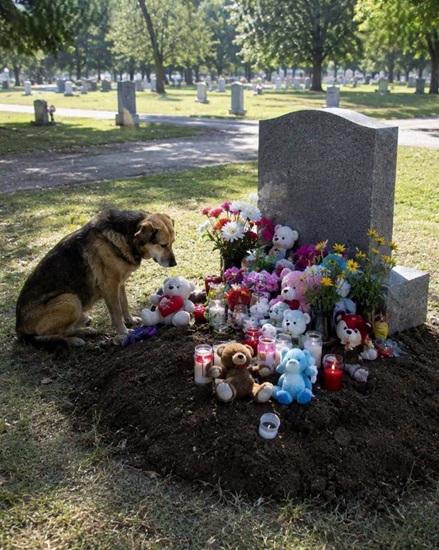
Stories about grief often become powerful because of the emotions they explore rather than because of a dramatic headline. The idea of an unfamiliar dog repeatedly visiting a young man’s grave and later appearing at his family’s home with a toy creates an immediately moving image. But unless such an account is supported by independently verifiable reporting, it should not be presented as a documented real event. The scenario is better understood as a reflective story about grief, companionship, communication, and the human tendency to search for meaning during difficult periods.
Imagine a parent returning regularly to a cemetery after losing a son. The surroundings gradually become familiar: the path leading toward the grave, nearby trees, neighboring headstones, and the changing appearance of the landscape through different seasons. Then something unexpected begins happening. A dog that does not belong to the family appears near the grave. At first, there is no obvious reason to consider the animal’s presence significant. Dogs wander, follow scents, explore unfamiliar places, and sometimes develop routines based on experiences people cannot immediately identify.
If the dog returned repeatedly, however, curiosity would naturally grow. The grieving parent might begin wondering where the animal came from and why it seemed interested in that particular location. Perhaps someone nearby owned it. Perhaps the dog had previously encountered another visitor there. Maybe food, familiar scents, or ordinary exploration explained the behavior. Without additional evidence, none of these possibilities could responsibly be presented as fact. Still, repeated encounters would understandably encourage questions and emotional interpretations.
Grief can make apparently ordinary moments feel unusually significant. Bereavement is deeply personal, and people respond to loss in many different ways. Some find comfort in routines, photographs, belongings, familiar music, or places associated with the person who died. Others notice unexpected experiences that remind them of their loved one. These moments do not require supernatural explanations to have emotional importance. Something can be meaningful to a grieving person even when its precise cause remains unknown.
The dog’s presence could therefore become part of the parent’s cemetery visits without anyone fully understanding why. Perhaps it would sit quietly several feet away. Maybe it would approach briefly and then leave. Over time, the animal might become familiar enough that its absence would be noticed. What began as an unexplained occurrence could gradually become associated with a place already filled with powerful memories.
Yet this is where assumptions can become dangerous. A grieving person might understandably connect the dog’s behavior with the deceased family member, but emotional significance does not automatically establish a factual connection. The dog cannot explain why it visits. Without identifying its owner or discovering documented information about its history, any claim that it “knew” the person buried there would remain speculation. Responsible storytelling should preserve that uncertainty instead of transforming an emotional possibility into a supposedly proven fact.
The same principle applies when misunderstandings develop between people. Human beings often interpret events before collecting enough information to understand them. Someone may see another person’s behavior and immediately decide that it represents indifference, dishonesty, selfishness, or hostility. Once that interpretation takes hold, later information can be filtered through the original assumption. A simple misunderstanding can then become a larger conflict because each new event appears to confirm what people already believe.
Communication can make the difference between resolving such a situation and allowing it to grow. Asking straightforward questions may reveal information that was previously unavailable. Who owns the dog? Has anyone else seen it visiting the cemetery? Did the animal have some connection with the neighborhood? Is there a practical reason it follows a particular route? These questions may not produce a dramatic answer, but they offer something more valuable: a way to separate what is known from what is imagined.
Suppose that, after many months of occasional encounters, the same dog unexpectedly appeared near the family’s home carrying a toy. Such an event would naturally be surprising, especially if the home were some distance from the cemetery. Before interpreting it as evidence of an extraordinary connection, however, there would be practical questions to answer. Identification tags, a microchip, neighbors, local animal services, or community groups might help determine where the dog belonged and how it arrived there.
Finding the owner could completely change the understanding of the situation. Perhaps the animal had been regularly walked through the cemetery. Maybe its owner had some connection with the family or the person who died. Alternatively, the explanation might be entirely ordinary and unrelated. The important point is that discovering additional information can transform an initial interpretation. What appears mysterious from one perspective may become understandable once missing context is available.
This pattern occurs frequently in everyday relationships as well. People rarely possess every relevant fact when they first encounter a difficult situation. One person knows something another does not. Someone may be dealing privately with financial pressure, family responsibilities, grief, anxiety about work, or another personal challenge. Their behavior can consequently appear confusing from the outside. That does not excuse harmful actions, but context can help explain why people behave in ways that initially seem difficult to understand.
Problems become more complicated when communication begins to fail. Instead of asking what happened, people sometimes react to what they assume happened. A delayed message can be interpreted as rejection. A forgotten appointment can be interpreted as disrespect. A quiet response can be mistaken for anger. Once emotions rise, people may defend their interpretation rather than investigate whether it is correct.
Old frustrations can then enter a new disagreement. A conflict that began with one misunderstanding suddenly includes arguments from months or years earlier. People stop discussing the original issue and begin defending themselves against broader accusations. At that point, even a relatively simple explanation may be difficult to accept because admitting the misunderstanding can feel like losing the argument. Pride can become more important than discovering what actually happened.
This is why additional information sometimes creates a turning point. A previously unknown detail does not necessarily erase hurt or make every earlier decision acceptable. What it can do is provide context. Behavior that once seemed inexplicable may suddenly have an understandable motivation. A person who appeared indifferent might have been overwhelmed. Someone who seemed secretive might have been protecting another person’s privacy. An action that looked deliberately hurtful may have resulted from misunderstanding rather than malicious intent.
Learning the truth then creates another choice. People can continue defending the conclusions they originally formed, or they can update those conclusions when stronger evidence becomes available. Changing one’s mind is sometimes uncomfortable, particularly after an emotional argument. Yet accepting new information is an important part of resolving conflict. Acknowledging that an assumption was incorrect does not require pretending the resulting feelings never existed.
Accountability remains important as well. Understanding why someone behaved a particular way is different from saying that every action was appropriate. People can have understandable reasons for making poor decisions. They can apologize for the consequences while still explaining the circumstances that influenced them. Healthy resolution generally requires both context and responsibility rather than choosing one at the expense of the other.
The fictional image of a dog waiting quietly beside a grave works particularly well as a symbol because animals are often associated with companionship and routine. Dogs can form strong social bonds with people, recognize familiar individuals, learn locations, and develop repeated behavioral patterns. However, interpreting a particular animal’s motivation requires caution. A dog returning to one location does not by itself prove that it understands death or is deliberately participating in human mourning in the same way a person would.
Scientific research does indicate that dogs are socially responsive animals capable of forming close attachments. They can react to changes in routines and to the absence of familiar people or animals. Owners sometimes report behavioral changes following the loss of another household member. Researchers continue studying how animals experience such changes, and it is wise to avoid assigning complex human explanations to behavior when simpler possibilities remain available.
None of that makes an emotional encounter with an animal meaningless. A grieving parent could find genuine comfort in seeing a friendly dog during cemetery visits regardless of why the dog was there. Emotional meaning belongs to the person experiencing the moment. The scientific question of what motivated the animal is separate from the personal question of whether the encounter offered comfort during bereavement.
The toy in the imagined story works in a similar way. To an outside observer, it could simply be an object carried by a dog. To someone grieving a child, particularly if the toy resembles something associated with that child, the moment could feel profoundly significant. Both descriptions can exist simultaneously. An experience can have powerful personal meaning without requiring an unsupported factual claim about what caused it.
That distinction is particularly important online, where emotional stories can quickly lose their original context. A fictional story may be reposted as a real event. A photograph from one situation may be attached to an unrelated narrative. Details can become increasingly dramatic with each retelling. Eventually, readers may have no practical way to distinguish verified information from creative storytelling unless the publisher clearly labels the material.
Responsible writing should therefore tell readers what kind of material they are reading. A documented news report should rely on identifiable evidence and trustworthy sources. A personal account should be presented as the individual’s experience unless independently verified. A fictional or illustrative story should not be marketed as a confirmed real event. Emotional impact does not require misleading an audience about authenticity.
The broader lesson behind this scenario remains useful regardless of whether the events are fictional. First impressions are often incomplete. People make rapid judgments because doing so is efficient, but those judgments can be wrong. Asking questions, checking available evidence, and listening to other perspectives can prevent misunderstandings from becoming permanent conflicts.
Patience matters for the same reason. Waiting for additional information can feel uncomfortable when emotions are intense, yet immediate reactions are not always the most accurate ones. A short pause can create enough distance to ask whether there might be another explanation. This does not mean ignoring warning signs or tolerating mistreatment. It means distinguishing between situations where facts are established and situations where important information remains missing.
Grief makes that patience especially important because bereavement can influence attention, memory, emotion, and everyday routines. There is no single correct timetable for mourning. Some people want to talk extensively about the person they lost, while others prefer privacy. Some regularly visit a grave or memorial location, while others find comfort elsewhere. These differences do not indicate how much someone loved the deceased.
Support can therefore be more valuable than judgment. Listening without immediately trying to explain another person’s grief may help them feel less isolated. Practical assistance can also matter, particularly during periods when everyday responsibilities become difficult. Professional bereavement support may be appropriate for people who want additional help navigating a loss. The important point is that grief is an individual experience rather than a competition with a single correct response.
The imagined relationship between the parent and the visiting dog ultimately represents something larger than an unexplained cemetery encounter. It reflects the human desire for connection after loss and the ways unexpected experiences can become attached to memories. Whether the dog arrived because of scent, habit, previous contact, or coincidence would not necessarily determine the emotional value of those visits.
If the animal eventually appeared at the family’s home, the responsible response would combine compassion with practical investigation. The dog should be kept safe while attempts are made to locate its owner. Its identification could be checked, and appropriate local services could assist if necessary. Only after learning more could anyone responsibly determine whether a genuine connection existed between the dog, the cemetery, and the family.
Perhaps the eventual explanation would be surprisingly ordinary. Perhaps it would reveal a genuine connection nobody initially knew about. Either possibility could still produce a meaningful story because the emotional center is not dependent on mystery. It is about what happens when people resist the temptation to decide what something means before they have enough information.
That lesson applies far beyond grief. Relationships are often damaged not only by what people do but by what others assume those actions mean. Communication can fail because everyone believes their interpretation is obvious. Trust can disappear before anyone asks the simplest question: “What actually happened?”
Listening does not guarantee reconciliation, and discovering new context does not automatically repair every injury. Some relationships cannot or should not return to what they were. But accurate information gives people a better foundation for whatever decision comes next. It allows choices to be based on reality rather than assumptions.
Ultimately, the story of a stranger’s dog returning to a grave is most valuable when presented for what it is: an illustrative narrative about grief, connection, patience, and the danger of jumping to conclusions—not a verified news report unless credible evidence establishes the underlying events. Its central message does not need exaggeration to be meaningful.
Sometimes an unexpected encounter can bring comfort during an extraordinarily difficult period. Sometimes the explanation behind that encounter is simpler than people imagine. And sometimes learning the full context changes how an entire situation is understood. The lasting lesson is straightforward: listen before judging, distinguish evidence from assumption, allow room for new information, and remember that understanding the truth often begins by admitting that the first version of a story may not have been complete.
