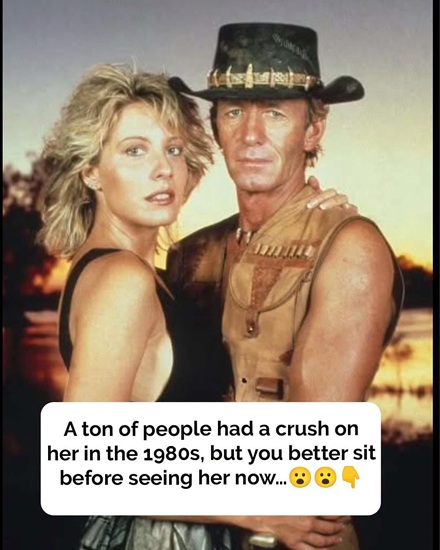
Linda Kozlowski became internationally recognizable almost overnight after playing journalist Sue Charlton opposite Paul Hogan in the 1986 comedy-adventure Crocodile Dundee. The role transformed a classically trained actress who had spent years trying to establish herself into the female lead of one of the decade’s biggest movie successes. The original film ultimately earned about $328.2 million worldwide, an extraordinary result that turned both Kozlowski and Hogan into internationally familiar faces.
Yet Kozlowski’s life after that breakthrough followed a very different path from the traditional Hollywood story. Rather than spending decades pursuing increasingly prominent movie roles, she eventually left acting behind, focused on family and later built a new chapter of her life connected with Morocco and travel. Her journey demonstrates that starring in a worldwide blockbuster does not necessarily mean someone wants to remain in the entertainment industry forever.
Linda Kozlowski was born on January 7, 1958, in Fairfield, Connecticut, and grew up there as the daughter of Stanley and Helen Kozlowski. She attended Andrew Warde High School and graduated in 1976 before pursuing professional dramatic training. Acting was not merely a hobby for her; Kozlowski gained admission to the prestigious drama division of the Juilliard School in New York City. She completed her studies there in 1981 and began trying to establish herself professionally in theater. Her early years were therefore quite different from the sudden celebrity status that would arrive later.

Before Hollywood knew her name, she was working through the same uncertain process faced by many young performers trying to turn professional training into a sustainable career. Kozlowski began appearing in theatrical productions, including off-Broadway work, before receiving one of the opportunities that would eventually change her career. She appeared in the television adaptation of Arthur Miller’s Death of a Salesman, starring Dustin Hoffman. Her work on that production gave her valuable exposure and also led to a friendship with Hoffman.
According to accounts Kozlowski later shared, New York had become frustrating because acting opportunities were limited and she was struggling to see a clear path forward. She worked as a waitress after the production and eventually considered leaving the city. Her source biography describes Hoffman and his wife allowing her to stay at their Malibu beach house when she moved west, giving her a place to live while trying to find new opportunities.
Only weeks after arriving in California, Kozlowski auditioned for Crocodile Dundee. She later remembered the atmosphere of the audition as unusually positive and said she felt strongly that the meeting had gone well. Hoffman also contacted people associated with the production after being impressed with her earlier work, providing an influential vote of confidence.
Kozlowski’s longtime friend William DeAcutis later emphasized, however, that Hoffman’s recommendation was an endorsement rather than the reason she received the part; according to him, the filmmakers had already responded positively to her. The distinction matters because Kozlowski’s performance and chemistry with Paul Hogan ultimately became essential to the finished film. Her role was not simply handed to her through a celebrity connection.
When Kozlowski arrived in Australia for filming, the environment was dramatically different from the theatrical world in which she had trained. She later recalled arriving extremely early in the morning, facing cold conditions and encountering the unfamiliar wildlife of the Australian landscape. Her Juilliard background also meant she was accustomed to a more structured approach to performance, while Hogan came from television comedy and had a considerably more relaxed style.
A recent account of the production notes that Kozlowski initially struggled with the casual, improvisational atmosphere, although the chemistry between her and Hogan became increasingly apparent as filming progressed. Those differences ultimately helped create the contrast between Sue Charlton, the sophisticated American journalist, and Mick Dundee, Hogan’s unconventional Australian bushman.
The movie’s premise was simple but highly effective. Sue travels to Australia to interview the supposedly legendary Mick Dundee and later brings him to New York, where his unfamiliarity with urban life creates many of the film’s best-known comic moments. Kozlowski’s character played an important role in making the story work because Sue functioned as the connection between Dundee’s world and the audience. Her relationship with Mick also gradually evolved from professional curiosity into romance, providing the film with an emotional center beyond its comedy and adventure.
The commercial response exceeded almost every reasonable expectation. Crocodile Dundee became one of the major box-office hits of 1986 and eventually earned approximately $328.2 million worldwide. In the United States alone, it grossed roughly $174.8 million. The film’s enormous popularity meant that Kozlowski went from a relatively unknown performer to an internationally recognized actress in a remarkably short period of time. It also earned her a Golden Globe nomination for Best Supporting Actress.
The transition into celebrity was strange because the movie did not open everywhere simultaneously. Kozlowski later compared the experience to Cinderella, recalling that she could be treated like a major star in Australia while still driving her own old Toyota in the United States and visiting casting directors. The contradiction illustrated how quickly international movie success could develop before global entertainment coverage became as immediate as it is today.
Her hometown of Fairfield also followed her sudden rise closely, though she joked that local coverage continued identifying her primarily in relation to her father rather than treating her as an unreachable Hollywood figure. Her source account preserves those memories of being both internationally famous and still strongly connected to the place where she grew up.
The film also changed Kozlowski’s private life. She and Paul Hogan developed a relationship after working together, although Hogan was still married during the period when their connection developed. The resulting personal situation became a major subject of tabloid attention in Australia. Kozlowski and Hogan eventually married on May 5, 1990, in New South Wales. Contemporary reporting described the ceremony as private and attended by family and close friends. The Los Angeles Times also reported that Hogan had built a roughly $2 million house near Byron Bay as a wedding gift for Kozlowski.

Their on-screen collaboration continued as well. Kozlowski returned as Sue in Crocodile Dundee II, released in 1988. That sequel was commercially successful in its own right, earning more than $109 million domestically in the United States according to Box Office Mojo. More than a decade later, she returned once again for Crocodile Dundee in Los Angeles, released in 2001. That third installment performed far more modestly, earning about $25.6 million domestically. It also became Kozlowski’s final credited film role.
Despite the success of the Dundee franchise, Kozlowski did not feel compelled to accept every project offered to her. She later explained that many proposed roles simply asked her to play another girlfriend or romantic counterpart to a male comic character. She found much of that material uninteresting and became increasingly dissatisfied with the choices available to her.
Her source biography even records her joking that some scripts were useful mainly as kindling for the fireplace. The remark reflected frustration rather than an inability to find any work at all. Kozlowski had already experienced what it felt like to appear in an enormous hit and did not seem interested in repeating similar supporting parts simply to remain visible.
She did take other roles during her career. Her credits included Pass the Ammo, Almost an Angel, The Neighbor, Backstreet Justice, Zorn, and John Carpenter’s Village of the Damned. None became remotely as culturally dominant as Crocodile Dundee. Over time, acting increasingly became less important to her personal sense of fulfillment.
Another major change occurred when Kozlowski and Hogan became parents. Their son, Chance Hogan, was born in 1998. This is one of the factual corrections necessary to the supplied version, which incorrectly gives his name as “Change.” Kozlowski increasingly focused on family, and by the time Crocodile Dundee in Los Angeles arrived in theaters in 2001, she was effectively finishing her screen career. Her source biography identifies the 2001 film as her final acting production.
Kozlowski and Hogan remained married for more than two decades, but eventually their relationship changed. Kozlowski filed for divorce in October 2013, citing irreconcilable differences, and the divorce was finalized in 2014. Both later spoke publicly about having grown apart rather than portraying the separation as a bitter personal war. Kozlowski said that the two had increasingly little in common, while Hogan similarly described them as opposites whose differences had worked for many years before eventually becoming more difficult.
The financial terms of their divorce have sometimes been reported inconsistently because Australian stories converted the settlement into Australian dollars. The reported lump-sum payment was US$5.775 million, which was approximately A$6.25 million at the time. This explains why some older articles incorrectly make it appear that two different settlement amounts were reported. Kozlowski was also reportedly permitted to remain in their Venice Beach home until 2018 or until she remarried, and Hogan retained rights associated with the Crocodile Dundee character.
Perhaps more notable than the settlement was the way both described their relationship after the marriage ended. Kozlowski said the separation was amicable and that she and Hogan continued communicating. She explained that after spending many years largely associated publicly with her husband and the Crocodile Dundee franchise, she enjoyed rediscovering her own identity. Her comments were not an attack on Hogan so much as an acknowledgment that people can change over the course of a long marriage. The original source also records her saying that they remained friendly and continued seeing one another casually after the divorce.
Her life after Hollywood became centered on something almost completely unrelated to acting: Morocco. Kozlowski traveled there and developed both a personal and professional relationship with Moroccan tour specialist Moulay Hafid Baba. By 2014, the pair were identified as co-founders of Dream My Destiny, a bespoke travel company creating private experiences in Morocco. Forbes described Kozlowski and Baba as personal and professional partners involved in the new luxury travel venture in Marrakech. Other travel coverage from the same period similarly described the business as offering customized Moroccan trips.
Kozlowski spoke enthusiastically about the relationship, describing an immediate connection when they met. She also praised Baba’s knowledge of Morocco and said their partnership allowed them to design experiences around individual travelers rather than selling standardized tours. The change was substantial: instead of waiting for a screenplay or audition in Los Angeles, she could travel, meet people, and build experiences in a country she had come to love. Her source biography describes the company as Marrakesh-based and emphasizes how strongly she associated her new life with personal freedom.
More recent reporting indicates that Kozlowski and Moulay Hafid Baba later married, with reports placing their marriage in 2017, and that Morocco remained an important base in her post-Hollywood life. A May 2026 report likewise described her as continuing her life in Morocco away from film sets. Because information about private business operations can change, it is more accurate to say that she founded and has been associated with Dream My Destiny than to assume every detail of the company’s present-day operations without current corporate records.
Kozlowski has also appeared occasionally in public even though she is no longer pursuing acting. Recent photographs have generated entertainment coverage largely because audiences still associate her with the youthful Sue Charlton of the 1980s. That kind of comparison can be misleading, considering nearly four decades have passed since the original Crocodile Dundee. Kozlowski was 28 when the film became an international hit; she turned 68 in January 2026. Natural aging does not diminish the significance of her career or require framing her present appearance as a dramatic transformation.
Her connection with Hogan also remained part of the family’s story because of their son Chance. A 2025 profile of Hogan noted that he was living in Venice Beach with Chance, then 27, while Kozlowski had long since moved into a different stage of her own life. This illustrates how the former couple’s lives continued to overlap through their family even after the marriage ended.
Kozlowski’s decision to leave acting may seem unusual in an industry where performers often spend decades trying to remain visible. Yet her own explanation has always been comparatively straightforward. She did not feel an overwhelming need to return. She had experienced international celebrity, attended premieres, worked on successful films, and discovered that fame was not necessarily the life she wanted permanently.
She has said that acting sometimes interfered with the adventurous life she wanted because professional performers often need to remain close to Los Angeles, maintain availability for auditions, and wait for projects to materialize. Leaving that system gave her freedom to travel and pursue interests that were not dependent on casting decisions. Her comments suggest that retirement was less about rejecting the profession entirely and more about realizing that another lifestyle suited her better.
That perspective makes her career particularly interesting. Hollywood often encourages the idea that becoming famous is the final goal and that stepping away from fame represents some kind of failure. Kozlowski’s story suggests the opposite. She received the breakthrough that thousands of actors spend their careers hoping for, became internationally recognizable, and then eventually decided that maintaining celebrity was not important enough to organize the rest of her life around.
Her years as Sue Charlton remain the defining part of her screen legacy. The character was confident, intelligent, adventurous, and capable of holding her own alongside Hogan’s larger-than-life Mick Dundee. Their chemistry helped transform a relatively modest Australian production into an international phenomenon. The original movie remains by far the most commercially successful film in the franchise, while Kozlowski’s performance continues to be the role for which she is most widely remembered.
The movie also permanently linked Kozlowski’s professional and personal histories. She did not simply meet Hogan while making a successful film; their relationship eventually produced a marriage lasting more than two decades and a son. Even after their divorce, neither has described the entire relationship as a mistake. Hogan has more recently spoken warmly about the women he married while acknowledging his own shortcomings as a husband.
Looking back, Kozlowski’s trajectory is almost the reverse of the conventional celebrity story. She began as a trained but struggling actress, worked in theater, waited tables, received help from an established actor and eventually landed the role of a lifetime. That film made her famous and introduced her to the man she would marry. She then gradually realized that Hollywood fame did not necessarily provide the fulfillment she wanted, became a mother, retired from acting, ended a long marriage amicably, and pursued an entirely different life involving travel.
Today, Linda Kozlowski should therefore not be described simply as an actress who “disappeared.” She made a deliberate transition away from an industry she no longer wanted to pursue. At 68, she remains best known publicly for Crocodile Dundee, but her life after the franchise has included motherhood, travel, entrepreneurship, a new relationship and years spent largely outside the Hollywood system.
For audiences who first saw her walking through the Australian Outback beside Mick Dundee, Sue Charlton will probably always be the image most closely associated with Linda Kozlowski. Yet the woman behind that character chose a path very different from the one Hollywood success initially seemed to promise. Rather than spending the rest of her life chasing another blockbuster, she eventually decided that freedom, family and real-world adventure mattered more to her than another film credit.
That may ultimately be the most interesting part of her story. Crocodile Dundee gave Linda Kozlowski international fame, Paul Hogan became both her co-star and husband, and Hollywood provided opportunities few performers ever experience. But after the cameras stopped, she discovered that the life she wanted did not necessarily exist on a movie set. Her screen career ended in 2001, yet the decades that followed became a new chapter rather than an epilogue—one defined much more by personal choice than by celebrity.
