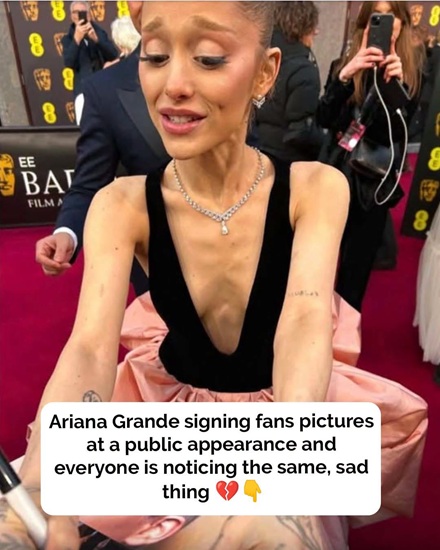
Ariana Grande has spent much of her life in the public eye, first becoming widely known through Nickelodeon before developing into one of the world’s most successful pop performers. More recently, her performance as Glinda in Wicked brought another major chapter in her acting career. That role earned Grande a Supporting Actress nomination at the 2025 BAFTA Film Awards, where she attended the ceremony at London’s Royal Festival Hall on February 16, 2025.
Alongside attention surrounding her professional achievements, Grande’s appearance has repeatedly become a subject of online discussion. Photographs from premieres, awards ceremonies and other public appearances have generated thousands of comments about her body. Some social-media users have expressed concern, while others have made much stronger claims about her health. However, photographs alone cannot establish whether someone has a medical condition, and speculation about a person’s diagnosis should not be presented as fact.
This distinction is particularly important because some online comments about Grande have gone far beyond simply observing that her appearance has changed. People have attempted to diagnose eating disorders or other medical problems based solely on photographs and videos. There is no responsible basis for making such a diagnosis from someone’s appearance. A person’s weight can be influenced by many factors, and accurate medical conclusions require appropriate information and professional assessment rather than visual assumptions made by strangers online.

Grande herself has previously addressed the broader discussion surrounding her body. In a widely reported 2023 social-media video, she asked people to be more considerate when discussing other people’s bodies and explained that the body some viewers had been comparing her current appearance with had represented an unhealthy period for her. Her central message was that outsiders do not necessarily know what another person is experiencing and therefore should avoid making judgments based solely on appearance.
The subject returned during the promotional period for Wicked. In a December 2024 interview, Grande became emotional while discussing years of criticism surrounding her appearance. She explained that she had experienced public scrutiny since she was approximately 16 or 17 years old and had heard many different opinions about what people believed was supposedly wrong with her appearance. She argued that society has become far too comfortable commenting on other people’s bodies, faces, clothing and perceived health.
Grande also made clear that this kind of commentary can be uncomfortable regardless of whether someone is famous. She compared intense public scrutiny with ordinary situations in which relatives or acquaintances make unsolicited observations about someone’s weight. Her broader point was that comments about another person’s appearance can have consequences even when the person making them believes they are expressing concern. She said she now tries not to make space in her life for that kind of external judgment.

That context matters when considering reactions to Grande’s appearance at the 2025 BAFTAs. Her attendance itself is documented by BAFTA, which listed her among the confirmed nominees attending the ceremony. She had received her first BAFTA Film Award nomination for her performance in Wicked, competing in the Supporting Actress category. The award ultimately went to Zoe Saldaña for Emilia Pérez.
Images from such events naturally circulate widely, but photographs provide only limited information. Lighting, camera angles, clothing, makeup, posture and image selection can all influence how someone appears in an individual photograph. Even when a physical change is genuine, its cause cannot automatically be determined visually. For that reason, statements claiming that Grande “clearly” has a particular medical condition should be understood as speculation rather than verified information.
It is also worth separating genuine concern from language that can become unnecessarily invasive. Someone may sincerely hope that a celebrity is healthy without knowing anything about that person’s private medical circumstances. But repeatedly examining photographs for evidence of illness or assigning diagnoses can transform concern into another form of body scrutiny. Grande’s own comments suggest that she would prefer people not to participate in that kind of discussion.
Her experience also highlights the unusually intense expectations placed on celebrities, particularly women. Public figures can receive criticism for gaining weight and then receive another wave of criticism for losing it. They may be judged for appearing too natural in one photograph and criticized for looking overly styled in another. The result is a standard that can become impossible to satisfy because the expectations themselves frequently contradict one another.
Social media magnifies that problem. A photograph taken during a few seconds of an awards ceremony can be separated from its original context and distributed to millions of people. Individual comments can then generate further reactions, turning one image into a much larger conversation about someone’s health or private life. Repetition can also make an unsupported claim appear more credible even though thousands of people repeating the same assumption does not transform it into verified information.
Grande has described living with this level of scrutiny for much of her career. During the 2024 Wicked interview, she said she had essentially grown up while being publicly examined and criticized. She described learning to protect herself from the surrounding noise and emphasized the importance of having supportive people in her life. Her comments provide direct insight into how she views public discussion of her appearance, unlike theories constructed by observers from photographs.
Meanwhile, her professional career has continued to evolve. Wicked represented an important return to acting for Grande and brought significant awards recognition. BAFTA confirmed that her Supporting Actress nomination was her first nomination in a BAFTA performance category. Her work therefore received substantial attention during the same period in which online conversations frequently focused on her body rather than her performance.
That contrast raises a broader question about celebrity culture. When an actor or musician appears at an event celebrating their work, discussion can quickly shift away from what they accomplished and toward their physical appearance. For someone who has already publicly requested greater sensitivity around body commentary, repeatedly making appearance the dominant subject can ignore what that person has explicitly said about the issue.
Concern for someone’s well-being does not require diagnosing them. It is possible to wish Grande well while acknowledging that the public does not possess the information necessary to determine her health status. Unless Grande or an authorized representative chooses to disclose medical information, claims about specific conditions remain speculation. Responsible reporting should make that distinction clear rather than presenting social-media theories as medical facts.
It is similarly important not to assume that a person’s body tells a complete story about their health. Body size alone cannot provide a comprehensive assessment of physical or psychological well-being. Even medical professionals require considerably more information than a red-carpet photograph before reaching conclusions about someone’s health. The same principle applies not only to celebrities but to people encountered in everyday life.
Grande’s own words offer perhaps the clearest framework for approaching the discussion. She has repeatedly emphasized greater kindness and less judgment when talking about people’s bodies. In 2024, she described unsolicited commentary about appearance as something people have become too comfortable doing and said she no longer welcomes that scrutiny into her life.
The public conversation surrounding Ariana Grande therefore does not need to become a debate about diagnosing her from photographs. What can be established is that her appearance has generated significant online commentary, that some people have expressed concern, and that Grande has previously spoken directly about how harmful and inaccurate body commentary can be. What cannot responsibly be established from those images is whether she has a particular medical condition.
Ultimately, Grande’s health belongs to her private life unless she chooses to discuss it publicly. Her career, meanwhile, provides plenty of verified material to discuss—from her music to her acclaimed performance in Wicked and her 2025 BAFTA nomination. Treating speculation as speculation, avoiding amateur medical diagnoses and respecting her publicly stated boundaries allows the conversation to remain both accurate and considerate.
