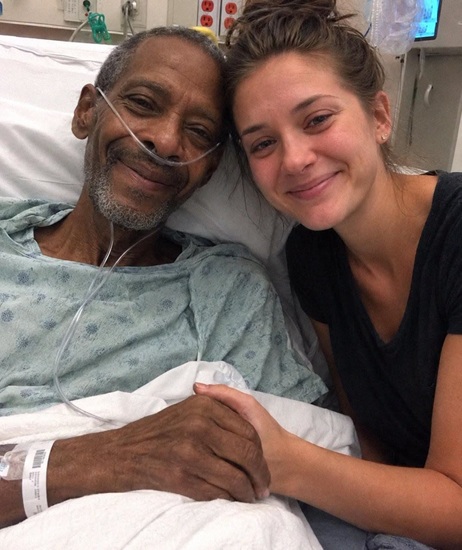
Frank had been the only father I could truly remember. He entered my life when I was four years old, married my mother, and quietly learned how to care for a little girl who did not trust him yet. He never demanded that I call him Dad, never tried to force affection, and never seemed offended when I refused to answer his questions. Instead, he learned the small things: how much strawberry jam I wanted on toast, which stories helped me sleep, and how frightened I became during thunderstorms.
Every Sunday morning, he stood at the stove and made apple pancakes using an old metal cutter shaped like a star. I thought it was simply one of his harmless traditions, never realizing that those pancakes carried a history he had hidden from me for most of my life. I was sitting beside his hospital bed when I mentioned those Sunday breakfasts to the nurse. Frank was 78 by then, and the strong man who had once carried me on his shoulders had become frighteningly thin.
Tubes disappeared beneath his hospital gown, oxygen helped him breathe, and each movement seemed to require more energy than he had left. I tried to fill the room with ordinary memories because talking about the end felt impossible. I joked that his famous pancakes had never actually been very good because he always burned the pointed edges. Frank opened his eyes and managed the faintest smile. “You still ate them,” he whispered. “Of course I did,” I told him. “The alternative was probably oatmeal.”
For a moment, he almost looked like himself again. Then the smile disappeared. His eyes filled with tears, and something about his expression made me lean closer. I asked if he was in pain, but he shook his head. The nurse checked his monitor and quietly stepped away, leaving us alone. Frank stared at me as though he were memorizing my face. I had seen sadness in his eyes before, particularly after my mother died, but this was different. It looked like guilt.
Frank had married my mother when I was four. At first, I barely acknowledged him. My biological father had disappeared so early that I had no real memory of him, but somehow I had already learned that adults could leave. When Frank offered me toast, I pointed toward the bread instead of answering. When he offered to read a story, I hid beneath the blanket. He never treated my silence as rejection. He simply stayed close enough for me to decide when I was ready.
Three months after the wedding, I wandered into the kitchen one Sunday morning and called him “Dad” without thinking. Frank dropped the spatula onto the floor. I remember staring at him because I thought I had done something wrong. He never commented on the word. He simply placed the least-burned star pancake on my plate and asked whether I wanted extra syrup. From that morning onward, Dad was what I called him.
Five months later, my mother died suddenly from a brain aneurysm. There had been no long illness and no chance for proper goodbyes. One morning she was reminding me to put away my shoes, and soon afterward the house was filled with relatives speaking in whispers. I remember adults discussing my future as though I could not hear them. Someone mentioned that Frank was not my biological father. Another suggested that my aunt might raise me. Someone else wondered aloud whether Frank would want to “start over.”
I understood enough to become terrified.
The night after the funeral, I crawled beneath the kitchen table and stayed there until nearly sunrise. Frank eventually found me. He did not ask me to come out. He lowered himself onto the floor and sat beside me. I remember looking at his tired face and asking the only question that mattered.
“Are you leaving?”
His expression changed instantly.
“No.”
“Everybody leaves.”
“I won’t.”
I asked him to promise.
Frank extended his little finger beneath the table.
“I promise.”
That promise became the foundation of my childhood. He kept showing up through school plays, bad grades, heartbreak, graduation and every ordinary day in between. He taught me how to drive and somehow remained calm even when I nearly backed into a mailbox. He walked me down the aisle when I married. When my daughter was born, he held her as carefully as though she were made of glass. To me, he had never been my stepfather. He was simply my father.
Whenever I asked about his life before he met my mother, Frank became strangely vague. He would smile and say, “The important part started when you came along, sweetheart.” I always interpreted those words as affection. I thought he meant becoming my father had given his life greater purpose. It never occurred to me that the sentence was also a way of avoiding a past too painful to discuss.
His health began deteriorating shortly after his 78th birthday. First came the fatigue, then weight loss, then medical appointments that seemed to multiply every week. Eventually the conversations changed from treatment plans to comfort. Doctors became careful with their words. Frank understood what they meant before I did.
During his final week, I practically lived in his hospital room. I slept badly in a vinyl chair and woke whenever his breathing changed. I learned the rhythm of every machine and became strangely dependent on their beeps. As long as the monitors were making noise, some irrational part of me believed we still had time.
On his final evening, a doctor quietly asked me into the hallway.
“It may be only a few hours, Rosalie.”
I nodded because I knew that if I tried to speak, I would fall apart.
When I returned to the room, Frank appeared to be sleeping. I sat beside him and slipped my hand beneath his. Suddenly, his fingers closed tightly around my wrist.
“Promise you’ll hear me out before you hate me,” he said.
I stared at him.
“I could never hate you.”
His grip tightened.
“I’ve lied to you your entire life.”
My first reaction was confusion rather than fear. I assumed medication had left him disoriented. I started to call the nurse, but Frank stopped me.
“My mind is clear,” he whispered. “Everything you believe about your childhood and about me is incomplete.”
Questions appeared faster than I could process them. Had my biological father contacted him? Had Frank hidden letters? Had there been another family? Another marriage? A secret he had protected because he believed knowing it would hurt me?
He reached beneath the blanket and removed a folded piece of paper.
“Go there,” he said.
I unfolded it.
An address.
“I’m not leaving you.”
“You have to.”
Tears moved slowly down his face.
“Please, Rosalie.”
He had not called me Rosalie in years. To him, I was almost always Rosie or sweetheart.
I leaned close.
“Tell me yourself.”
Frank closed his eyes.
“Some truths need another voice.”
Those were the final words he ever spoke to me.
A nurse entered moments later when one of the machines changed rhythm. She checked his pulse and oxygen and told me he was still alive but might never wake again. I stood in the hallway staring at the address. The house was less than twenty minutes away.
Everything in me wanted to stay.
But I remembered the fear in Frank’s eyes.
He had not seemed afraid of dying.
He had seemed afraid of dying before I understood him.
I drove through nearly empty streets, gripping the steering wheel so tightly my hands hurt. During those twenty minutes, my imagination invented every possible betrayal. Perhaps Frank had another wife. Perhaps I was about to meet children who knew him as Dad too. Perhaps someone would tell me that the man who had raised me had lied about everything.
The house was modest and quiet, with a porch light glowing above the door. I knocked.
An elderly woman opened it.
She had silver hair and pale blue eyes. The moment she saw me, she covered her mouth.
“Rosalie,” she whispered.
I stepped backward.
“How do you know my name?”
“My name is Caroline,” she said. “Frank called me last month.”
The sound of his name coming from a stranger made my stomach twist.
“He said you might come.”
“Might?”
“He hoped he would find the courage to send you.”
Caroline invited me inside. Every instinct said I should return to the hospital immediately, but I followed her to the kitchen.
“Tell me what he lied about,” I said.
Instead of answering, she opened a drawer.
Inside were old metal cookie cutters shaped like hearts, animals, flowers and apples.
Then I saw the star.
It looked almost identical to the cutter Frank had used every Sunday morning.
I picked it up.
“Where did you get this?”
“It belonged to Frank.”
“No. His is at my house.”
Caroline gave me a sad smile.
“He had two.”
She removed a photograph from the drawer.
A little girl stood beside a kitchen table holding a plate of star-shaped pancakes. Frank stood behind her. He looked younger than I had ever known him, but there was no mistaking his face.
“Who is she?”
Caroline sat down slowly.
“Her name was Miley.”
I waited.
“She was Frank’s daughter.”
For several seconds, I could not understand the sentence.
“His daughter?”
“Frank was married before he met your mother.”
I looked again at the photograph.
“Where is she now?”
Caroline lowered her eyes.
“Miley died when she was five.”
I sat down because suddenly standing required too much effort.
Caroline told me there had been an accident at a lake. It happened quickly. Frank blamed himself even though, according to her, there had been nothing he could reasonably have done. His marriage eventually collapsed under the weight of grief. He stopped answering friends, packed away photographs and removed almost everything that reminded him of being a father.
Caroline had known him long before I existed.
“He stopped saying Miley’s name,” she said. “He believed remembering her would destroy him.”
I stared at the star cutter.
“The pancakes.”
Caroline nodded.
“He made them for Miley.”
The realization hurt in a way I could not explain. Something I had believed belonged entirely to my childhood had existed before me.
Then Caroline told me the part Frank had never managed to say himself.
Shortly after he married my mother, I apparently climbed into his lap one morning and asked whether he could make pancakes shaped like stars. I had no memory of asking. I was four.
Frank called Caroline afterward.
“He could barely speak,” she said. “He told me he made the pancakes for you. And then he said Miley’s name for the first time in years.”
I covered my mouth.
“He thought loving you meant betraying her,” Caroline continued. “Then you helped him understand that remembering his daughter and loving another child were not opposites.”
The kitchen blurred through my tears.
“Then what was the lie?”
Caroline became quiet.
“After your mother died, Frank packed his truck.”
I stared at her.
“He was going to leave?”
“Yes.”
The answer hurt more than I expected.
“He drove here after the funeral. He believed your aunt should raise you.”
“But he promised me he would stay.”
“He made that promise afterward.”
Caroline explained that Frank had spent most of the night sitting in the same kitchen where we were now talking. He had been terrified of losing another child.
“He told me, ‘Every time Rosalie runs toward the road, I stop breathing. Every time she gets sick, I see a hospital room. Every time she laughs, I hear Miley.’”
My chest tightened.
“He thought leaving would protect him from losing another daughter.”
“What did you tell him?”
Caroline reached across the table.
“I told him not to leave because he was afraid of loving you. I told him to stay because he already did.”
Frank went home before sunrise.
He unpacked the truck.
He found me beneath the kitchen table.
And he promised he would never leave.
For my entire life, I had remembered that promise as effortless certainty.
Now I knew it had required courage.
“He almost left me,” I whispered.
“Yes,” Caroline said.
She did not try to soften the truth.
“But he turned around.”
I asked why Frank had kept everything secret for so many years.
“Because he never wanted a little girl to think she was responsible for saving a grown man,” Caroline said. “He knew what it meant to carry grief too young. He refused to make his pain your burden.”
Suddenly, dozens of things he had said throughout my childhood sounded different.
“You gave me a reason to keep going.”
“I’m lucky you found me.”
“The important part started when you came along.”
I thought they had been ordinary things fathers said to daughters.
They had been literal.
“He let me believe he rescued me,” I said.
Caroline squeezed my hand.
“He did rescue you.”
Then she smiled.
“And you rescued him too.”
I drove back toward the hospital with the photograph of Miley sitting on the passenger seat.
Every traffic light seemed unbearably slow.
I needed Frank to know I understood.
I needed to tell him I was not angry that Miley had existed.
I needed him to know that learning he had almost left did not erase the thousands of times he chose to stay afterward.
When I reached the hospital floor, the nurse was waiting outside his room.
One look at her face told me I was too late.
“I’m sorry,” she said.
I walked past her.
Frank lay exactly where I had left him, but the room had become terribly quiet.
I sat beside him and held his hand.
“You should have told me,” I whispered.
Tears fell onto his fingers.
“You should have let me thank you.”
The nurse later handed me a small bag containing his belongings. His watch was inside, along with his keys and the brown wallet he had carried for as long as I could remember.
I opened it.
Behind his driver’s license was an old photograph.
Miley.
She stood beside a plate of star-shaped apple pancakes.
Behind that picture was another photograph.
Me, around the same age.
I was holding a crooked pancake with one burned point and smiling at the camera.
Frank had carried both photographs every day.
That was the moment the truth finally settled inside me.
He had never replaced Miley with me.
And loving me had never required forgetting her.
He had simply discovered that grief did not destroy his ability to love again.
It made loving someone frightening.
And he chose to do it anyway.
That evening, I went home.
My daughter was waiting at the kitchen table.
“Is Grandpa coming back?”
I sat beside her and shook my head.
“No, sweetheart.”
She cried against me until exhaustion replaced the tears.
Eventually, I opened the drawer beside the stove.
Frank’s old metal star cutter was near the back.
It was scratched, darkened and slightly bent after decades of Sunday breakfasts.
I began mixing flour, eggs, milk, cinnamon and chopped apples.
My daughter watched quietly.
“Why did Grandpa always make them stars?” she asked.
I looked at the two photographs beside the stove.
“Because he learned something important a long time ago.”
“What?”
“That loving someone new doesn’t mean forgetting someone you loved before.”
She considered that for a moment.
Then she nodded as though it made perfect sense.
The first pancake burned at one point.
Just like Frank’s.
My daughter took a bite and laughed.
For half a second, I understood exactly what Caroline had meant.
That kind of laughter had once frightened Frank because it reminded him how much he had already lost.
Eventually, the same laughter taught him that love could survive loss.
When breakfast was over, I washed the little metal star and placed it beside the stove.
It would be there the following Sunday.
And every Sunday after that.
Not because grief disappears when someone dies.
Not because another person can replace the one who came before.
But because sometimes love becomes large enough to remember everyone.
This is a fictional narrative created for storytelling purposes. It should not be presented or shared as a verified real-life event.
