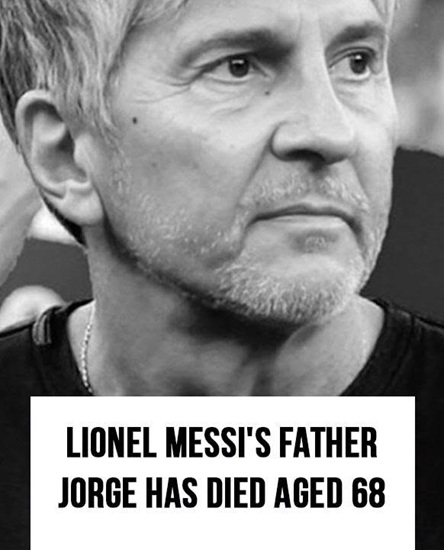
Jorge Messi, the father and longtime representative of football superstar Lionel Messi, has died at the age of 68 following a period of illness. He died in Rosario, Argentina, where he had been receiving medical treatment. The news brought messages of sympathy from across Argentine and international football, reflecting the important role Jorge played not only in his son’s personal life but also throughout Lionel Messi’s extraordinary career. Newell’s Old Boys, the Rosario club where Lionel spent part of his childhood development, was among the organizations to publicly mourn his death.
Jorge was far more than the father of one of football’s most famous players. For decades, he was closely involved in Lionel’s professional affairs and served as his longtime agent and representative. Before becoming known internationally through his son’s career, Jorge worked as a chemical technician and steelworker in Argentina. As Lionel’s exceptional football ability became increasingly clear during childhood, his family played a crucial role in helping him pursue opportunities that eventually took him from Rosario to Barcelona and onto the biggest stages in world football.
One of the defining moments in that journey came when Lionel was still a teenager. Messi moved from Argentina to Spain after Barcelona became interested in his development and agreed to support treatment connected with a growth hormone deficiency. Jorge accompanied his son during those formative years and remained closely involved as Lionel progressed through Barcelona’s system. What followed became one of football’s most remarkable careers, with Messi eventually winning major trophies in Spain, France, the United States and internationally with Argentina.
Newell’s Old Boys highlighted that long relationship when paying tribute following Jorge’s death. The club described him as a fundamental source of support behind Lionel’s career and emphasized the guidance he provided alongside his wife, Celia Cuccittini. Jorge’s influence was often exercised away from stadium cameras, through negotiations, family decisions and the management of his son’s professional interests. His involvement continued even after Lionel became one of the most recognizable athletes in the world.

A Difficult Period During the 2026 World Cup
Concerns about Jorge’s health had become public during the 2026 World Cup. Lionel Messi became visibly emotional during Argentina’s 3-0 victory over Algeria in June, a match in which he scored a hat trick. Afterward, Messi explained that his emotions were connected to circumstances outside football. He said he had been experiencing difficult days and thanked his teammates and the Argentine delegation for supporting him during the situation. At that stage, Messi did not publicly provide extensive details about what his family was facing.
Shortly afterward, Messi’s family confirmed that Jorge was experiencing health problems and was under medical supervision. At the time, the family said his condition was improving considering the circumstances. The announcement helped explain the emotion supporters had witnessed from Lionel during Argentina’s opening World Cup match. It also made clear that the matter was a private family health situation rather than something connected to Messi’s football performance.
The situation placed Messi in the difficult position of competing at football’s biggest tournament while his father was seriously unwell. Throughout his career, Jorge had been a consistent presence behind his son, from the early days in Rosario through Barcelona and the many major decisions that followed. Messi continued representing Argentina during the tournament while receiving support from teammates and staff. His comments at the time remained restrained, reflecting the family’s desire to keep details of Jorge’s condition largely private.
The False Report Weeks Before His Death
Jorge’s illness had already become the subject of a major media controversy several weeks before his actual death. In June, Argentine television presenter Florencia Peña announced during a live Luzu TV broadcast that Jorge Messi had died. The information was false. The incorrect announcement quickly circulated online, creating confusion at an especially sensitive moment for Messi and his family while Jorge was receiving medical care.

Messi’s family subsequently clarified that Jorge was alive and hospitalized with an undisclosed medical issue. According to reporting at the time, the family expressed frustration over the handling of such a private situation. Luzu TV also responded to the incident, while Peña publicly apologized for announcing information that had not been properly confirmed. The episode became a significant example of how quickly inaccurate information involving a globally famous family can spread through television broadcasts and social media.
Peña later ended her collaboration with Luzu TV and accepted responsibility for making the announcement on air. Reports said she explained that the information had been communicated to her through the production process, but she nevertheless acknowledged that broadcasting it was a serious mistake. Luzu TV said employees responsible for the dissemination of the false information had been removed from their positions. The incident occurred only weeks before Jorge’s actual death, making the earlier mistake particularly striking in retrospect.
Jorge Messi’s death now closes an important chapter in the story surrounding Lionel Messi’s rise from a talented child in Rosario to one of football’s most accomplished players. Although supporters around the world knew Jorge primarily through his connection to his famous son, his influence stretched across decades of Lionel’s life and professional career. He remained closely involved as a father, adviser and representative while Lionel moved through different clubs and stages of his career. Tributes following his death have therefore focused heavily on that longstanding support.
For Lionel Messi and his family, however, the loss is fundamentally personal rather than sporting. Jorge is survived by his wife, Celia, and their children. Public tributes may focus on his contribution to the career of an extraordinary footballer, but his death also marks the loss of a husband and father whose relationship with Lionel existed long before worldwide fame, trophies or individual awards. The messages issued after his passing have reflected both sides of that legacy: the influential figure behind a historic football career and the father who accompanied his son through much of an extraordinary journey.
