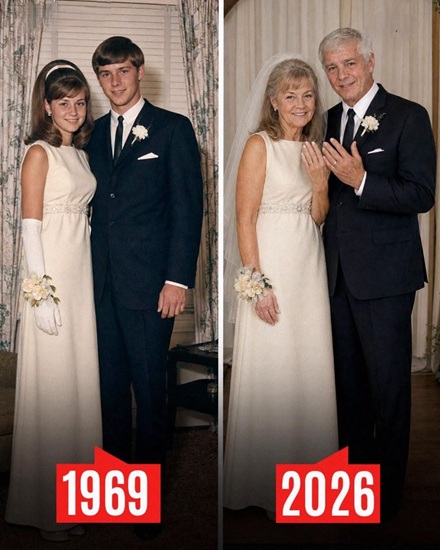
For more than half a century, an ivory prom dress remained carefully protected inside a garment bag in my attic. Other possessions came and went, furniture was replaced, and photographs faded around the edges, but I could never bring myself to throw that dress away. I had worn it in 1969, when I was eighteen and believed the future stretched endlessly ahead of me. That night, I attended senior prom with Daniel, the boy I was convinced I would eventually marry.
Daniel and I had grown up knowing each other, but our friendship changed during our final years of school. By graduation, we were making the kinds of plans young people make when they have no idea how unpredictable life can become. We talked about marriage, a small house and perhaps children someday. None of those dreams felt unrealistic then. Soon afterward, everything changed. Daniel left for military service during the Vietnam War era.
The night before he departed, we sat together on a hillside until morning. Neither of us wanted to say goodbye because saying it aloud made the separation feel real. Before leaving, he touched the sleeve of my prom dress and jokingly asked me to save it.
I did.
Then communication stopped.
Eventually, I was told that Daniel was missing.
Weeks became months.
Months became years.
My family encouraged me to continue living, but part of me remained attached to the possibility that Daniel might someday return. My older sister, Margaret, was especially insistent that I move forward. Whenever I asked whether anyone had contacted the family looking for me, she always gave the same answer.
“No.”
Life continued around me.
Friends married.
Children were born.
Careers changed.
My parents grew older.
I worked, traveled occasionally and created a quiet life for myself, but I never married. Whether that decision came entirely from Daniel’s disappearance or from the person I became afterward, I could never fully explain.
The prom dress remained upstairs.
Every few years, I opened the garment bag.
The fabric slowly aged, but the memories did not.
Then, fifty-five years after that final summer together, someone knocked on my door.
When I opened it, an elderly man stood on the porch.
His hair was silver.
His shoulders were different.
Time had changed almost everything.
But I recognized his eyes.
“Daniel?”
He smiled.
Neither of us knew what to say.
We spent hours talking.
In this fictional story, Daniel explained that his military service and the years afterward had been complicated, but the most devastating revelation concerned what happened when he eventually tried to find me.
He had returned.
And he had looked for me.
Daniel said he went to my parents’ former home hoping someone could tell him where I was living.
Margaret answered the door.
According to Daniel, she told him I had moved on, married and built another life.
He believed her.
He said he tried again later, hoping something had changed, but Margaret continued insisting that I wanted no contact with him.
I felt physically sick listening to him.
For fifty-five years, I had believed Daniel never returned.
He had spent years believing I had chosen someone else.
Neither story was true.
Daniel eventually found my address through someone who remembered my family and knew where I had settled.
That was how he arrived at my door.
The days that followed felt impossible.
We could not pretend we were eighteen again. Too much life had happened between us.
Instead, we started getting to know the people we had become.
Daniel told me about his life.
I told him about mine.
Sometimes we laughed about high school.
Sometimes we sat quietly because there were no words capable of containing fifty-five lost years.
Several weeks later, in the deliberately romantic world of this fictional story, we decided to marry.
It wasn’t an elaborate ceremony.
There was no enormous reception.
A few people close to us gathered in my living room while we exchanged vows.
I did not wear the old prom dress.
It belonged to the girl I had been.
But I brought it downstairs and hung it carefully nearby.
That evening, after everyone left, Daniel became unusually quiet.
“There is something else you need to know,” he said.
He explained that Margaret had not simply turned him away once.
According to him, she had repeatedly prevented information from passing between us.
The next morning, I called my sister.
I did not accuse her immediately.
I asked one question.
“Did Daniel ever come looking for me?”
There was a long silence.
That silence told me almost everything.
Daniel and I went to see her.
When Margaret opened the door and saw him standing beside me, her expression changed instantly.
At first, she denied everything.
Then she said she had been trying to protect me.
Finally, after I continued asking questions, the truth emerged within the fictional narrative.
Money had been involved.
Our father’s estate arrangements had created financial consequences connected to how family property would eventually be divided. Margaret had convinced herself that keeping Daniel out of my life would protect her own family’s financial interests.
I could barely understand what she was saying.
“You traded decades for property?”
Margaret began crying.
She tried to explain that she had been young, frightened and selfish.
Perhaps she expected me to scream.
I didn’t.
Nothing I could say would restore the years that had disappeared.
I told her I wanted nothing from the inheritance.
No house.
No money.
No furniture.
Nothing.
Those things suddenly seemed insignificant compared with what had been lost.
I also told Margaret that forgiveness, if it ever came, would not happen simply because she finally admitted what she had done.
Daniel took my hand.
We left.
That evening, I carried the ivory dress downstairs permanently.
For fifty-five years, it had represented waiting.
Now I wanted it to represent something else.
Survival.
Daniel and I sat together on the porch as the evening light disappeared.
We talked about all the things we could never recover.
We would never have our twenties together.
Or our thirties.
Or our forties.
No apology could manufacture those years again.
Eventually, Daniel looked at me and said, “We still have today.”
It was such a simple sentence.
But after spending most of my life looking backward, I finally understood its importance.
The past mattered.
The truth mattered.
What Margaret had done could not simply be erased.
But neither could it control every day that remained.
I looked through the window toward the old prom dress hanging inside.
For decades, I had preserved it because it represented a promise made when two teenagers believed they had unlimited time.
Now we knew better.
Time was never guaranteed.
So we stopped counting the years we had lost.
We began counting the mornings we still had.
And for the first time since 1969, the dress was no longer waiting for Daniel.
He was finally home.
