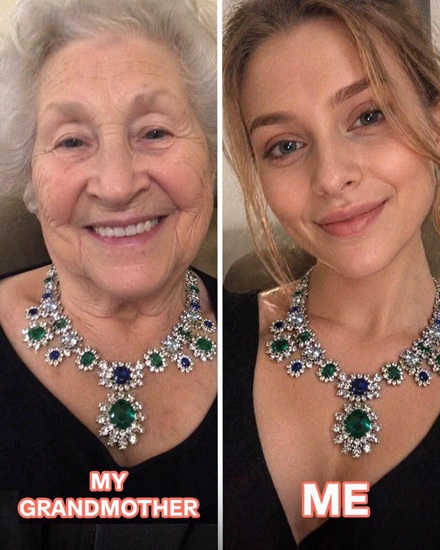
After my marriage ended, I measured survival in very small things. A warm meal at the end of a double shift felt like a victory. A bus arriving on time felt like mercy. A full night of sleep felt almost luxurious. I had left the home I once shared with my husband carrying two bags of clothes, an old phone with a cracked screen, and a cardboard box filled with objects I could not bear to lose. Of everything inside that box, one piece mattered more than the rest: a silver necklace that had belonged to the woman who raised me.
Her name was Evelyn, but I had always called her Nana. She was the person who taught me how to make soup from almost nothing, how to sew a missing button back onto a coat, and how to remain kind without allowing the world to mistake kindness for weakness. She had given me the necklace on my fifteenth birthday, fastening it carefully around my neck while telling me that some things carry stories long before we understand them. At the time, I thought she meant family memories.
Years later, I would discover that she meant far more. The necklace was unlike anything else Nana owned. It had a delicate silver chain and a small oval pendant engraved with a pattern of stars surrounding a tiny blue stone. She never explained where it came from, only that it had been with me since before I could remember. Whenever I asked whether it was valuable, she would smile and say that value was not always measured in money…
-After her death, I kept it wrapped in a soft handkerchief inside a wooden jewelry box, taking it out only on days when I missed her most. By the time I was thirty-two, nearly every part of my life had changed. My marriage ended after months of distance, arguments, and promises that never became actions. Around the same period, I lost a pregnancy I had hoped would bring us closer. Instead, grief widened the space between us until my husband finally admitted he had been seeing someone else. Within weeks, I was living alone in a small apartment above a closed bakery, working as many shifts as possible at a neighborhood diner and trying not to think too far ahead.
The apartment was modest but clean. The heating pipes knocked loudly at night, cold air slipped through the window frames, and the kitchen ceiling carried a faint stain from an old leak. Still, it was mine, and for a while that was enough. I created routines to keep myself steady. I woke before sunrise, walked to work, served coffee to construction crews and office workers, then stayed late to clean tables and count my tips beneath the fluorescent lights. Exhaustion became easier to manage than loneliness because exhaustion at least had a purpose.
Despite my efforts, the numbers stopped working. Rent increased, utility bills arrived together, and an unexpected medical expense consumed the small emergency fund I had managed to save. I began choosing which bills could wait and which could not. Every purchase became a calculation. I stopped taking the bus on clear days and walked instead. I ate dinner at the diner whenever the manager allowed me to take home leftover soup. I told myself the situation was temporary, even as the weeks passed and the balance in my account continued shrinking.
One rainy evening, I returned home and found an official notice attached to my door. The words were printed in bold red letters, impossible to misunderstand. Unless the overdue rent was paid within several days, legal eviction proceedings would begin. I read the notice three times before unlocking the door. Inside, I sat on the edge of the bed without removing my coat. For the first time since the divorce, determination was not enough to stop the fear from rising…
-I called two friends, but both were struggling financially themselves. I considered asking my former husband for help, then immediately rejected the idea. Pride was not the only reason. I had spent too long rebuilding the parts of myself that disappeared during the marriage, and I could not return to him as if nothing had changed. By midnight, only one possible source of money remained. I opened the closet, pulled the wooden box from behind a stack of blankets, and placed Nana’s necklace in my palm.
For nearly an hour, I argued with myself. Selling the necklace felt like betraying the one person who had never abandoned me. Yet losing the apartment would mean losing what little stability I had left. I tried to imagine what Nana would tell me. She had always been practical. She would probably remind me that memories do not disappear when objects change hands. Still, when I wrapped the necklace in its old handkerchief and placed it in my bag, I whispered an apology into the silent room.
The following morning, I walked downtown to a jewelry and loan shop I had passed many times but never entered. The storefront was narrow, with faded lettering above the door and several antique clocks displayed behind protective glass. A small bell sounded when I stepped inside. The room smelled faintly of polished wood, old paper, and metal. Behind the counter stood a man in his sixties wearing a dark vest and thin-framed glasses.
He introduced himself as Mr. Bell and asked what he could do for me. My voice sounded smaller than I expected when I said I wanted to sell a necklace. I unfolded the handkerchief and placed the pendant on a black velvet pad. At first, he examined it with the practiced calm of someone who had handled thousands of pieces of jewelry. Then his expression changed. He leaned closer, removed his glasses, cleaned them carefully, and looked again.
“Where did you get this?” he asked.
The question made me uneasy. I explained that it had belonged to my grandmother and that she had given it to me when I was young. Mr. Bell asked for her full name. When I told him Evelyn Hart, he stepped backward as though the answer had confirmed something he had hoped never to hear. He asked whether I would wait while he made a phone call. I told him I only needed an estimate, but he insisted the call was important.
He disappeared into a small office behind the counter. Through the partially open door, I heard him speaking quietly and urgently. He mentioned the pendant, the blue stone, and Evelyn’s name. Then he said something that made my stomach tighten.
“She finally brought it in.”
When he returned, he locked the front door and turned the sign from OPEN to CLOSED. I immediately stood and reached for the necklace, but he raised both hands to reassure me. He said I was not in danger and that no one intended to take the pendant from me. Before I could demand a clearer explanation, headlights appeared outside. A dark car stopped at the curb, and a woman stepped out carrying a leather folder.
She entered the shop without knocking. She appeared to be in her late sixties, dressed simply but elegantly, with silver hair cut neatly around her face. The moment she saw me, she stopped moving. Her eyes filled with tears, though she did not immediately speak. Then she looked at the necklace lying on the counter and pressed one hand against her chest.
“My name is Clara,” she said softly. “I knew Evelyn for almost fifty years.”
The name was familiar. Nana had mentioned a Clara several times when I was a child, describing her as a friend who lived far away. I searched the woman’s face for something recognizable, but time had erased whatever memories I might once have had. Clara asked whether she could sit with me. Something in her voice was so sincere that I agreed, though every instinct warned me that the day was moving far beyond a simple visit to a pawnshop.
She opened the leather folder and removed an old photograph. It showed Nana as a much younger woman standing beside Clara outside a hospital. In Nana’s arms was a baby wrapped in a white blanket. Around the baby’s neck was the same oval pendant resting on the counter between us.
“That baby is you,” Clara said.
I stared at the photograph until the edges blurred. Nana had always told me that my parents died when I was too young to remember them. She said she became my legal guardian because there was no one else. I had never questioned the story. It explained the absence of photographs, the lack of relatives, and the gaps in our family history. Yet Clara now told me that the truth had been more complicated.
According to her, I had been found as an infant near a rural train station after a winter storm. Nana was working as a nurse at a nearby clinic when police brought me in for examination. I was healthy, carefully dressed, and wearing the necklace. Authorities investigated but found no missing child report that matched my description. Months passed, then years. Eventually, after repeated legal reviews and unsuccessful searches for relatives, Nana was permitted to adopt me.
Clara said Nana had never stopped wondering where I came from. The necklace appeared to be custom-made and carried a tiny maker’s symbol on the back. With Clara’s help, she spent years contacting jewelers, private investigators, and family organizations. They followed several possible leads, but none could be confirmed. When Nana became seriously ill, she asked Clara to continue searching after her death.
I struggled to speak. Every memory of my childhood still felt real, but the foundation beneath those memories had shifted. Clara reached across the table and told me that none of this changed Nana’s love for me. She had not kept the truth hidden because she wanted to deceive me. She feared that telling a child she had been abandoned without being able to explain why would cause more pain than clarity.
Then Clara opened the final section of the folder.
Inside were recent documents, a family photograph, and the results of a private genealogical investigation. She said a breakthrough had occurred only months earlier when a distant relative submitted DNA information to a family-history service. The match led investigators to a couple who had spent more than three decades searching for a daughter who disappeared as an infant under circumstances that had never been fully explained.
Clara looked at me carefully before asking the question that changed my life for the second time that morning.
“Would you like to know who they are?”
I looked down at the necklace I had entered the shop intending to sell for rent money. Only an hour earlier, it had seemed like the last valuable piece of my old life. Now it appeared to be a key to a history I had never known existed.
After a long silence, I nodded.
For the next several days, my thoughts never settled. I still went to work, poured coffee, smiled at customers, and carried plates from one table to another, but my mind kept returning to Clara’s folder. Every detail she had shared replayed in my head. I found myself touching the necklace throughout the day, almost as if it had suddenly become heavier with meaning. It was no longer simply my grandmother’s keepsake. It had become a bridge connecting two completely different chapters of my life.
Clara never pressured me to make a decision. Instead, she encouraged me to take as much time as I needed. She reminded me that discovering biological relatives would never erase the childhood Nana had given me. Love, she said, is not measured by shared DNA but by years of presence, sacrifice, and commitment. Those words brought me comfort because they echoed the lessons Nana had repeated throughout my life. She believed that family was built every single day through kindness rather than biology alone.
After nearly a week of reflection, I agreed to meet the people identified through the investigation. Before arranging anything, independent professionals carefully reviewed documents, historical records, and DNA results to ensure the findings were accurate. I appreciated that nothing was rushed. Everyone involved understood that lives could be permanently affected by assumptions or mistakes. Only after every available record pointed to the same conclusion did Clara arrange a meeting.
The meeting took place in a quiet private room at a local community center instead of someone’s home. It felt like the right decision because nobody wanted the encounter to feel overwhelming. When I arrived, I noticed a middle-aged couple sitting together near the window. They immediately stood when they saw me. Neither rushed forward. Neither expected an embrace. Instead, they simply smiled through tears, respecting that this was as emotional for me as it was for them.
The woman introduced herself as Caroline, while the man quietly said his name was Thomas. Their voices trembled with emotion, but they remained remarkably composed. They explained that they had spent decades wondering what had happened after their infant daughter disappeared during a chaotic family emergency many years earlier. Investigators at the time had searched extensively but never found conclusive evidence explaining where the child had gone. As the years passed, hope slowly gave way to uncertainty, but they never completely stopped searching.
Rather than asking me to immediately accept them as parents, they began by telling me about themselves. They showed photographs from throughout the years, shared stories about their lives, and spoke honestly about both their happiness and their regrets. They acknowledged that they had missed every birthday, every graduation, every childhood milestone—not by choice, but because circumstances had kept them separated. They also recognized that another woman had been there through every one of those moments, and for that they expressed sincere gratitude.
Listening to them stirred emotions I had never experienced before. I wasn’t suddenly overwhelmed with the feeling that I had found missing parents. Instead, I felt curiosity mixed with sadness. These were people connected to me by birth, yet we were strangers trying to understand one another. That realization was strangely comforting because nobody attempted to force an instant relationship. Everyone accepted that trust would take time to develop naturally.
The conversation eventually turned toward Nana. When Caroline learned about the life Evelyn had given me, she quietly wiped away tears. She asked to see photographs of the woman who had raised me, and I showed her dozens stored on my phone. She smiled while looking at pictures of Nana baking cookies, gardening, and attending my school events. “She gave you the childhood we prayed someone would give you,” Caroline said softly. “For that, I will always be thankful.”
Thomas then surprised me by asking about my own life instead of focusing on the past. He wanted to know what kind of work I enjoyed, what books I liked reading, whether I preferred cities or small towns, and what dreams I still hoped to accomplish. It wasn’t an interview. It was simply a father trying to understand the woman sitting across from him after so many years apart. Those ordinary questions somehow meant more than dramatic speeches ever could.
Over the following months, we met regularly but without expectations. Sometimes we shared lunch. Other times we simply walked through parks or visited museums. We slowly learned about each other’s habits, personalities, and values. There were awkward moments, naturally, because relationships cannot be built overnight. Yet there were also unexpected similarities. We laughed at the same type of humor, preferred the same music, and even shared remarkably similar handwriting.
Financially, my situation also improved. Clara refused to let me sell the necklace. Instead, she introduced me to a nonprofit organization that helped people facing temporary housing crises. Through their assistance and additional hours at work, I managed to keep my apartment while searching for better employment. A few months later, one of Clara’s business contacts offered me an administrative position that provided stable hours, healthcare benefits, and opportunities for advancement. For the first time in years, I could breathe without constantly calculating every dollar.
The necklace remained exactly where it belonged. Rather than sitting hidden inside a box, I began wearing it again. People occasionally complimented its design without realizing the remarkable journey attached to it. Whenever someone asked whether it held sentimental value, I smiled and answered honestly that it represented every chapter of my life. It reminded me of loss, hope, resilience, and the extraordinary kindness of people who refused to stop caring.
As time passed, I realized that my story had never truly been about discovering biological relatives. It was about understanding that identity is built from many different pieces. Nana had shaped my character through unconditional love and steady guidance. Clara had honored a promise that lasted decades without expecting recognition. Caroline and Thomas had never stopped hoping despite years of uncertainty. Each person had contributed something essential to the woman I eventually became.
Looking back now, I often think about the morning I walked into that small pawnshop convinced I had reached the lowest point of my life. I believed I was about to lose the last meaningful object connecting me to my past. Instead, that difficult decision opened a door I never imagined existed. Sometimes life changes not because we are searching for miracles, but because we continue moving forward despite believing there are none left to find.
Today, the necklace still rests around my neck almost every day. It reminds me that difficult seasons rarely last forever and that unexpected answers sometimes arrive through ordinary moments. I no longer see it as a symbol of mystery. Instead, it represents the extraordinary people who shaped my life through compassion, patience, and unwavering love. Most importantly, it reminds me of Evelyn, the woman who chose me without hesitation and taught me that family is ultimately defined by the people who remain beside us when we need them most.
If there is one lesson my journey has taught me, it is that hope often survives quietly beneath disappointment. Even when life seems to be taking everything away, there may still be unseen chapters waiting to unfold. We cannot control every hardship we encounter, but we can choose how we respond to it. In the end, the greatest inheritance I received was never the necklace itself. It was the example of generosity, resilience, and unconditional love left behind by those who refused to let fear define the rest of my story.
