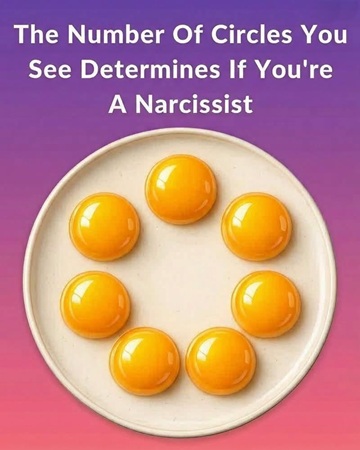
At first glance, this visual puzzle appears extremely simple. You are shown what looks like a plate with several circular shapes arranged in a pattern, and you are asked a straightforward question: how many circles can you see? The image seems harmless, almost playful, and most people respond within seconds, feeling confident in their answer. However, what makes this type of illusion so fascinating is not the image itself, but the way it exposes the complexity of human perception and how differently our brains interpret the same visual information.
As people begin to analyze the image more carefully, something interesting happens. The initial confidence often starts to fade. What seemed like an obvious answer suddenly becomes uncertain. Some viewers focus only on the clearly visible circular objects, while others begin to include additional shapes formed by shadows, reflections, or negative space. This is where disagreement begins, and why different people often report completely different counts despite looking at the same image. The puzzle is not changing — only the interpretation of it is.
This phenomenon is closely connected to how the human brain processes visual information. Our eyes do not function like cameras that simply record reality. Instead, the brain actively interprets what we see, constantly making assumptions based on previous experience, context, and expectations. When faced with ambiguous images, the brain tries to “fill in the gaps” and create a coherent picture. This can lead to different interpretations depending on what each person focuses on first.

Some individuals naturally prioritize the most obvious elements in a scene. They tend to focus on clearly defined objects and ignore subtle details in the background. In this case, they may count only the most visible circular shapes and quickly arrive at a lower number. Others are more detail-oriented and begin to include secondary elements such as edges, curves, reflections, and overlapping structures. This leads them to a higher count, even though both groups are observing the same image.
There is also a concept in visual psychology known as “figure-ground perception,” which describes how the brain separates objects from their background. In ambiguous images, this separation is not always clear. What one person sees as a background detail, another may interpret as a meaningful shape. This is why optical illusions are so effective at producing multiple valid interpretations. They exploit the brain’s natural tendency to organize chaos into recognizable patterns.
Another important factor is attention. Human attention is limited, and the brain must decide what information is most relevant at any given moment. In fast-paced environments, we tend to rely on shortcuts, known as cognitive heuristics, to process visual data quickly. These shortcuts are useful in everyday life but can lead to different conclusions when analyzing complex or ambiguous images. As a result, two people can observe the same picture and genuinely believe they are correct, even when their answers differ significantly.
What makes these visual puzzles so popular is not just the challenge itself, but the social experience that comes with them. People often share their answers with friends or online communities, only to discover that opinions vary widely. This creates discussion, curiosity, and sometimes even friendly debate. The enjoyment comes not from finding a single “correct” answer, but from observing how differently people perceive the same visual information.
It is important to clarify that claims suggesting these puzzles can accurately measure intelligence, personality, or psychological traits are not scientifically supported. While it is tempting to assign deeper meaning to different answers, a single optical illusion cannot reliably diagnose cognitive ability or predict behavior. These interpretations are mostly entertainment-based and should be understood as such. Psychology is a complex field, and accurate assessment requires controlled testing, not casual visual puzzles.
Despite this, optical illusions still provide valuable insight into how perception works. They remind us that what we see is not always an exact reflection of reality, but rather a constructed interpretation created by the brain. This understanding has been important in fields such as neuroscience, psychology, and cognitive science, where researchers study how humans process visual stimuli and make sense of uncertain information.
In everyday life, this means that perception can vary significantly between individuals. Two people can witness the same event and remember it differently, not because one is lying, but because their brains prioritized different details. Optical illusions simply make this process visible in a controlled and playful way. They reveal the hidden mechanisms behind perception that usually operate without our awareness.
Ultimately, the true value of this kind of visual puzzle is not in the final number you choose, but in the awareness it creates. It encourages you to slow down, observe more carefully, and question your initial assumptions. It highlights the fact that perception is subjective and that reality, as experienced by the human mind, is always partially constructed.
So when you look at the image again, the goal is not necessarily to find a “correct” answer, but to understand how your mind is interpreting what you see. Whether you count more circles or fewer circles, the interesting part is realizing that someone else may see the same image completely differently. And in that difference lies the true lesson of the illusion: reality is not just what exists in front of us, but also how our brain chooses to understand it.
