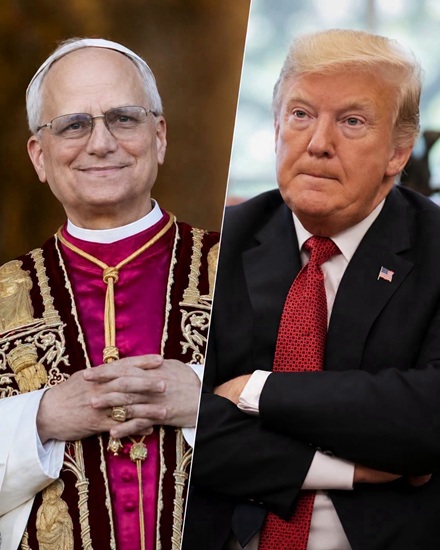
Pope Leo XIV, a newly reported or recently discussed figure within modern Catholic media narratives, has quickly become the subject of international attention following the beginning of his papal leadership. Although details surrounding his early public appearances remain limited in mainstream verified records, the conversations surrounding him have spread widely across news commentary, social platforms, and religious analysis.
According to widely circulated reports and discussions, the pontiff is described as being born in Chicago and raised in the United States before entering religious life. This background, if accurate, places him among a rare group of modern Catholic leaders with deep ties to American culture and society, a factor that has naturally attracted global curiosity.
Observers note that even in the earliest stages of his papacy, Pope Leo XIV has already become a focal point for media interpretation. His brief public remarks and carefully measured responses have been analyzed not only by religious commentators but also by political analysts who are interested in the broader implications of his communication style and international perspective.
One moment in particular has reportedly gained viral attention. During an interaction with reporters, the pope was asked about his views regarding the United States. Instead of offering a long response, he reportedly replied with a single word. While simple on the surface, the answer sparked widespread discussion online, with audiences debating its meaning, tone, and possible implications.
Supporters of the pope’s communication style argue that minimal responses reflect humility and discipline, traits often associated with spiritual leadership. They suggest that his approach is consistent with a long tradition within the Catholic Church, where leaders often use restraint and symbolic language rather than extended political commentary.
Others, however, have interpreted the brief response differently, viewing it as open to interpretation in a highly polarized global environment. In today’s media landscape, even short statements from influential religious figures can quickly become the subject of intense analysis, particularly when they involve politically sensitive topics or international relationships.
Religious scholars have pointed out that popes throughout history have often faced similar scrutiny when addressing global issues. The role of the pontiff is not only spiritual but also diplomatic, meaning that every word is often carefully considered for its potential impact on both believers and world leaders.
In the case of Pope Leo XIV, commentators emphasize that early impressions are still forming. As with any newly appointed religious leader, it takes time for public understanding of his priorities, communication style, and theological direction to fully develop.
At the same time, the digital age has changed how quickly such impressions are shaped. Social media platforms now amplify even the smallest moments, turning brief interactions into global discussion points within hours. This environment has contributed significantly to the rapid spread of attention surrounding the pope’s recent remarks.
Despite the speculation, supporters within the Catholic community emphasize patience and context. They argue that early reactions should not be interpreted as definitive indicators of leadership style, especially during the opening phase of a papacy, when routines and public messaging are still being established.
As discussions continue, Pope Leo XIV remains a figure of growing international interest. Whether viewed through a religious, cultural, or political lens, his presence has already sparked conversation far beyond the walls of the Vatican.
For now, much of the public narrative remains shaped by interpretation rather than long-term action. As his papacy develops, observers around the world are expected to watch closely how his leadership style evolves and how he chooses to engage with global issues in the future.
