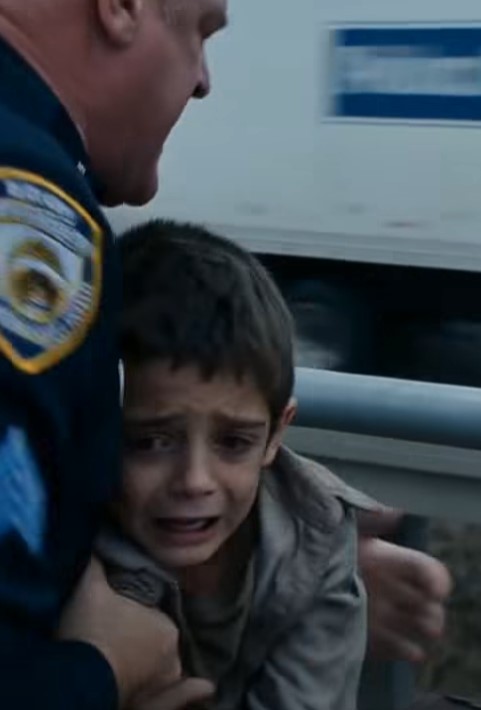
A chilling winter wind swept across the highway overpass as evening traffic rushed beneath the fading light. Drivers barely noticed the small figure standing near the edge of the road, a child alone in the cold, waving his arms with desperate urgency. At first glance, it appeared to be a dangerous and reckless situation, with the boy throwing stones toward passing vehicles. Several cars swerved slightly, confused and alarmed, but none stopped at first. A patrol officer responding to nearby reports of suspicious activity arrived within minutes.
As he approached, he expected to confront a frightened or troubled child causing disruption on the roadway. Instead, he found a small boy, no older than seven, shivering violently in thin, torn clothing. His face was pale from cold exposure, and his eyes were filled with fear rather than mischief. The officer quickly realized something was deeply wrong. The boy was not trying to run away or hide. Instead, he kept pointing repeatedly toward the steep embankment below the bridge.
His breathing was uneven, and he seemed to struggle to speak clearly. The urgency in his gestures suggested that whatever he was trying to show was a matter of life and death. Carefully descending the icy slope, the officer followed the direction of the child’s trembling finger. Hidden among the frozen grass and discarded debris, he discovered a dark duffel bag partially unzipped. At first, it looked abandoned, but a disturbing detail immediately caught his attention—something small moved inside.
Opening the bag revealed a horrifying scene. Inside was an infant girl wrapped in a thin, insufficient blanket, her skin cold and pale from prolonged exposure to freezing temperatures. The officer immediately lifted her into his arms, holding her close in an attempt to transfer warmth while calling for emergency medical support. Every second mattered as the child showed signs of severe hypothermia.
The young boy, later identified as Leo, broke down in tears as he explained that the baby was his baby sister, Maya. According to his fragmented words, they had been left there and no one had returned for them. He had tried desperately to stop passing cars earlier by waving, but when no one noticed, fear pushed him into throwing stones in hopes of forcing someone to stop.
Emergency responders arrived swiftly and transported the infant to the nearest hospital under critical care protocols. Leo remained close to the officer, refusing to leave his sister’s side even as he struggled with shock and exhaustion. His small hands shook as he repeatedly asked whether Maya would survive the cold night that nearly claimed her life.
Doctors worked urgently to stabilize the infant, treating severe hypothermia and dehydration. Against the odds, her condition gradually improved after hours of intensive care. Though still fragile, Maya began responding to treatment, offering a fragile but powerful sign of survival that brought relief to everyone involved.
As investigators continued to gather information, a darker picture of the situation began to emerge. Evidence suggested that the children had been abandoned under intentional and highly dangerous circumstances. Authorities launched a full investigation into the individual suspected of being responsible, treating the case as a serious criminal act involving endangerment of minors.
While the hospital remained under heightened security, officers received intelligence that the suspect might attempt to return. Precautionary measures were immediately taken, and access to the pediatric unit was restricted. Despite the tension, Leo was finally allowed to see his sister briefly through protective glass, offering him a moment of emotional relief after hours of fear.
The situation escalated when the suspect attempted to enter the hospital premises. Security teams responded quickly, preventing any access to the children’s ward. The individual was detained without harm to patients or staff, bringing the immediate threat to an end and ensuring the safety of both children.
In the days that followed, both Leo and Maya remained under medical and psychological care. While Maya recovered physically, Leo faced the emotional weight of everything he had witnessed and endured. Social services worked alongside hospital staff to ensure the siblings would not be separated during their recovery process.
As no immediate family placement was able to safely accommodate both children together, an unexpected decision changed the course of their lives. The officer who had first responded to the call stepped forward, expressing his willingness to provide a temporary home, ensuring the siblings could remain together during recovery.
Over time, the environment of fear and trauma slowly gave way to stability and care. Maya grew stronger, eventually returning to normal childhood development with little conscious memory of the events that had nearly cost her life. Leo, though still carrying emotional scars, began adjusting to a safer and more stable life.
What began as a routine response to a dangerous roadside disturbance ultimately transformed into a story of survival, resilience, and protection. In the end, two children who were once moments away from tragedy were given not only a second chance at life, but also a chance to grow up together in safety and care.
