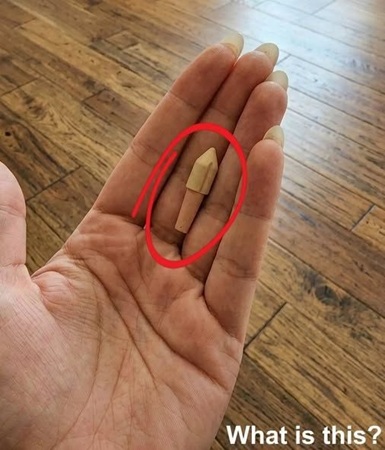
My heart skipped the moment my fingers brushed against something cold and sharp hidden deep inside the lining of my husband’s jeans. At first, it didn’t feel like anything significant—just an unexpected object caught during laundry. But as I pulled it out, the weight and shape of it immediately changed the feeling in the room. It was metallic, pointed, and deliberately manufactured, not something that simply ends up in fabric by accident. In that instant, my thoughts began to spiral into questions I wasn’t prepared to answer.
I stood there for a moment, holding it in my palm, staring at it under the dull laundry room light. My mind started filling the silence with assumptions. Why would something like this be in his pocket? Was there something he hadn’t told me? The more I looked at it, the more my imagination began constructing scenarios I could not prove but couldn’t stop thinking about either. It was as if the object itself had opened a door to doubt.
When I confronted him, his response was unexpectedly calm. He barely reacted, as if I had shown him something completely meaningless. He shrugged and said he didn’t know what it was or how it ended up there. That reaction should have reassured me, but instead it did the opposite. His indifference made my thoughts louder, not quieter. I found myself questioning whether calmness meant honesty—or concealment.
For the next hour, I remained in the laundry room, unable to move past it. I turned the object over repeatedly, studying every angle. It was precisely engineered, with a tapered metal tip and a threaded base that suggested it belonged to something functional and deliberate. It didn’t look random. It looked designed. That detail alone was enough to keep my thoughts circling back into suspicion. The ordinary sound of the house around me felt distant, as if I were separated from it by glass.

Every small detail became something I overanalyzed. A faint scratch near the edge. The way the metal caught light in a sharp reflection. Even its weight felt intentional in my hand. I began thinking less like a spouse and more like someone trying to solve a puzzle with missing pieces. In my mind, it stopped being an object and became evidence—something that needed explanation, something that demanded a story I didn’t yet have.
At one point, I even considered confronting him again with more force, more certainty in my tone. I was preparing arguments in my head, building explanations for why I felt something wasn’t right. The longer I sat with it, the more real my assumptions became, even without proof. It was unsettling how quickly uncertainty can transform into belief when left unchecked.
Then something small changed everything. As I held it closer under the light, I noticed faint markings engraved at its base. They were subtle, almost invisible at first glance, but once I saw them, I focused more carefully. My breathing slowed as curiosity replaced anxiety for the first time since I had found it. I searched for meaning in those tiny details, expecting them to confirm my fears.
Instead, they did the opposite. The realization came gradually, then all at once. It wasn’t anything suspicious or dangerous. It wasn’t a hidden tool for deception or something connected to a secret life. It was a field point—a practice tip used for archery, designed specifically for training arrows on targets. Something entirely ordinary in a completely different context, but completely unfamiliar in mine.
The shift in my emotions was immediate but complicated. Relief came first, but it was quickly followed by embarrassment. My mind had built an entire narrative around an object I didn’t understand. I had turned confusion into suspicion and suspicion into certainty without any real evidence. My husband hadn’t been hiding anything harmful or deceptive. He had simply kept a personal hobby to himself—something quiet, harmless, and separate from our shared routines.
As I sat there holding the object now understood in its proper context, I began to reflect on how easily perception can distort reality. A lack of information had allowed fear to grow into assumption, and assumption had nearly become belief. The object itself hadn’t changed at all, but my understanding of it had transformed completely in a matter of minutes.
What stayed with me most wasn’t the object itself, but the realization of how quickly trust can be tested not by truth, but by interpretation. Silence is not always secrecy. Privacy is not always deception. And not knowing something does not automatically make it something dangerous. Sometimes, the mind fills gaps too quickly, creating stories that feel real but are built on uncertainty.
In the end, I learned that fear often speaks louder than facts when we don’t pause long enough to understand what we are seeing. And sometimes, the most important thing uncovered in a moment of doubt is not a secret about someone else—but a truth about how easily we can misread the world when we let suspicion lead the way.
