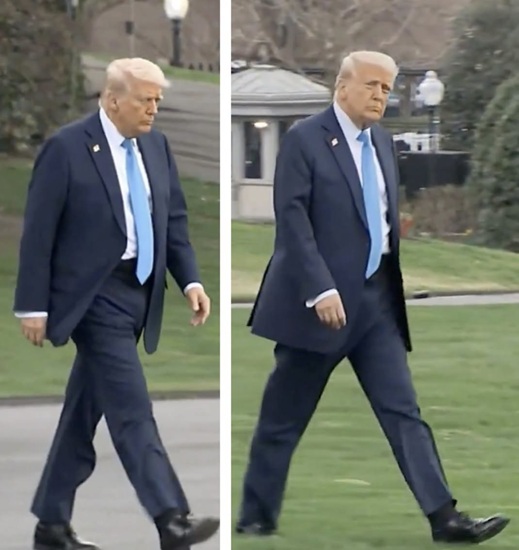
Images of President Donald Trump boarding Marine One, originally published in 2025, have once again resurfaced across social media platforms in 2026. The photos, which show the former president walking across the White House South Lawn before boarding the helicopter, have continued to attract attention due to renewed online discussions about his appearance and public schedule.
While the images themselves are not new, their repeated circulation has sparked fresh commentary online. Many users have focused on visual details such as posture, clothing fit, and perceived physical changes, interpreting them in different ways depending on political perspective. As with many widely shared political images, the discussion has become highly polarized.
At the same time, it is important to note that social media interpretations of appearance are not medical assessments, and public figures are often subject to speculation that is not supported by verified medical information.
Renewed Online Discussions and Unverified Claims
In 2026, online conversations have continued to include speculation about President Trump’s health, particularly following viral posts and reposted images. One rumor that circulated briefly earlier in the year suggested he had been taken to Walter Reed Medical Center. This claim was later denied by official White House communications, and no verified evidence supported the report.

President Trump has publicly stated that he is in good health, while also remaining a frequent subject of public discussion due to his age and high-profile political position. At 79 years old, he became the oldest individual to take the presidential oath of office when he assumed the presidency, which has contributed to increased media attention on his physical condition.
However, no official medical findings have been confirmed in relation to the viral claims circulating online, and much of the discussion is based on interpretation of public appearances and social media content.
Social Media Reactions to the Marine One Images
As the Marine One photographs resurfaced, online reactions quickly divided into different viewpoints. Some social media users described Trump as appearing more energetic or healthier compared to earlier appearances, while others suggested that the images simply reflect normal variations in posture, lighting, or clothing.

In many cases, discussions focused less on the political context of the images and more on visual interpretation. This type of reaction is common when widely recognized public figures are featured in viral content, especially when images are shared repeatedly over time.
Experts and commentators often note that social media environments can amplify subjective interpretations, particularly when images circulate without full context or updated information.
Speculation, Diet Discussions, and Public Image Narratives
Alongside the viral images, online discussions have also included broader speculation about lifestyle and diet. Some posts have suggested changes in eating habits, while others have made unverified claims about possible weight-related trends. These discussions, however, are based largely on public commentary and have not been confirmed through medical documentation.
President Trump has spoken publicly in past interviews about his dietary preferences and habits. He has also been frequently associated in media coverage with fast food consumption, a topic that has been widely discussed in both news reporting and popular culture.
Over the years, various reports and statements from individuals associated with his political campaigns have described his well-known preference for certain foods and beverages. These accounts have contributed to a long-standing public narrative around his diet, though they are often presented in a humorous or anecdotal context rather than as formal health information.

It is important to emphasize that such discussions do not provide medical insight and should not be interpreted as clinical evaluation.
Media Narratives and Repeating Image Cycles
The Marine One photos originally shared in 2025 have continued to reappear online, particularly during moments of increased political attention or public appearances by Trump. Social media accounts, including political pages and supporter networks, often repost older images when related topics trend again.
This cycle of resurfacing content is common in digital media, where older visuals are frequently recontextualized based on current events or discussions. As a result, images can take on new meaning over time, even though the original context remains unchanged.
In this case, the repeated sharing of the Marine One photos has contributed to ongoing debate, with different audiences interpreting them in contrasting ways. Public Perception and Online Interpretation
Public reactions to the images remain divided. Some viewers interpret them as showing a healthier or more energetic appearance, while others caution against drawing conclusions from photographs alone. Lighting, angle, timing, and context can all influence how an image is perceived.
This type of disagreement is common in the digital age, where viral content spreads rapidly and is often analyzed without full context. As a result, visual content involving political figures frequently becomes part of broader discussions that extend beyond the images themselves.
Despite differing interpretations, there is no verified evidence linking the resurfaced photos to any confirmed medical condition or official health update.
Viral Images and Ongoing Public Attention
The renewed circulation of Donald Trump’s 2025 Marine One photographs highlights how older images can re-enter public discussion and take on new meaning in changing political and social contexts. While some viewers focus on perceived physical changes, others emphasize the importance of avoiding speculation without verified information.
As of now, discussions surrounding the images remain based on public interpretation and online commentary rather than confirmed medical reporting. The continued attention reflects the broader role of social media in shaping narratives around public figures, where visuals often become central to debate regardless of their original context.
Ultimately, the viral nature of these images shows how digital platforms can keep past moments active in public conversation, especially when they involve high-profile political figures.
