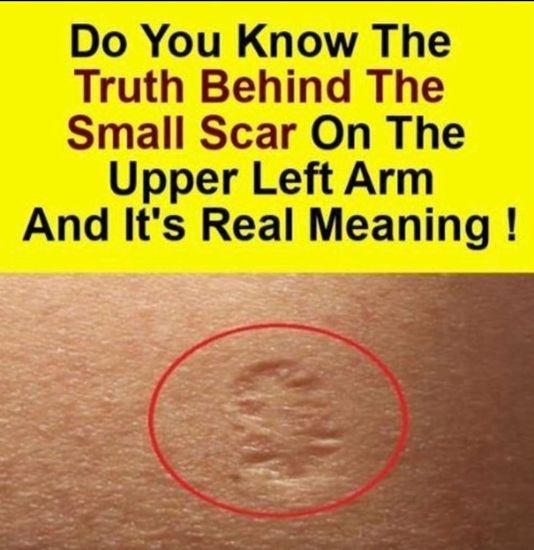
I have a clear memory of noticing a distinct scar on my mother’s arm when I was a child. It sat high up near her shoulder, forming a small circular pattern of tiny indents surrounding a larger mark in the center. At the time, I remember being strangely fascinated by it, even though I could not explain why it drew my attention so strongly. It was simply one of those childhood observations that stick in your mind without reason. Over the years, however, that curiosity faded into the background of everyday life.
The scar remained exactly where it always had been, but my awareness of it gradually disappeared. Looking back, I realize I never truly forgot about it; I simply stopped thinking about it consciously. The memory itself became buried beneath time and routine. I may have even asked my mother about it once, but if she explained, I no longer retained the answer. Childhood memories often behave this way—some details remain vivid while others dissolve completely.
That small scar became one of those forgotten mysteries, something I saw but no longer questioned. It wasn’t until many years later that the memory resurfaced in an unexpected way. One summer, I helped an elderly woman step off a train during a short journey. As I assisted her, I happened to notice a familiar-looking mark on her upper arm. It was almost identical in placement and shape to the scar I had once seen on my mother.
That moment immediately reignited my curiosity, bringing back a memory I hadn’t consciously thought about in years. Unfortunately, the train was about to depart, and I had no opportunity to ask her about it. The encounter ended too quickly, leaving me with unanswered questions once again.

Later that day, I decided to call my mother to finally resolve the curiosity I had carried since childhood. To my surprise, she told me she had actually explained it to me before, more than once. However, like many childhood explanations, it seems I had never considered it important enough to remember at the time. She then revealed that the scar came from the smallpox vaccination, a routine immunization that was once widely administered. Hearing this connected all the missing pieces of memory that had lingered in the background for so long.
Smallpox itself was a highly contagious viral disease that once caused widespread fear across the world. It produced severe skin rashes, high fevers, and in many cases led to serious complications or death. According to health authorities such as the Centers for Disease Control and Prevention, fatality rates during major outbreaks could reach approximately three out of ten infected individuals. Survivors were often left with permanent scarring or disfigurement. The disease had a devastating global impact before vaccination efforts eventually brought it under control.
Thanks to extensive vaccination programs, smallpox was eventually eradicated in the United States in 1952. Over time, continued global efforts led to the worldwide eradication of the disease, making it one of the greatest achievements in public health history. By 1972, smallpox vaccinations were no longer part of routine immunization schedules in many countries. For generations before that time, however, receiving the vaccine was a normal part of childhood healthcare. Almost everyone born during that era carries some form of reminder of it.
The method used to administer the smallpox vaccine was also quite different from modern vaccination techniques. Instead of a single injection, a special two-pronged needle was used to puncture the skin multiple times. This allowed the vaccine to reach the dermis layer beneath the outer skin. The process intentionally created a localized infection using a weakened virus, which triggered the body’s immune response. As the immune system reacted, a series of physical changes began to occur at the injection site.
In the days following vaccination, a small bump would form and gradually develop into a raised lesion. This lesion would then progress into a fluid-filled blister known as a vesicle. Over time, the vesicle would rupture and begin to dry out, forming a scab. Eventually, as the skin healed, it left behind a permanent circular scar. This distinctive mark became a recognizable sign of vaccination for many people of that generation. In a way, it served as an early visual record of medical protection.
For many individuals, including my mother, this small scar is a lasting reminder of a time when vaccination campaigns played a crucial role in eliminating a deadly disease. What once seemed like a simple childhood mark carries with it a much larger historical significance. It represents not only personal medical history but also a global achievement in disease prevention. That realization added new meaning to something I had once seen as just a curious detail on her arm.
In the end, what began as a forgotten childhood observation became a reminder of how personal memories often connect to larger historical events. A simple scar on my mother’s arm was not just a mark—it was a piece of medical history, shared quietly by millions of people from her generation.
