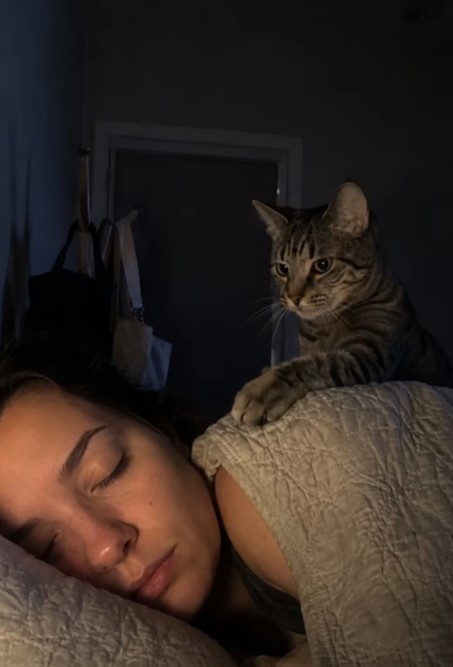
The Cat Forced Her Owner Out of the Bedroom Every Night Until a Veterinarian Suggested a Hidden Medical Cause Behind the Strange Behavior A Strange Nightly Routine Begins. Anna never expected that living with her cat would slowly turn into a nightly struggle that left her exhausted, confused, and increasingly worried about what was happening inside her own home. At first, everything seemed normal. Her gray cat, Luna, was affectionate, calm, and well-behaved during the day, showing no signs of unusual stress or behavioral problems at all.
However, each night brought a completely different pattern. Around the same time every evening, Luna would begin waking Anna repeatedly, interrupting her sleep in ways that gradually became more aggressive and persistent. Initially, Luna would gently tap Anna’s face with her paw, as if trying to get attention or encourage her to wake up briefly before settling back to sleep again peacefully.
When that did not work, the behavior slowly escalated. The cat began scratching the blanket, nudging more forcefully, and occasionally biting lightly, always targeting Anna during deep sleep cycles. No matter what adjustments Anna made, nothing seemed to stop the pattern. Closing the door, changing feeding times, or adjusting routines made no noticeable difference in the nightly disturbances she experienced.
Eventually, Anna discovered a strange and consistent outcome. The only way the situation would settle was if she physically left the bedroom and moved to sleep on the living room couch instead. Once Anna left the room, Luna would immediately calm down, return to the bed, and sleep peacefully until morning, as if the entire disruption had never occurred in the first place.
This unusual cycle repeated night after night for several weeks, gradually leaving Anna physically drained and emotionally concerned about whether something serious was wrong with her cat or the environment. Searching for Answers and Veterinary Help
After nearly three months of disrupted sleep, Anna decided she could no longer ignore the situation and scheduled a veterinary appointment to better understand her cat’s unusual nighttime behavior.. When she called the clinic, her voice reflected exhaustion and concern. She explained that her cat was preventing her from sleeping and that the situation had become increasingly difficult to manage alone.
Veterinarians often hear about behavioral issues in cats, especially nocturnal activity, which can include excessive energy, vocalization, or attention-seeking behaviors that disturb owners during nighttime rest periods. However, something about Anna’s description stood out as different. She did not sound frustrated or angry, but instead genuinely worried, as if she believed something deeper might be going on. When Anna arrived at the clinic, she appeared tired but composed. She carried Luna carefully in a pet carrier, treating her with the same gentle attention as someone deeply attached to their animal.
“This is Luna,” Anna explained. “She is normally very sweet, but at night she behaves like she is trying to force me out of the room completely.” Inside the carrier, Luna appeared calm and alert, observing her surroundings quietly. There was no visible aggression, distress, or unusual physical symptoms that immediately suggested illness or neurological issues. The veterinarian began a standard examination, checking vital signs, breathing patterns, heart rate, and general physical condition, all of which appeared within normal and healthy ranges for a cat her size.
No obvious medical explanation could be found. There were no signs of infection, pain, injury, or behavioral disorder that would clearly explain such consistent and targeted nighttime actions. However, during the consultation, the veterinarian noticed something subtle but unusual. Luna’s gaze remained fixed on Anna, tracking her movements closely, even when the owner was not interacting with her. A Critical Question Changes Perspective.
The veterinarian then asked Anna a series of additional questions about her own health, sleep quality, and emotional state, shifting the focus slightly away from the cat and toward the owner herself. Anna paused before responding and admitted that she often woke up feeling anxious, with a racing heartbeat, dry mouth, and a sensation of breathlessness that made her feel physically unwell. She explained that she had previously assumed these symptoms were caused by stress or insomnia, and that she had even been prescribed mild sedatives to help her sleep more normally.
Despite treatment attempts, her condition had not improved significantly. Instead, she continued experiencing interrupted sleep and unexplained nighttime discomfort that left her increasingly exhausted during the day. Anna also mentioned something a neighbor had observed. At night, her breathing sometimes sounded irregular, including moments where she appeared to stop breathing briefly before suddenly gasping for air. This detail immediately caught the veterinarian’s attention, suggesting that the issue might not be purely behavioral but potentially connected to an underlying medical or sleep-related condition affecting respiration.
The veterinarian gently explained that some animals are highly sensitive to changes in breathing, heart rhythm, and physical distress, often reacting to subtle cues that humans are unaware of during sleep. A Possible Medical Explanation. Based on the information provided, the veterinarian suggested that Luna’s behavior might not be aggression or confusion, but instead a response to physical distress occurring while Anna was asleep.
The veterinarian explained that animals can sometimes detect changes in breathing patterns or cardiovascular irregularities long before humans recognize symptoms, especially during unconscious states such as deep sleep. “It is possible,” the veterinarian said, “that your cat is reacting to changes in your body while you sleep. She may be responding to warning signals that are not obvious to you.” Anna was surprised by this possibility and asked whether her cat could actually be trying to wake her for safety reasons rather than behaving aggressively or unpredictably during the night.
The veterinarian recommended that Anna undergo medical testing, including blood work, heart evaluation, and a sleep study to rule out conditions such as breathing disorders or metabolic imbalances. A week later, Anna followed that advice and scheduled a full medical examination, including specialist consultations to better understand the symptoms she had been experiencing for months. Medical Results Reveal the Underlying Issue
When Anna returned to the clinic for a follow-up call, her tone had changed. Instead of exhaustion and confusion, she now sounded surprised and relieved, though still processing the results. Medical tests revealed that her blood sugar levels were significantly elevated, and doctors recommended further evaluation for potential metabolic conditions that required immediate attention and lifestyle adjustments.
Additional cardiac assessments indicated irregularities that needed monitoring, leading specialists to investigate possible cardiovascular strain that may have been contributing to her nighttime symptoms. Most importantly, a sleep study confirmed episodes of interrupted breathing during the night, suggesting a condition that required ongoing treatment and careful medical supervision to prevent complications.
Suddenly, the cat’s behavior no longer seemed random. Each time Luna had forced Anna to wake up, it likely coincided with moments when her breathing or physical condition became unstable. Once Anna sat upright or moved to another room, her breathing improved slightly, which may explain why the cat consistently stopped reacting once she left the bedroom environment. A New Understanding Between Human and Animal
With treatment underway, Anna gradually began to feel improvements in her health. Medical care, monitoring, and lifestyle adjustments helped stabilize her condition over time. As her health improved, Luna’s behavior also changed. The nighttime aggression stopped completely, and the cat no longer needed to force her owner out of bed during sleep.
Instead, Luna began sleeping quietly beside Anna, remaining calm throughout the night. The relationship between them became more peaceful, stable, and emotionally reassuring for both owner and pet. What once appeared to be disruptive or problematic behavior was now understood in a completely different light, reflecting a possible instinctive response to changes in human health conditions.
Anna later reflected on the experience, realizing that she had initially misinterpreted her cat’s actions, assuming they were behavioral issues rather than potential responses to physical distress signals. She acknowledged that without Luna’s repeated interruptions, she might not have sought medical help as early as she did, potentially delaying the discovery of her underlying condition. Today, Anna and Luna continue their lives together with a renewed understanding and stronger bond, built on both medical awareness and the complex connection between human and animal perception.
