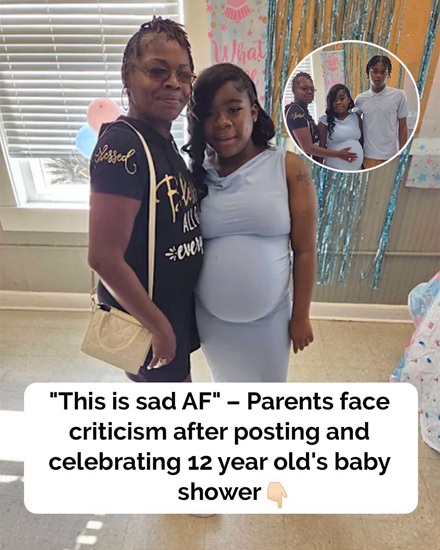
A family from Mississippi became the center of widespread online discussion after photos from a baby shower were shared on social media and later circulated far beyond their original audience, sparking intense debate. What began as a private family gathering quickly turned into a viral topic across multiple platforms, raising questions about teen pregnancy, parental responsibility, public reaction, and the ethics of sharing sensitive family situations online.
The original post was shared on Facebook by Greenwood resident Sheila Marble on April 27, featuring images from a baby shower event that included decorations, balloons, and a pregnant teenager believed by online viewers to be very young. In her post, Marble expressed pride in the family moment, describing the event in affectionate terms, while appearing alongside the pregnant girl in several photos that were later widely reshared by other users.
Some additional images from the same event also showed another young individual identified by social media users as a teenage boy, although no official or verified details about relationships or circumstances were confirmed publicly by the family. The baby shower itself appeared decorated in a traditional celebratory style, with themed colors, banners, and gifts arranged around the space, resembling many standard family-oriented celebration events.
At first, engagement on the original Facebook post remained relatively limited, with comments mostly coming from friends, relatives, and acquaintances who responded with supportive or neutral reactions. However, the situation changed significantly on April 29 when screenshots of the post were reposted on the social media platform X, where they quickly reached a much larger and more global audience.

Within a short period, the images gained millions of views, transforming a private family moment into a widely discussed public controversy involving users from different countries and backgrounds. As the content spread, reactions became increasingly divided, with some users expressing concern and shock regarding the apparent age of the individuals and the circumstances surrounding the celebration.
A portion of commenters questioned whether it was appropriate to publicly celebrate such an event, raising broader concerns about how teenage pregnancy is discussed and portrayed in online spaces. Others focused on the emotional and social implications, suggesting that public reactions should consider the sensitivity of minors involved and the complexity of family situations behind such events.
At the same time, many users defended the family’s right to respond to their circumstances privately, arguing that public judgment and online criticism could add unnecessary pressure to an already difficult situation. Some commenters also highlighted broader societal debates around education, access to reproductive health information, and how different regions address teen pregnancy and family support systems.
The conversation gradually expanded beyond the specific family, becoming part of a larger discussion about social media ethics, including how quickly private images can be shared and reinterpreted by mass audiences. Several users pointed out that the original Facebook post appeared to have been intended for a small, familiar audience, and that its viral spread raised questions about consent and privacy in the digital age.
Concerns were also raised about the fact that the individuals involved are reportedly minors, leading some commenters to urge caution in how the situation is discussed publicly online. Others emphasized that many details circulating in comments were based on assumptions rather than confirmed information, reminding users that online interpretations can often exaggerate or distort real-life situations.
The discussion also reflected broader cultural differences in how family events and teenage circumstances are viewed, with opinions varying widely depending on personal beliefs and social perspectives. As the debate continued, the situation became an example of how quickly social media can transform a personal family moment into a global discussion involving judgment, empathy, and controversy.
Despite the intense online attention, much of the actual context surrounding the situation remains limited to what was originally shared by the family on social media platforms. Ultimately, the incident highlights the challenges of privacy in the digital era, where personal posts can rapidly become viral content and generate widespread debate far beyond their intended audience.
