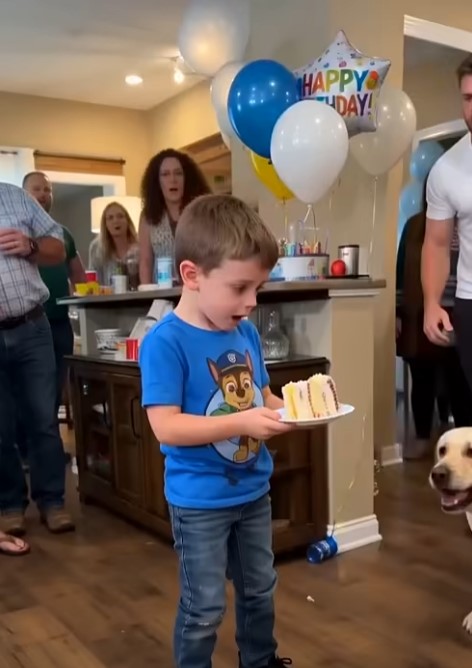
At the heart of the family home stood Buster, a six-year-old yellow Labrador who had been part of Leo’s life since infancy. The dog was known in the neighborhood for his calm temperament and gentle behavior around children. Buster had never shown aggression toward anyone. He tolerated playful roughness, sudden hugs, and loud noise without stress. To Leo’s parents, he was not just a pet but a trusted and beloved member of the family.
As the birthday cake was carefully placed on the outdoor table, the children gathered closer with excitement. Cameras were raised, candles were prepared, and the moment seemed ready to unfold into a simple, joyful tradition. Then, without warning, everything changed in an instant that no one in the backyard would forget. The atmosphere shifted from celebration to panic as an unexpected reaction unfolded in front of everyone.
As Leo reached toward the cake, Buster suddenly emitted a deep, sharp growl that none of the family had ever heard before. The sound immediately startled the nearby guests and silenced the children’s excitement. Before anyone could react, the Labrador moved quickly and knocked Leo backward onto the wooden deck. The sudden motion caused immediate screams from the adults who rushed toward the scene in confusion and fear.
Buster then positioned himself between the child and the cake, standing firmly as if guarding or blocking access. To the observers, the behavior appeared aggressive and unpredictable, causing immediate panic among the adults present. Leo’s father reacted instinctively, pulling the dog away by the collar. Believing his son had been attacked without provocation, he quickly moved Buster into the garage to prevent further danger.
The celebration ended abruptly, replaced by shock, confusion, and fear. Guests tried to comfort Leo, while the family struggled to understand what had caused their usually gentle dog to behave in such a way. Within minutes of the incident, however, a far more serious situation began to develop that would shift the entire understanding of what had just occurred at the birthday party.
Leo began crying intensely, initially appearing shaken by the fall and the sudden chaos. At first, the family assumed his distress was emotional rather than medical in nature. Soon after, his breathing became noticeably strained. A wheezing sound emerged, and red patches began appearing on his skin, quickly spreading across his face, arms, and neck.
His lips began to change color, and swelling around his mouth and eyes became increasingly visible. Panic spread among the adults as they realized this was no longer a simple fright response. Neighbors immediately contacted emergency services while Leo’s parents tried to keep him conscious and stable. The child struggled for air as his condition rapidly worsened in front of them.
Paramedics arrived within minutes and quickly identified the symptoms of a severe allergic reaction, specifically anaphylaxis, which can become life-threatening if not treated immediately. Emergency medication was administered on-site, along with oxygen support to stabilize Leo’s breathing. For a brief moment, the response seemed uncertain, leaving the family in extreme distress.
Gradually, his breathing improved, and color returned to his face. Although stabilized, paramedics warned that the situation remained extremely serious and required immediate hospital treatment. Leo was transported urgently to the hospital for further care and monitoring. As the ambulance left, the family was left behind trying to understand how such a sudden medical emergency had developed.
At the hospital, doctors began intensive treatment to reduce the allergic reaction and stabilize his condition. Medical staff worked quickly to identify the exact cause of the severe response. Initially, there was confusion, as Leo had no previously documented severe allergies. His parents could not recall any recent exposure that might explain such a violent reaction.
Doctors carefully reviewed everything Leo had eaten, touched, or been exposed to during the birthday party. Attention soon focused on the birthday cake as the only potential source. It was confirmed that Leo had not actually eaten a slice of cake but had briefly touched the frosting while reaching toward it during the celebration moments before collapsing. That small contact became the central focus of the investigation, as even minimal exposure can trigger severe reactions in individuals with undiagnosed or hidden allergies.
The family later reviewed the bakery order and discovered a critical mistake had been made during preparation of the cake, which changed everything about the case. The cake that had been delivered was not the original order requested by the family. Instead, it contained peanut-based ingredients and almond flour that had not been properly labeled.
These ingredients had been hidden within chocolate-flavored frosting, making them nearly impossible to detect visually. The substitution created a serious and dangerous risk. Doctors confirmed that Leo had suffered a life-threatening allergic reaction caused by accidental exposure to peanuts and tree nuts, both known for triggering severe anaphylaxis. Medical staff explained that even a small amount of contact, such as touching frosting and then touching the face or mouth, could be enough to trigger such a reaction.
The realization brought relief and fear at the same time, as the cause was accidental but potentially fatal. The family now understood how close the situation had come to tragedy. Meanwhile, Leo’s father began reflecting on the earlier events involving Buster. The dog’s behavior, once viewed as aggressive, began to appear different in light of new information. Buster had not bitten or scratched Leo during the incident. Instead, he had physically blocked access to the cake, standing between the child and the dessert itself.
This behavior led the family to reconsider the dog’s actions entirely. What had initially been interpreted as aggression now appeared to possibly be protective instinct. Dogs possess an advanced sense of smell capable of detecting chemical changes and substances far beyond human perception. Many trained dogs can identify allergens or dangerous materials. The family began to wonder whether Buster had detected something unusual about the cake before anyone else and reacted instinctively to prevent Leo from consuming it.
As this possibility became clearer, the earlier fear surrounding the dog gradually shifted into understanding and regret for misinterpreting his actions. Leo’s father eventually returned home to find Buster still inside the garage, quiet and unaware of the confusion he had caused. The dog responded with affection rather than fear or aggression. The emotional moment that followed marked a turning point for the family, who now viewed the dog’s actions through an entirely different perspective.
In the following days, Leo recovered fully under medical supervision and was officially diagnosed with a severe peanut and tree nut allergy requiring lifelong management. The family was trained in allergy safety procedures, including strict dietary precautions and the use of emergency medication such as epinephrine auto-injectors. Leo returned home safely after several days in the hospital. Waiting for him was Buster, whose presence brought immediate comfort and reassurance to the recovering child.
Their reunion reflected a bond strengthened by fear, misunderstanding, and ultimately survival. The emotional connection between them remained strong and unchanged. In the years that followed, Buster continued to stay close to Leo, often following him quietly and watching over him during daily activities at home. The birthday incident remained a powerful memory for the family, serving as a reminder of how quickly perception can change when full information becomes available.
What was first seen as a frightening attack was ultimately understood as a moment of instinctive protection, highlighting the complex and often misunderstood nature of animal behavior.
