A morning walk through an ancient forest often feels like stepping into a quieter world, where time slows and the air carries a mix of moisture, earth, and decaying wood beneath towering trees. The light usually filters gently through dense canopies, forming shifting patterns on the forest floor. Every step on soft soil, roots, and leaves creates a rhythm that feels calm and deeply grounding for visitors. On one such hike, a father and his young son, Leo, follow a narrow trail winding between tall, old-growth trees.
The boy’s curiosity leads him slightly ahead, constantly exploring stones, branches, and small forest movements. The forest appears peaceful at first, with only distant bird calls and the occasional rustle of wildlife. Everything feels familiar and safe, encouraging a relaxed pace as they continue deeper into the woodland environment together. However, the atmosphere begins to change subtly when Leo suddenly stops walking. His body stiffens, and he steps backward slowly, gripping his father’s sleeve with visible uncertainty and fear.
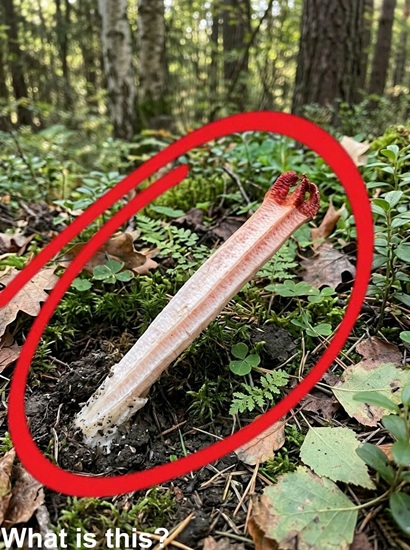
The father immediately notices the child’s reaction and looks ahead toward what has captured his attention. Near the base of a large tree, something unusual appears partially hidden among leaves and damp soil. From a distance, the object looks unfamiliar and slightly alarming. Several elongated red shapes seem to rise from the ground, creating an impression that is difficult to interpret without closer inspection or prior knowledge.
The unusual appearance naturally triggers concern in both father and son. In quiet forest settings, unfamiliar shapes can easily appear more threatening due to shadows, texture, and the surrounding silence of the environment. As they carefully observe from a safer distance, the structure appears more organic than artificial. Its form suggests a natural growth rather than anything mechanical or animal-related, though it still looks strange and unsettling.
The father, still cautious, considers whether the object could be something dangerous or related to wildlife. In unfamiliar environments, it is common for people to misinterpret rare natural organisms as hazards. After a moment, curiosity replaces initial fear, and the father uses a smartphone to gather more information. Descriptions of similar red, finger-like forest fungi begin to appear in search results.
What they are observing is identified as a type of fungus known as Clathrus archeri, commonly called “devil’s fingers” or “octopus stinkhorn.” It is found in certain woodland environments around the world. This fungus grows naturally on decaying organic matter such as dead wood, leaves, and nutrient-rich soil. It plays an important ecological role in breaking down organic material and recycling nutrients in forest ecosystems.
Its life cycle begins as a small, egg-like structure partially buried in the ground. At this early stage, it does not resemble its final form and remains mostly unnoticed in the forest floor. As it matures, the outer layer splits open, revealing several elongated structures that expand outward. These finger-like arms often develop a bright red coloration, making them visually striking against green and brown surroundings.
The surface of these structures is covered with a sticky, dark substance known as gleba. This material contains spores, which are essential for the fungus’s reproductive process and long-term survival. One of the most notable features of this fungus is its strong odor. The smell is often compared to decaying organic matter, which can be unpleasant but serves a very specific biological purpose.
The odor attracts insects such as flies, which are drawn to the scent and land on the fungus. As they move away, they unintentionally carry spores to new locations, helping the organism reproduce. Although its appearance may seem disturbing at first glance, Clathrus archeri is completely harmless to humans and animals. It does not produce toxins that affect people through contact or proximity.
Encounters like this highlight how easily unfamiliar natural organisms can be misinterpreted. In dense forest environments, many species have evolved unusual appearances that serve survival rather than aesthetic purposes. Without prior knowledge, bright colors, unusual shapes, and strong smells can trigger fear or confusion. However, these traits often play essential roles in reproduction, protection, or ecological interaction.
In this case, the fungus’s resemblance to something unnatural is purely coincidental. Its appearance is a result of evolutionary adaptation aimed at maximizing spore dispersal efficiency in forest habitats. Once the explanation becomes clear, initial fear often transforms into curiosity and appreciation. Observers begin to understand how complex and diverse forest life truly is beneath the surface.
The father and son, now reassured, observe the fungus more closely from a safe distance. What once seemed disturbing becomes an interesting example of nature’s ability to create unusual biological forms. This moment turns into an informal learning experience, where curiosity replaces misunderstanding. The forest reveals itself as a place filled with hidden ecological processes and interconnected life cycles.
Continuing their walk, the surrounding environment feels slightly different. Awareness of natural details increases, and both begin noticing smaller organisms that were previously overlooked. Such experiences often encourage greater respect for biodiversity and natural systems. Forests are not only landscapes of beauty but also complex environments filled with decomposition, regeneration, and adaptation.
Fungi like Clathrus archeri demonstrate how life can thrive in unexpected ways. Even decaying material becomes part of a continuous cycle that supports new growth and ecological balance. Understanding these processes helps reduce unnecessary fear when encountering unknown natural forms. Knowledge transforms uncertainty into appreciation for biological diversity and evolutionary creativity.
As the hike continues, the forest gradually returns to its peaceful rhythm. The earlier moment remains in memory as a brief encounter with something unusual but entirely natural. Ultimately, the experience serves as a reminder that nature often appears mysterious at first glance. With understanding, what seems strange or alarming can reveal itself as an important part of the ecosystem.
