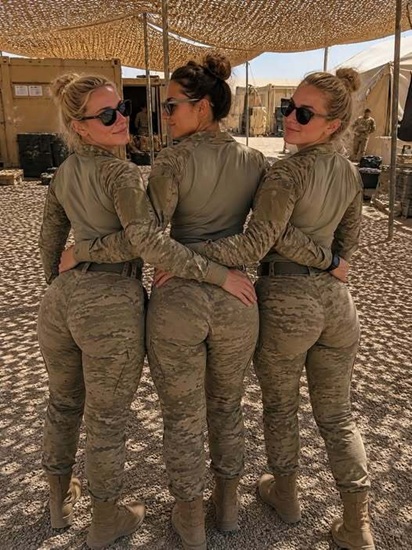
Three young women—Ava, Camila, and Brooke—have recently drawn online attention after appearing together in uniform, which led to widespread discussion shaped more by perception and assumption than by verified understanding of their actual experiences and responsibilities. From an external viewpoint, many viewers focused primarily on their appearance in photographs, interpreting confidence, posture, and presentation as indicators of personality or capability.
These impressions, however, often overlook the context behind structured professional environments. Their story highlights a broader issue frequently seen in public discourse: how quickly visual impressions can lead to assumptions about competence, seriousness, or capability, especially when individuals are seen in uniformed roles or disciplined settings.
In reality, environments that require uniformed service or structured professional training are defined by strict expectations, continuous evaluation, and high levels of physical and mental discipline that are not visible in public images. Daily routines in such settings typically involve repetition, structured schedules, physical conditioning, and ongoing skill development. These elements are designed to ensure readiness, consistency, and teamwork under pressure.
Ava, Camila, and Brooke are often described as sharing a close friendship, which, according to general observations about group dynamics, can play an important role in maintaining morale during demanding and repetitive training periods. Friendship and familiarity within a team can provide emotional stability in environments where individuals are frequently challenged to perform under stress, fatigue, and time constraints.
Many people outside these professions tend to underestimate the intensity of training involved, as images shared publicly rarely capture the full scope of preparation, correction, and evaluation that occurs behind the scenes. Their experience also reflects a common dynamic in professional environments where appearance is often the first point of judgment, particularly when individuals are seen in structured attire or uniform roles.
Public commentary in such cases can vary widely, ranging from admiration to skepticism, often focusing on perceived traits rather than verified performance or professional evaluation.
This creates a recurring pattern where individuals are assessed visually before their actual responsibilities, skills, or contributions are fully understood or acknowledged. In many structured professions, however, evaluation is based on consistency, reliability, teamwork, and the ability to perform effectively under pressure rather than outward appearance.
Training environments typically emphasize repetition and gradual improvement, requiring individuals to develop discipline over time rather than relying on natural ability alone. Mental resilience is a key component in such settings, as participants must remain focused and composed even during physically demanding or stressful situations.
Over time, trust within a team becomes essential. Individuals learn to rely on one another to complete tasks efficiently and safely, particularly in situations where coordination and timing are critical. Observers outside these environments may interpret isolated moments or images without understanding the broader context of preparation and sustained effort required to reach those points.
This gap between perception and reality often leads to simplified narratives that do not accurately reflect the complexity of professional development or training processes. For Ava, Camila, and Brooke, their shared experience represents both personal growth and collective endurance, shaped by repeated challenges and continuous adaptation to structured demands.
Their story also reflects a broader cultural conversation about how women in visible or disciplined roles are perceived, particularly when public attention focuses more on appearance than achievement. In many cases, confidence displayed in professional settings is misinterpreted, while discipline and dedication are not always immediately recognized by outside observers.
Similarly, strong presentation or composure may be incorrectly associated with superficial qualities rather than the result of training, experience, and effort. Despite these external perceptions, real validation within such environments typically comes from performance-based assessment, teamwork, and the ability to meet established standards consistently.
Instructors, supervisors, and peers tend to evaluate individuals based on reliability, improvement over time, and contribution to overall group success rather than external impressions. As training progresses, initial perceptions become less relevant compared to demonstrated capability and sustained commitment under structured conditions.
Ultimately, their story illustrates how easily surface-level impressions can shape public opinion, while the deeper reality is defined by discipline, repetition, and perseverance. It also reinforces a broader understanding that true professional identity is built gradually through consistent effort, resilience, and the ability to perform when conditions become challenging.
While appearance may influence first impressions, long-term respect and recognition are typically earned through reliability, teamwork, and measurable performance over time.
