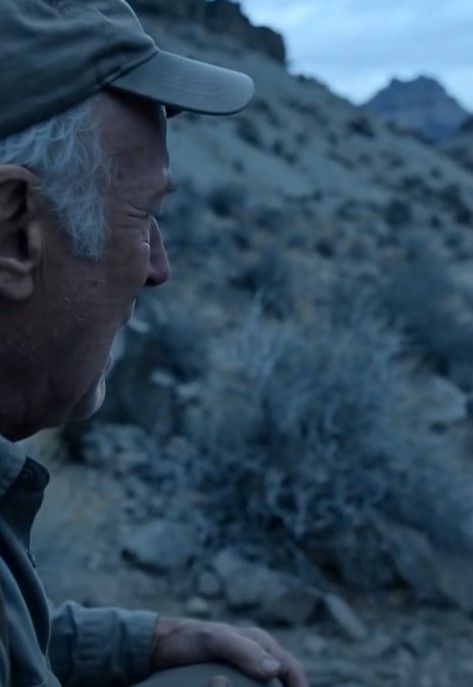
Richard had spent most of his life studying the vast and unforgiving landscapes of the American Southwest, but nothing in his decades of geological work prepared him for the emotional silence left behind by a missing dog. At sixty-eight, the retired geologist lived alone in a remote cabin on the edge of Arizona’s desert terrain. His life was quiet, structured, and defined by isolation, until a rescue dog named Jess entered it unexpectedly. Jess was a large gray mixed-breed dog with visible scars across his muzzle, suggesting a difficult past filled with neglect, fear, or survival on the streets before arriving at the shelter.
When Richard first brought Jess home, the dog was extremely withdrawn. He avoided eye contact, retreated from sudden movements, and reacted nervously to even gentle attempts at human interaction or affection. For several months, Jess maintained distance inside the cabin. He chose corners over comfort, silence over engagement, and often observed Richard from afar without fully trusting his presence. Richard understood that healing could not be forced. He adjusted his behavior, moving slowly, speaking softly, and allowing Jess to set the pace for any form of connection or trust.
He often sat quietly on the floor near the fireplace, reading or working, simply allowing Jess to exist in the same space without pressure or expectation of interaction. The cabin gradually became a shared space rather than a divided one. Jess slowly began to observe Richard more closely, responding less to fear and more to curiosity over time. One stormy night in late November, heavy thunder rolled across the canyon walls, echoing through the narrow valleys and shaking the wooden structure of the isolated cabin.
Jess, terrified by the sudden noise, trembled inside his crate. His breathing became rapid, and his body pressed tightly against the back wall as the storm intensified outside. Richard approached slowly and sat nearby without opening the crate or forcing contact. He simply remained present, offering calm stability during the overwhelming noise of the storm. After a long and quiet hour, Jess finally gathered enough courage to step forward. He moved cautiously, then rested his head gently into Richard’s open hand for the first time.
That single moment marked a turning point in their relationship. It was not dramatic or loud, but it represented the beginning of trust after months of emotional distance and fear. Jess had chosen safety. He had chosen connection. For Richard, it was a moment that felt more significant than any professional achievement in his entire life. Two weeks later, that fragile sense of stability was broken when Jess disappeared without warning, leaving only confusion and fear behind inside the quiet desert home.
Richard first noticed something was wrong when the back yard felt unusually empty. There was no sound of movement, no presence waiting at the door, and no familiar shadow near the fence line. Outside, he discovered a small gap beneath the wooden fence, partially widened by shifting ground and desert erosion, creating an unexpected escape route for a frightened animal. Nearby, Jess’s collar was caught on dry brush, torn slightly and partially buried in sand, suggesting he had passed through the area in a sudden and uncontrolled movement.
There were no clear pawprints leading away, only faint traces disrupted by wind and shifting terrain, making it impossible to determine direction or distance. Without hesitation, Richard prepared supplies. He packed water, food, medical items, a flashlight, and Jess’s favorite treats wrapped inside an old flannel shirt that carried his scent.
His son Mike strongly urged caution, reminding him of the harsh desert conditions and the dangers of searching alone in such a remote and unforgiving environment. Richard promised regular communication, though coverage in the region was unreliable. Within hours, he stepped into the open desert, beginning a search that would extend far beyond expectation.
At first, he stayed close to the cabin, inspecting dry creek beds, rocky ridges, shaded rock formations, and any place where a scared dog might seek shelter.
Each morning began before sunrise, when temperatures were still manageable. Each evening ended with exhaustion, dehydration, and the growing uncertainty of whether Jess was still alive. As days turned into weeks, Richard expanded his search deeper into canyon systems, where terrain became more unstable, temperatures more extreme, and silence more overwhelming. He occasionally discovered animal tracks, but they belonged to coyotes, foxes, or mountain lions, reinforcing the danger faced by a domestic dog lost in the wilderness.
On the fiftieth day, while navigating a narrow sandstone ledge, the ground beneath Richard suddenly gave way, causing him to fall into a lower section of the canyon.
He landed heavily, injuring his knee and briefly losing orientation. The remote location offered no cellular signal, and no immediate assistance was available. For a moment, he considered the possibility that the search might end there, trapped in isolation without rescue or direction back to safety. But then he remembered Jess. Reaching into his pack, he touched the flannel shirt and treats, grounding himself in the purpose that kept him moving forward.
Using a broken branch, he created a crude splint and slowly forced himself to stand. Pain remained constant, but determination outweighed physical limitation. Despite the injury, Richard continued moving, refusing to abandon the search while there remained even the smallest chance of finding Jess alive. Weeks later, in northern canyon territory, he encountered an elderly shepherd who reported seeing a gray dog moving cautiously through high rocky terrain. The shepherd described the animal as thin, alert, and highly cautious, behaving less like a domestic pet and more like a creature adapting to survival in the wild.
Richard understood what that meant. Jess had likely begun to adapt to the environment, surviving independently, but potentially becoming more distant and difficult to approach.
Despite the warning, Richard continued the search, convinced that recognition and familiarity might still exist beneath the layers of fear and survival instinct. On the one hundred and thirteenth day, while moving through a dry wash surrounded by boulders and sand, Richard noticed subtle movement near the base of a rock formation. He called out softly, his voice strained from exhaustion and time spent in isolation. The movement paused, and a gray figure slowly lifted its head.
Jess appeared, but he was changed. His body was thin, covered in burrs, and marked with scratches from long exposure to harsh terrain and survival conditions. There was no immediate recognition in his eyes. Instead, caution and distance remained, as if memory and familiarity had been buried beneath weeks of survival instinct. Richard did not move forward. He lowered himself carefully to the ground, reducing his presence, and avoided any sudden motion that might trigger fear or retreat.
He placed the flannel shirt and remaining treats on a nearby rock, allowing scent and familiarity to replace force or pressure in the fragile moment of reconnection.
Jess hesitated. He sniffed the air repeatedly, slowly processing the familiar scent that connected him to a life he had once known and briefly trusted. Gradually, his posture softened. His ears lifted slightly, and his body trembled as recognition began to override fear and uncertainty accumulated during his time alone. He moved forward slowly, step by step, until he finally reached Richard and rested his head against his chest in a moment of silent reunion.
Richard held him gently, overwhelmed by emotion, allowing relief and exhaustion to merge into a quiet moment of relief inside the harsh desert environment.
They could not return immediately. Jess was too weak to travel long distances, and Richard’s injured leg made extended movement extremely difficult and painful.
They sheltered in a small cave near a natural water basin, carefully rationing supplies and slowly rebuilding strength through patience and survival adaptation. Over several weeks, Richard made repeated journeys between the cabin and the shelter, gradually restoring Jess’s strength through consistent care and controlled movement. Eventually, after one hundred and fifty-eight days since the disappearance, they began the slow journey back home across the desert landscape.
When the cabin finally came into view, Jess hesitated briefly before stepping forward, recognizing the place but processing it through layers of survival memory.
He entered the cabin slowly, then walked directly to Richard’s chair and rested his head against him, signaling complete return and restored trust. In the months that followed, Jess regained strength and weight. His coat returned to its natural condition, though physical scars remained as evidence of survival. Richard’s injured leg healed partially but never fully recovered, becoming a lasting reminder of the physical cost of endurance and emotional commitment.
Each morning now begins quietly, with Jess resting nearby as sunlight enters the desert cabin, marking a return not only of the dog, but of stability itself. For Richard, the experience confirmed a simple truth shaped by time, distance, and hardship: connection, once formed through patience, can survive even the harshest environments.
