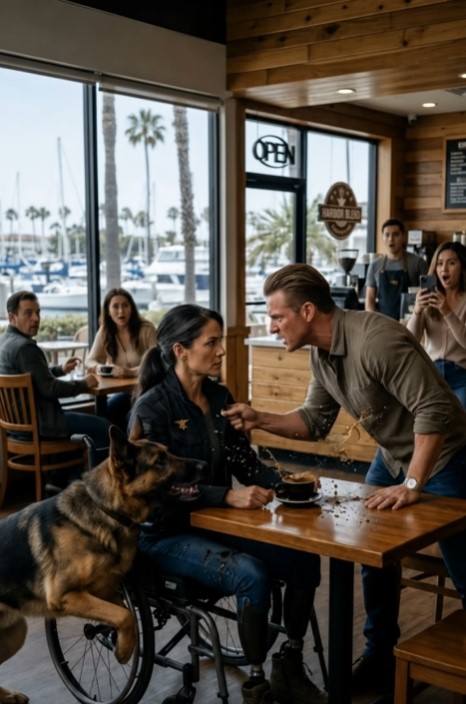
Mia Carter sat quietly near the window of a small neighborhood café, the soft hum of conversation and the scent of fresh coffee surrounding her like a familiar blanket. It was the kind of place where people came to think, to rest, or to escape the noise of the world for a little while. Beside her chair rested a folded wheelchair, and a service dog lay calmly at her feet, watching everything with quiet awareness. The café had always been a peaceful place for Mia, somewhere she could blend into the background without drawing attention.
She rarely asked for special treatment and preferred silence over conversation. Her presence was subtle, yet there was something dignified about the way she carried herself, even when people failed to notice it. That afternoon, the calm atmosphere was interrupted when a man entered with two friends, speaking loudly enough to draw attention from nearby tables. His name was Brandon, and he immediately fixated on Mia, noticing her wheelchair and the military-style insignia on her jacket.
His tone carried an unnecessary confidence, the kind that often comes from misunderstanding someone else’s story. He made a mocking remark about her dog and her condition, loud enough for others in the café to hear. Conversations around the room slowly faded as people became aware that something uncomfortable was unfolding. Mia did not respond immediately. Instead, she looked up calmly, as though measuring the situation rather than reacting to it.
Her response was short and controlled. She asked him to leave her alone. However, Brandon seemed encouraged rather than discouraged by her calmness. He continued speaking, now focusing on the medal pinned to her jacket, questioning its authenticity with sarcastic remarks that made his friends laugh.
Mia remained still, her expression unchanged. The service dog at her feet shifted slightly, sensing the tension in the air, but a gentle hand from Mia brought it back to calm. Her silence, rather than stopping the situation, seemed to embolden the man further.
The situation escalated when Brandon suddenly knocked her coffee cup from the table. The hot liquid spilled across the surface and onto her clothing, drawing gasps from nearby customers. The sound of the cup hitting the floor echoed through the café, leaving an uncomfortable silence in its wake.
At that moment, something shifted in the room. People stopped pretending not to notice. A few reached for their phones, uncertain whether to intervene or simply document what was happening. Mia, however, did not react with anger. She simply looked at the spilled coffee and remained seated, her composure unbroken.
Brandon then reached toward her jacket and grabbed the military badge attached to it. His words were dismissive, suggesting she had not earned it. The comment hung in the air longer than the action itself, making the atmosphere in the café feel heavier and more serious.
Near the counter, another customer who had been quietly observing the situation slowly turned his head. His expression changed as he recognized the insignia more clearly. Unlike the others, he understood what it represented. Years earlier, he had served in the military and had crossed paths with individuals like Mia during operations overseas.
He recognized not just the badge, but the weight behind it. Without drawing attention to himself, he stepped outside and made a phone call. His voice was steady, but firm, as he simply said that a situation was unfolding and that assistance might be needed.
Within a short time, the atmosphere outside the café began to change. Several vehicles arrived quietly, not with urgency or noise, but with precision. The people inside the café noticed movement outside the windows before the doors opened. A group of disciplined individuals entered, scanning the room calmly before focusing their attention on Mia.
There was no aggression in their movements, only recognition and respect. They approached her first, confirming her well-being. One of them offered a quiet apology for what had happened, while others observed the situation in silence. The contrast between their composed presence and the earlier behavior in the café was immediately noticeable.
Brandon’s confidence began to fade as he realized the shift in energy. The people who had laughed with him earlier now avoided eye contact. The room felt smaller, quieter, and heavier than before. The consequences of his actions were no longer abstract—they were present in the form of people who clearly understood who Mia was.
One of the visitors finally spoke, explaining in calm but firm language that Mia had served in military operations where she had risked her life to save others. Her injuries, her presence, and even the insignia on her jacket were part of a history that demanded respect rather than ridicule.
The explanation changed the atmosphere completely. The café, once filled with tension caused by mockery, now carried a different kind of silence—one of realization and discomfort. Brandon attempted to respond, but his words lacked confidence. The situation he had controlled moments earlier was now completely out of his hands.
Mia slowly rose from her seat, supported by her prosthetics, and adjusted her posture with quiet dignity. Her service dog immediately stood beside her, attentive and calm. She looked at Brandon for a moment, not with anger, but with a measured calm that carried more weight than any confrontation.
She spoke briefly, reminding everyone that strength is not measured by physical ability or appearance, but by character in moments when others are vulnerable. Her words were not loud, but they carried clearly through the silent café. No one interrupted her.
After speaking, she gathered her things and moved toward the exit. People instinctively stepped aside to let her pass. There was no applause, no dramatic reaction—only a quiet recognition of what had just taken place. The visitors who had arrived earlier followed her out, leaving the café in a stillness that lingered long after she had gone.
Inside, people remained seated, processing what they had witnessed. The realization settled slowly that the moment had not been about confrontation, but about misunderstanding and respect. The earlier laughter and mockery now felt distant and uncomfortable in memory.
Brandon stood in silence, no longer speaking or reacting. The weight of the situation had fully settled, leaving him with nothing to say. The café gradually returned to normal activity, but something had changed in the atmosphere. People were quieter, more reflective, and more aware of how quickly judgment can lead to consequences.
In the end, the moment remained in the memory of those who were present—not as a dramatic confrontation, but as a reminder of how easily people misinterpret what they do not understand, and how dignity often speaks more powerfully than anger ever could.
