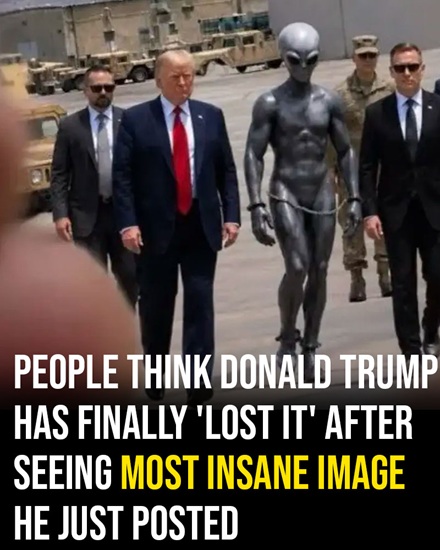
Reports circulating online on Monday night claimed that former President Donald Trump drew significant attention on social media after posting a series of AI-generated images featuring extraterrestrial themes and space-based military scenarios. The images were shared on his Truth Social account over a short period of time, with users noting a rapid succession of visually dramatic and science-fiction-style content. According to descriptions shared across social media platforms.
Trump posted approximately two dozen AI-generated images within just a few hours. Many of these visuals appeared to depict imaginative interpretations of outer space, alien encounters, and futuristic warfare. The posts quickly became a topic of discussion, with users debating both their meaning and their timing. One of the most widely discussed images reportedly showed Trump walking alongside what appeared to be an alien figure, while individuals resembling Secret Service agents followed behind him.
The image had a grainy, stylized appearance, and some observers noted that it resembled a staged or artificially constructed photograph rather than a real-life capture. This led to widespread online commentary and speculation. Another image shared during the same posting spree depicted a scenario labeled “Space Force.” In this visual, Trump was shown in orbit, surrounded by satellites, while appearing to oversee military actions directed toward Earth. The image included exaggerated visual elements such as explosions, missile trajectories, and large-scale destruction displayed on screens in front of him.

In the same set of AI-generated visuals, Trump was also portrayed seated in front of a large red button, with several military officials positioned nearby. According to descriptions shared online, the figures around him appeared significantly smaller in scale compared to the central image of the former president, creating a dramatic and symbolic composition.
The posts quickly sparked reactions across social media platforms, where users expressed a wide range of interpretations. Some individuals questioned the intent behind the images, suggesting they may have been designed to attract attention or shift public focus toward alternative topics. Others viewed the content as part of a broader trend of AI-generated political imagery increasingly circulating online.
At the same time, some supporters and observers interpreted the posts differently, suggesting that the images could be connected to renewed public interest in unidentified aerial phenomena, often referred to as UFOs or UAPs. This topic has received increased attention in recent years following government discussions and declassified materials related to unexplained aerial sightings.
The images were shared shortly after reports of newly released government materials concerning unidentified aerial phenomena, which have been the subject of public and congressional interest. These documents, according to official statements cited in media coverage, are part of ongoing efforts to increase transparency regarding unexplained observations reported by military and intelligence personnel.
Secretary of War Pete Hegseth, in comments reported by media outlets, stated that the department is working in alignment with the administration to provide greater transparency about government knowledge of unidentified anomalous phenomena. He emphasized that previously classified materials have contributed to public speculation and that releasing such information is intended to provide clarity.
According to the same reporting, officials described the release of declassified documents as part of a broader initiative aimed at increasing public access to historical and scientific records related to unidentified aerial sightings. However, the details and interpretations of these documents have continued to generate discussion and debate among researchers, journalists, and the general public.
Despite the official framing of the document release, critics on social media questioned whether the timing of the AI-generated images and the renewed UFO discussion was coincidental. Some users suggested that the content could be intended to redirect attention away from unrelated political controversies and ongoing national or international issues.
Among the online reactions, several posts claimed that the imagery served as a distraction from other topics being discussed in political circles. These comments circulated widely, reflecting the polarized nature of online political commentary and the speed at which interpretations can spread on social media platforms.
One user on X (formerly Twitter), as cited in online discussions, suggested that the situation was an attempt to shift focus away from ongoing controversies. Other users expressed similar opinions, arguing that the timing of the posts appeared connected to broader media narratives and public debates occurring at the same time.
However, other commentators emphasized that AI-generated content has become increasingly common in political and entertainment contexts, and that such imagery may not necessarily carry a specific political message. Instead, they suggested it could reflect broader trends in digital media, where artificial intelligence tools are frequently used to create attention-grabbing visuals.
As discussions continued, the posts remained widely shared and analyzed, with users dissecting the symbolism, tone, and possible intent behind each image. The combination of political figures, futuristic military themes, and extraterrestrial elements contributed to the viral nature of the content.
While interpretations varied widely, the incident highlighted the growing role of AI-generated media in shaping online political discourse. It also underscored how quickly such content can become a focal point for debate, speculation, and commentary across multiple platforms.
As of the time of reporting, no official statement from Trump’s representatives specifically clarifying the purpose of the images had been widely cited in the sources discussed online. The posts continue to circulate, with ongoing reactions from both supporters and critics.
The broader conversation surrounding the images reflects an increasingly complex media environment, where AI-generated visuals, political communication, and online speculation intersect. Whether viewed as satire, commentary, or attention-grabbing content, the posts have added another layer to ongoing discussions about technology and political messaging in the digital age.
