Leo stumbled through the door that evening covered in dried mud, his clothes stained and his face drawn with exhaustion, and I immediately knew something was wrong. He didn’t speak at first, and that silence felt heavier than anything I had ever seen him carry. It wasn’t just physical fatigue—it was as if the day itself had pressed down on him in ways he couldn’t yet explain. I asked him what happened, but he only looked away, still trying to process everything that had unfolded on the trail.
By the next morning, the school had already called. The principal’s voice on the phone was unusually tense, asking me to come in immediately without giving many details. That alone made my stomach tighten. As I drove toward the school, my mind filled with worst-case scenarios—disciplinary action, suspension, or something worse that could permanently damage my son’s record and emotional state. I had already been preparing myself for disappointment, for anger, and for the possibility that Leo had gone too far in trying to prove a point.
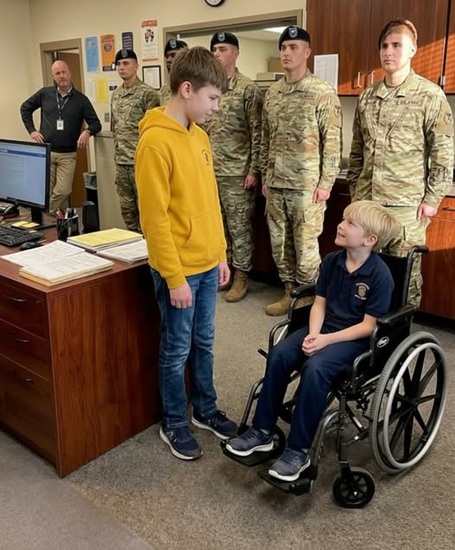
When I arrived at the administration building, I was surprised to see several uniformed military officers standing in a straight line inside the office. Their presence immediately changed the atmosphere of the room. This was no longer just a school matter. The principal looked pale and uneasy, as though she herself was still trying to understand why these men were there. I was told to wait, and the silence in the hallway felt unusually heavy, as if something significant was about to be revealed.
Moments later, Leo was brought into the room. He looked small, uncertain, and overwhelmed by the unfamiliar attention. His clothes still carried traces of the hike—faint dirt stains and scuffed fabric that told the story before he even spoke. I could see he was nervous, expecting punishment or disappointment. Instead, the tallest officer stepped forward. He was an older man with a firm posture, silver hair at his temples, and decorations on his uniform that suggested years of service.
The officer spoke calmly, addressing Leo directly. He mentioned the six-mile hike and what had been reported about how Leo had refused to leave his friend behind. The room became completely silent as he explained that the story had reached them through connections to Sam’s late father, a respected military figure who had served alongside some of the men present. For them, this was not just a school incident—it was something deeply connected to values they had carried throughout their lives in service.
Leo shifted uncomfortably, lowering his eyes as he tried to explain himself. In a quiet voice, he simply said that Sam was his best friend and that it didn’t feel right for him to be left behind. He didn’t describe it as heroic or extraordinary. To him, it was just something that needed to be done. He spoke about how he couldn’t accept the idea that his friend would miss out on something everyone else was experiencing, especially something as meaningful as reaching the top of the trail.
The officer listened carefully, then reached into his pocket. He pulled out a military patch—an insignia that represented service, loyalty, and endurance under difficult conditions. Without hesitation, he knelt slightly and pinned it onto Leo’s shirt. He told him that what he had done reflected a principle deeply valued in military life: never leaving a comrade behind. His voice softened as he added that such actions were rare, especially in someone so young.
He then mentioned Leo’s father, saying he would have understood exactly what that choice meant and would have been proud of him. Those words seemed to settle in the room in a way nothing else had. The teachers who had been ready to discipline Leo the day before now stood quietly in the corner, watching without interruption. The shift in perception was clear—what had once been seen as breaking rules was now being viewed through a completely different lens.
One by one, the officers stepped forward to shake Leo’s hand. Each gesture was simple, but carried a weight that even I could feel from where I stood. As I watched, I realized this wasn’t about praise or reward—it was about recognition of character. My son, who had been struggling quietly since losing his father, was being acknowledged for something that came naturally to him but was rare in the world around him.
That evening, when we returned home, the military patch sat on his desk catching the fading light from the window. Leo barely spoke, still trying to understand why everyone had reacted so strongly to what he saw as a simple decision. He didn’t see himself as brave or exceptional. He just saw a friend who needed help and chose not to turn away. But as I watched him sit there, I understood something I hadn’t fully seen before.
Strength, I realized, doesn’t always come from loud moments or clear intentions. Sometimes it comes quietly, in decisions made without hesitation, in loyalty that doesn’t ask for recognition. My son had not set out to be a hero, but in refusing to leave someone behind, he had shown me a kind of integrity that cannot be taught through rules or discipline. It is simply lived.
And in that quiet room, with the world finally recognizing what I had only begun to see, I understood that Leo was not defined by what he had endured, but by what he chose to carry forward.
