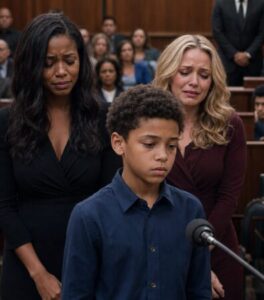
The courtroom was already heavy with emotion long before anyone spoke. It was one of those rare hearings where every seat was filled, yet silence felt louder than any argument. Two women stood on opposite sides of the room, both claiming to be the rightful mother of a young boy named Tommy. The air carried tension, not from anger alone, but from years of pain, separation, and unresolved questions finally colliding in one place.
Tommy stood near the center, close to the microphone, but he did not speak at first. His head remained lowered as the adults around him fought for a truth that felt increasingly complicated. To him, it was not just a legal dispute. It was his life being discussed as though he were not fully present in it. The confusion on his face reflected a burden no child should be expected to carry.
The first woman, visibly shaken, spoke through tears as she tried to explain her position. She insisted she was his biological mother, saying she had given birth to him and spent years searching for him after circumstances forced them apart. Her voice broke repeatedly, and she struggled to maintain composure, as though every word carried the weight of lost time and regret she could not undo.
The second woman responded with equal emotion, though in a quieter and more controlled manner. She explained that she had raised Tommy, cared for him through illness, comforted him during fear, and been present in every moment that shaped his daily life. Her argument was not based on biology but on lived experience, and she firmly believed that motherhood is defined by presence rather than genetics.
As both women spoke, the courtroom became increasingly tense. Attorneys attempted to maintain order, but emotion often interrupted logic. Spectators watched in silence, many visibly moved by the intensity of the situation. What was meant to be a legal determination had become something far more personal, where love and loss were being measured in competing forms.
Gradually, the background of the situation became clearer. Tommy’s biological mother had been very young when she made the difficult decision to give him up for adoption. She believed at the time that it was the only way to ensure he would have a stable future. The decision, though painful, was made under circumstances she felt she could not escape.
Tommy was eventually adopted into a home where he was raised with care and consistency. He grew up believing that his adoptive family was his only family, unaware that another life existed beyond what he knew. Over the years, his adoptive mother became the central figure in his upbringing, providing stability and emotional support through every stage of his childhood.
Meanwhile, the biological mother never stopped searching. Years passed with unanswered questions and emotional uncertainty. When she finally discovered Tommy’s whereabouts, legal proceedings began that brought both women into the same courtroom. What followed was not just a custody discussion, but a collision of two forms of motherhood, each rooted in different kinds of love.
As arguments continued, the judge eventually raised his hand for silence. The room immediately quieted. He looked directly at Tommy, recognizing that the most important voice in the room had not yet been heard. In a calm but serious tone, he asked the boy who he considered his mother.
The question hung in the air as every person in the courtroom waited for an answer. Tommy slowly lifted his head. His expression showed exhaustion rather than defiance, as though he had been carrying emotional weight far beyond his years. For several long seconds, he remained silent, looking first at one woman and then the other.
Finally, he spoke, but his answer was not what anyone expected. He said that he did not know how to choose. The words landed heavily in the room. One woman broke down immediately, overcome with emotion, while the other stood frozen, unable to respond. Even the judge appeared momentarily taken aback by the honesty of the response.
But Tommy continued speaking. His voice, though soft, carried clarity. He explained that both women kept talking about love, but neither had asked him how he felt. He said that all he had experienced throughout the process was conflict between two people he cared about, and that being placed in the middle of that conflict made him feel more like an object of dispute than a child.
He expressed that the constant arguing made him feel emotionally overwhelmed. He did not want to be a decision that forced one person to lose and another to win. Instead, he wanted the adults in his life to understand that his feelings mattered too, and that love should not require him to suffer in order for others to prove it.
As he finished speaking, the courtroom remained completely silent. The emotional impact of his words settled over everyone present. Both women appeared deeply affected, not by rejection alone, but by the realization that in their struggle to claim him, they had unintentionally ignored the emotional toll it was taking on him.
After a long pause, Tommy added something that shifted the atmosphere entirely. He said that he loved both women, but because of that, he could not choose between them. His statement was not spoken in anger, but in sadness, reflecting a desire for peace rather than division.
At that moment, something changed in the room. The conflict that had defined the hearing began to dissolve into understanding. The two women, who had previously been positioned as opponents, slowly began to see each other differently. The emotional weight of Tommy’s words forced them to reconsider not only their arguments, but the impact of their actions.
Following a break in proceedings, both women were given time to speak privately. When they returned, their approach had shifted. The adoptive mother expressed that Tommy’s stability and daily life should remain intact, emphasizing his existing home, school, and emotional environment. The biological mother, in turn, expressed a willingness to be part of his life without forcing separation or disruption.
Tommy listened quietly as the courtroom atmosphere softened. For the first time, he no longer appeared trapped between opposing sides. Instead, he seemed relieved that the conversation was moving toward understanding rather than competition. The tension that had filled the room earlier had been replaced by reflection.
By the end of the hearing, no dramatic ruling was needed to resolve everything emotionally. What changed the situation was not legal authority, but a child’s honest expression of what he was feeling. His words reminded everyone present that family is not defined solely by legal claims or biological connection, but also by emotional care and respect.
The courtroom eventually emptied, but the impact of what had occurred remained with those who witnessed it. It served as a reminder that decisions involving children require more than arguments between adults. They require listening, empathy, and recognition of the emotional world of the child at the center of the situation.
Tommy’s voice, though small in that courtroom, became the most powerful part of the entire hearing.
