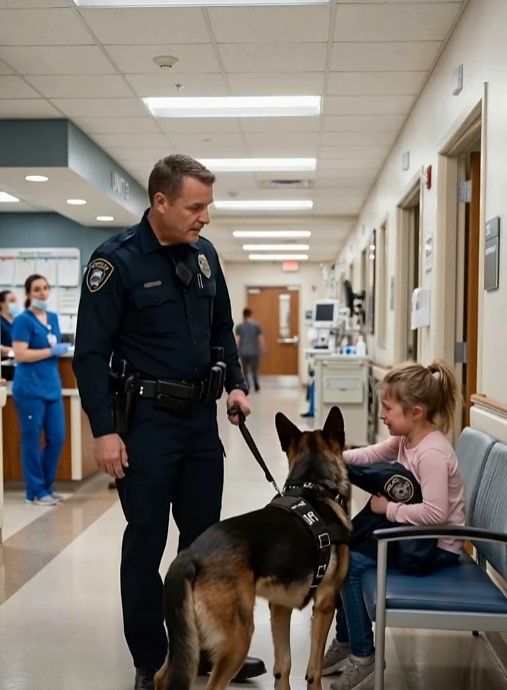
The story of Titan, Harper, and Officer Caleb Rhodes is one of those rare moments where ordinary hospital walls seemed to hold something far greater than medicine alone. It begins in a quiet pediatric corridor in Wichita, Kansas, where the sound of rain against glass mixed with the soft rhythm of distant monitors. Nothing about that afternoon suggested anything unusual was about to happen, yet life often changes direction in the smallest of moments.
Officer Daniel Mercer had walked those hospital hallways many times with his K9 partner, Titan. The German Shepherd was known for discipline, focus, and an almost uncanny ability to remain unaffected by emotional chaos. On most visits, Titan moved like a shadow beside his handler, calm and controlled, ignoring everything except command. But that day, something in the atmosphere felt different even before anyone understood why.
Titan stopped suddenly in the middle of the hallway. It was not hesitation—it was recognition. His ears lifted, his posture shifted, and his attention locked onto a small girl sitting alone on a bench near the end of the corridor. Harper looked fragile, curled inward as if trying to take up less space in a world that felt too large for her. She was holding a police jacket far too tightly for someone her size, as though it carried the only sense of safety she had left.
When Titan pulled forward, it was with urgency Daniel had never seen before. The dog was no longer following routine behavior; he was following something deeper, something instinctive. Nurses paused as he approached the child, unsure of what they were witnessing. Then Harper looked up, and everything changed. Her eyes filled with tears, and she whispered words that no one around her expected to hear: she recognized him.
The jacket she held belonged to Officer Caleb Rhodes, her father, who had been rushed into emergency surgery earlier that day after a serious accident during a storm response. The realization settled heavily across the hallway. Harper had been left waiting, surrounded by strangers, holding onto the one thing that still connected her to him. Titan’s reaction was immediate and gentle, as if he understood not just the object, but the meaning behind it.
Daniel knelt beside them, trying to piece together how a child so young had ended up alone in such an overwhelming place. Harper’s voice was soft but steady when she spoke, shaped by exhaustion and worry. She explained that her father had told her to wait, that everything would be okay, and that if Titan ever appeared, she would not be alone. Those words carried a weight that lingered in the air long after she finished speaking.
Inside the ICU, Caleb lay unconscious, his condition fragile but stable. Monitors blinked steadily as medical staff worked quietly around him. Outside that room, however, something equally important was unfolding—an emotional connection that no machine could measure. Titan remained close to Harper, refusing to leave her side, while Daniel watched in silence, realizing that this moment went beyond training, duty, or protocol.
When Harper was finally allowed into her father’s room, she held onto Titan as if he were part of the same lifeline that connected her to Caleb. The room itself felt suspended in time, filled with quiet tension and hope. Then Caleb’s fingers moved. It was a small motion, barely noticeable, but enough to shift everything. Harper’s breath caught as she called out to him, her voice breaking under the weight of relief and fear.
Caleb opened his eyes slowly, first seeing Titan, then his daughter. The faint smile that followed carried more meaning than words could express. In that moment, the distance between unconsciousness and awareness collapsed into something simple and human—recognition, love, and survival. Harper leaned closer, overwhelmed by emotion, while Titan rested calmly beside the bed as if confirming that his job was complete.
Over the following days, recovery became a shared experience. Harper visited daily, Titan often accompanying her, moving through the hospital like a quiet presence of comfort. Nurses began to recognize him not as an outsider, but as part of the healing environment itself. Patients responded to his presence with calmer expressions, and the pediatric wing slowly began to feel less heavy, less afraid.
What made the story resonate beyond the hospital walls was not a single dramatic event, but the accumulation of small, meaningful moments. A child who was no longer alone. A father who returned from the edge of danger. A dog who seemed to understand exactly where he was needed without being told. These details formed something larger than circumstance—they formed connection.
Months later, Harper returned to the same hallway where everything had begun. The bench by the window was still there, unchanged, as if waiting for memory to settle into it again. But Harper was different now. The fear that once defined that space had been replaced by understanding. She sat beside Titan, no longer holding onto her father’s jacket with the same desperation, because what she needed most was no longer missing.
Caleb watched them both and understood something quietly powerful. Strength was not only found in emergency response or physical endurance. It was found in presence, in staying when it would be easier to leave, in showing up even when words were not enough. Titan had done that instinctively, but so had Harper, and so had everyone who refused to let them face that moment alone.
In the end, the story was never just about a hospital visit or a medical recovery. It was about the invisible threads that hold people together during moments of uncertainty. It was about trust formed in silence, comfort offered without explanation, and the quiet truth that sometimes healing begins not with treatment, but with companionship that refuses to walk away.
