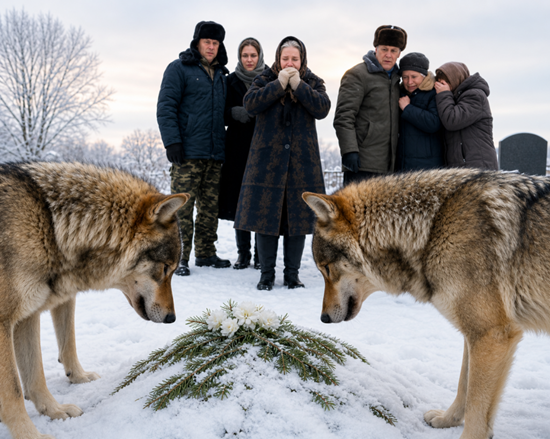
In the quiet rural settlement of Lesnaya Zavod, winter mornings often arrived in silence, broken only by the wind moving through frozen trees. The village was small, surrounded by dense forest that many residents respected but rarely entered without reason. Life there followed a steady rhythm shaped by nature, seasons, and tradition. It was a place where stories often blurred the line between reality and local legend. Among these stories, one tale has been passed down more than any other.
It is the story of a young girl named Alina Gromova and three wolves that once became part of her family’s life in an unexpected way. Alina was the daughter of Ivan Gromov, a local gamekeeper known for his deep understanding of the forest. Ivan spent much of his life maintaining balance between the village and the surrounding wildlife. Years earlier, he had encountered three wolf cubs after a harsh winter left them orphaned.
Rather than allowing them to perish, he made a difficult decision to intervene briefly, ensuring they survived their earliest vulnerable days. He never fully domesticated them, but he ensured they could return to the wild safely. Those cubs eventually grew into strong wolves, disappearing into the forest as nature intended. The villagers occasionally saw traces of the wolves over the years, but they rarely approached human settlements. Ivan named them North, Shadow, and Spark based on their behavior and markings.
North was the largest and most cautious, Shadow preferred distance and observation, and Spark showed nervous energy but deep awareness of surroundings. Though they lived freely, there remained an unusual familiarity between Ivan and the animals. It was not ownership, but rather a quiet understanding built on early survival and respect. The forest remained their true home, but their path occasionally crossed with human life.
Years later, Ivan and his wife Olga welcomed their daughter Alina into their lives after a long period of waiting and hope. Her birth was seen as a blessing in a family that had faced emotional challenges. Alina grew into a quiet, observant child who often spent time near the edge of the forest under careful supervision. She showed no fear of animals, and even in early childhood, she seemed to understand natural behavior in a way that surprised those around her. Animals rarely reacted aggressively toward her presence, which the villagers often found unusual but calming.
As she grew older, Alina developed a strong emotional connection with nature. She would sit quietly for long periods, observing birds, tracking footprints in the snow, and listening to the forest’s subtle sounds. Ivan noticed that she never forced interaction with animals but instead allowed them to approach her if they chose to. This gentle behavior seemed to create a sense of trust between her and the wildlife. Even wolves, which were typically cautious of humans, appeared to maintain distance rather than fear when they encountered her near forest edges.
However, during one particularly harsh winter, Alina became seriously ill. What began as a common respiratory infection quickly worsened due to limited medical access in the remote village. Despite efforts from local doctors and care from her family, her condition deteriorated rapidly. Eventually, medical professionals concluded that she had passed away during the night, leaving the family devastated. The loss deeply affected Ivan and Olga, and the entire village came together to support them during their grief. A small funeral was arranged, and Alina was laid to rest in the local cemetery under heavy snowfall.
The following morning, something unusual occurred that would later become the center of local legend. Three wolves were seen moving through the forest edge toward the cemetery. Villagers initially reacted with fear, as wolves rarely approached human burial grounds. However, what they observed was unexpected. The wolves did not behave aggressively or hunt-like. Instead, they moved with focused attention toward Alina’s grave, as if responding to something unseen or deeply familiar.
The largest wolf, identified by Ivan as North, began digging at the frozen ground. Shadow remained alert at a distance, watching the surroundings, while Spark moved anxiously around the site, repeatedly returning to the grave. Their behavior was persistent and unusually coordinated, drawing the attention of villagers who had gathered nearby. Ivan eventually approached, confused and unsettled by what he was witnessing. Something about the wolves’ actions did not resemble normal animal behavior driven by instinct or food.
As the wolves continued their efforts, a faint sound was reportedly heard beneath the frozen soil. At first, it was dismissed as imagination or environmental noise. But as the digging continued, the sound became clearer, prompting shock and confusion among those present. Ivan rushed forward and carefully began clearing the remaining soil. What they discovered defied their expectations: Alina was still alive, though in an extremely weak and unconscious state. She had not been fully confirmed deceased earlier, and her condition had resembled clinical death due to hypothermia and illness.
She was immediately removed from the grave and taken for urgent medical care. Olga collapsed in relief, while Ivan held his daughter tightly, overwhelmed by emotion. The wolves stepped back quietly, observing from a distance before slowly retreating into the forest. There was no aggression, no celebration—only silence. The event left the entire village in shock, struggling to understand how such a situation could have occurred and what role, if any, the wolves had played in it.
Medical professionals worked for days to stabilize Alina’s condition. Her recovery was slow but steady, and over time she regained strength. While doctors explained her survival through medical factors such as hypothermia slowing bodily functions, villagers continued to view the event through a more symbolic lens. Some believed the wolves had responded to her presence, while others saw it as a rare coincidence of timing and instinct. Regardless of interpretation, the event became deeply embedded in local memory.
As Alina grew older, she remained aware of the extraordinary circumstances surrounding her childhood experience. Rather than viewing it as something supernatural, she developed a strong interest in wildlife behavior and conservation. She later pursued studies related to animal ecology and environmental science. Her goal became understanding the natural world through research rather than mythology, while still respecting the emotional weight of her past experience.
Eventually, Alina returned to her village and established a small wildlife rehabilitation initiative. The project focused on caring for injured animals, educating local communities about forest ecosystems, and promoting coexistence between humans and wildlife. Her work became respected not only locally but also among visiting researchers interested in rural conservation practices. She often emphasized that nature should be understood through observation and respect rather than fear or romanticized interpretation.
The story of Alina and the three wolves gradually became part of local folklore, told during winter gatherings and passed down through generations. Near the cemetery, three pine trees were planted in memory of the unusual event that occurred that winter morning. Whether interpreted as coincidence, instinct, or symbolic connection, the story continued to shape how the villagers viewed the forest surrounding them. It reminded them that nature operates on principles far beyond human understanding.
Over time, the legend of the three wolves became less about mystery and more about perspective. It encouraged respect for wildlife and awareness of how closely human life is connected to the natural world. For the people of Lesnaya Zavod, it remained a story not of certainty, but of reflection. And in that reflection, they found meaning in the silence of the forest, where not everything is explained—but much is quietly understood.
