Law enforcement work often involves unpredictable situations where officers must rely on training, instinct, and quick decision-making. Police K9 units in particular are trained to detect unusual scents, alert handlers to concealed items, and assist in public safety operations. While the following story is not based on a confirmed real-world case, it is inspired by the type of scenarios that can occur during public safety assignments and community events where officers and service animals are present.
Officer Jack Thorne was a veteran law enforcement officer with many years of field experience. Over nearly two decades of service, he had participated in a wide range of assignments, from patrol duties to community safety operations. His trusted K9 partner, Bear, was highly trained in detection work and obedience under pressure. Together, they had developed a strong working bond built on discipline, communication, and mutual trust. Their assignments often included public demonstrations and safety presence at large gatherings.
On one particular Sunday morning, Jack and Bear were assigned to a community event at a large church known as Grace Covenant. The purpose of their presence was preventative and symbolic—offering reassurance to attendees and ensuring a visible security presence during a large public gathering. The church environment was calm, well-organized, and filled with families attending the service. Everything appeared normal, and there was no indication of any disruption or concern at the beginning of the event.
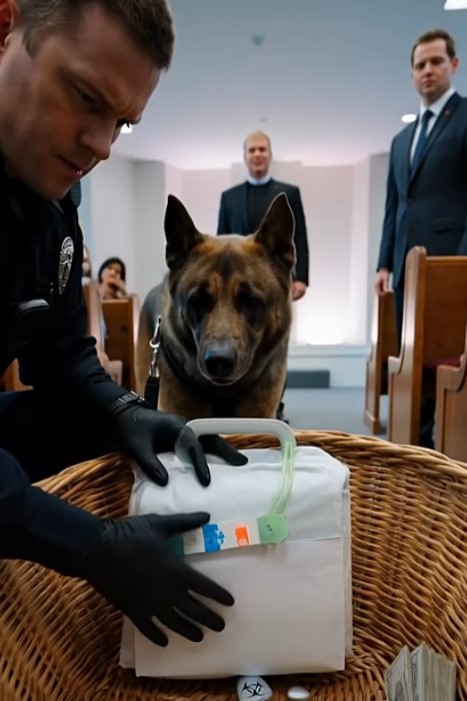
As the service progressed, Bear initially remained calm and focused, as expected from a trained service dog. However, at a certain moment, his behavior changed noticeably. His posture became tense, and his attention shifted toward one of the donation baskets being carried through the aisle. In trained K9 units, sudden behavioral changes are taken seriously, as they can indicate detection of unfamiliar or concerning stimuli.
Despite Jack’s verbal commands to remain calm and focused, Bear continued to show unusual behavior. He pulled toward the basket with increasing intensity, something that was highly out of character for him. This moment immediately drew Jack’s attention, as K9 handlers are trained to recognize when their partner is responding to something specific in the environment. The nearby ushers also noticed the interaction, creating a sense of confusion and concern among those present.
Jack stepped forward and requested space around the basket to assess the situation more clearly. Following standard procedure, he carefully examined the contents of the donation container. At first glance, it appeared to contain routine items such as envelopes and contributions from attendees. However, after further inspection, Jack identified something unusual hidden beneath the visible contents, prompting an immediate escalation of concern.
Inside the concealed area of the basket was a very young child who appeared to require urgent attention. The discovery was unexpected and required immediate action. Jack quickly removed the child from the basket and called for emergency medical assistance. His training in crisis response took priority, ensuring that the child received care as quickly as possible. Bear remained close, maintaining a protective and alert posture throughout the situation.
While assessing the scene further, Jack discovered a sealed envelope placed beneath the concealed area. The envelope contained markings associated with a local administrative office, though its purpose was unclear at the time. This discovery raised additional questions about how the child came to be in that situation and whether external involvement or oversight issues were present.
The atmosphere inside the building shifted rapidly as word of the discovery spread. Church officials attempted to manage the situation and maintain order, but the priority remained the safety of the child. Jack insisted that medical personnel be allowed immediate access, while communication attempts outside the building encountered delays due to network congestion and structural interference.
During this critical period, Jack reviewed the contents of the envelope more closely. Inside were documents and a digital storage device containing additional information. Although the full content was not immediately analyzed, the materials suggested that the situation involved circumstances requiring formal investigation. In law enforcement practice, such findings are typically preserved for evidence and transferred to appropriate authorities for review.
Recognizing the urgency, Jack moved to a secure area within the building where communication systems were available. He began the process of securing and transferring the digital data to ensure it would not be lost or altered. This step is consistent with standard evidence handling procedures in active situations where time-sensitive information must be preserved for investigative use.
Shortly after the initial response, emergency medical teams and law enforcement units arrived at the location. The scene was secured, and control was transferred to responding agencies. The child was transported to receive medical care, where trained professionals took over treatment and assessment. Authorities began the process of reviewing all available materials to determine the nature of the incident and whether further investigation was required.
As part of standard procedure, the collected data was examined by investigative teams. In scenarios involving vulnerable individuals, law enforcement agencies typically work to identify all relevant parties and determine whether any violations of law or policy occurred. While details of such investigations are often confidential, the focus remains on safeguarding those involved and ensuring proper legal review.
The K9 unit’s involvement highlighted the importance of trained detection animals in public safety operations. While Bear’s behavior in this scenario was fictionalized, real working dogs are often capable of detecting subtle environmental changes that humans may not immediately notice. Their role in supporting officers can be critical in both preventive and emergency situations.
Following the resolution of the immediate situation, Jack and Bear returned to standard duty assignments. Over time, Jack transitioned toward a less active role in law enforcement, focusing on administrative or community-based responsibilities. Bear remained a trusted partner throughout his service life, continuing to represent the importance of K9 units in public safety operations.
In this narrative, the child involved received appropriate care and support following the incident, reflecting the priority placed on safety and recovery in emergency response systems. While fictional in structure, the scenario emphasizes how quickly situations can evolve and how critical decision-making is in law enforcement environments.
Ultimately, the story serves as a reflection on awareness, training, and response under pressure. It highlights how observation, instinct, and professional discipline can play a role in identifying and addressing unexpected situations. Although not based on a confirmed real-world case, it draws from realistic principles of policing, K9 operations, and emergency response coordination.
