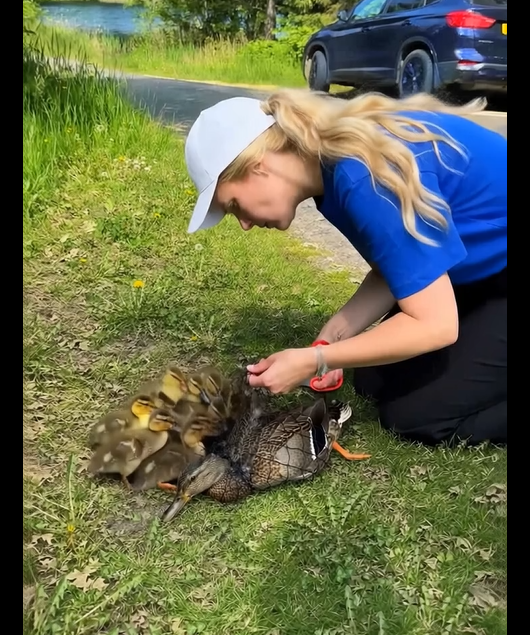
A quiet roadside scene turned into a remarkable moment of kindness when a woman stopped her vehicle after noticing a duck lying on the grassy edge of a road.
The adult bird appeared unable to move freely, with a large section of dark netting tangled around its legs and lower body. Just a short distance away, several small ducklings had gathered together, remaining close to the adult duck.
The unusual sight immediately drew attention to the situation, particularly because the birds were so close to a road where passing vehicles could create an additional danger. Rather than continuing her journey, the woman decided to approach carefully and see whether she could help.
The scene takes place beside a peaceful-looking body of water, with trees and green vegetation surrounding the roadside. At first glance, the setting appears calm and undisturbed, but the situation involving the birds tells a different story.
The adult duck is lying on the ground near the edge of the pavement, while the ducklings remain clustered together in the nearby grass. Their close proximity to the larger bird makes the situation especially concerning to watch.
Although the exact circumstances that brought the duck into contact with the net are not established in the footage, the tangled material is clearly visible and appears to restrict the bird’s movement.
As the woman approaches, the ducklings remain close to one another, with some moving around and reacting to the activity taking place nearby. Their attention appears focused on the adult duck, and they do not wander far from the area. For anyone watching the footage, this is one of the most noticeable details of the encounter.
The young birds are small and vulnerable, and their presence makes the situation even more delicate. The woman seems aware that she needs to handle the situation carefully, avoiding unnecessary movements that could frighten the animals or cause further difficulty.
Before beginning the rescue attempt, the woman gets down beside the birds to examine the situation more closely. She does not immediately pull at the netting or attempt to move the duck roughly. Instead, she takes a moment to assess where the material is caught and how it can be removed.
This is an important detail because tangled netting can sometimes hold an animal tightly, making sudden movements potentially harmful. The woman then prepares a pair of scissors, positioning herself near the trapped bird so she can work on the material more carefully.
The dark netting appears to be wrapped around the duck’s legs, with several sections extending across the ground beside its body. Removing something tangled around an animal requires patience, particularly when the material is caught near its feet.
The woman carefully begins cutting through the net, focusing on the sections that are restricting the bird. Throughout this process, the ducklings remain nearby, occasionally shifting their positions but continuing to stay together. The woman keeps her attention on the task, working to separate the bird from the material without making unnecessary movements.
As the cutting continues, more of the netting becomes detached from the duck. The woman gradually lifts the loosened material away, revealing the bird’s legs and orange feet more clearly.
The large piece of netting is eventually removed from around the duck, allowing it to lie without the same visible obstruction. This moment marks an important change in the situation.
What initially appeared to be a difficult entanglement is now being addressed through a careful and practical intervention. The discarded net is moved away from the animal, reducing the immediate risk of it becoming tangled again.
Once the netting has been removed, the woman remains beside the duck rather than immediately leaving the scene. She continues observing the bird and its young ones, seemingly checking how they respond after the material has been taken away.
The adult duck is still on the ground at this stage, so the woman does not simply assume that everything is fine. She stays close and gives the animal an opportunity to move on its own. The ducklings remain gathered around the same area, creating a touching picture of a group of young birds staying close to the adult.
A particularly encouraging moment comes when the woman gently supports the adult duck. After the net has been removed, the bird begins moving and eventually gets back onto its feet. Its movement changes the atmosphere of the entire encounter.
Instead of remaining motionless on the roadside, the duck is now able to stand and move again. The woman stays close, allowing the bird to regain its balance while avoiding unnecessary interference. Although the footage does not provide a veterinary assessment of the animal, seeing it stand after the net has been removed is a positive development.
The ducklings are also visible moving around the adult bird as the situation begins to settle. They continue staying close, and their movements suggest that the group is no longer in exactly the same position as when the woman first arrived. The adult duck’s ability to stand makes it possible for the group to move more naturally. For viewers, this part of the footage provides a welcome change after the uncertainty of the opening moments. The scene also highlights how a seemingly small piece of discarded material can become a serious obstacle for wildlife when it is left in an unsuitable place.
However, the woman’s assistance does not end with removing the net. She remains beside the birds and brings out a bottle of water, using it during the interaction near the ducklings. She also appears to offer the young birds some food, placing it on the ground where they can approach it. The ducklings gather around the food, moving closer as the woman watches them. Her actions show that she is taking time to observe the group after dealing with the immediate problem. Rather than rushing away as soon as the net is removed, she stays for a little longer.
The feeding scene provides another memorable part of the encounter. Several ducklings gather close together, with their attention directed toward the food placed on the ground. The woman remains crouched beside them, keeping her movements gentle and allowing the birds to approach at their own pace. The adult duck is also nearby, and the group appears more settled than it did at the beginning of the video. The contrast between the opening scene and these final moments is noticeable. What began with a bird caught in a net ends with the adult duck standing and the young birds gathered around it.
There is also a wider lesson in the presence of the discarded netting. Materials such as fishing nets, plastic lines, and other loose objects can create hazards for birds and other wildlife when they are abandoned outdoors. Animals may become caught in them while moving through grass, water, or areas close to human activity. Even when such objects seem harmless after being discarded, they can continue to pose a danger long after their original use has ended. The incident shown in the video serves as a reminder that properly disposing of waste is an important part of protecting the natural environment.
Roadside areas can be particularly challenging for wildlife because they combine natural habitats with regular human activity. Birds may move between nearby water, grass, and open ground without understanding the risks created by passing vehicles or discarded objects. In this particular scene, the duck and its young ones are positioned close to the road, making the woman’s decision to stop and assess the situation especially significant. Her actions demonstrate the value of paying attention to animals encountered during everyday journeys, while also reminding viewers that safety should remain a priority when approaching wildlife near traffic.
It is equally important to remember that helping a wild animal should be done with care. An animal that appears trapped or injured may require professional assistance, and handling it incorrectly can sometimes make the situation worse. Contacting a wildlife rescue organization or a qualified animal professional is often the safest option, especially when there are signs of serious injury. In the footage, the woman uses scissors to remove the visible netting and remains nearby as the duck begins moving again. The video does not show a professional medical examination, so the bird’s complete condition cannot be determined from these images alone.
The presence of the ducklings adds an emotional dimension to the encounter, but it is also a reminder of why wildlife situations deserve thoughtful attention. Young birds often remain close to adult members of their group, and disturbances can affect the entire group. In this case, the ducklings are repeatedly seen gathered beside the adult duck, both before and after the net is removed. Their continued presence makes the final moments particularly memorable, as the adult bird is once again standing near them. It is a simple scene, but one that highlights the importance of treating animals with patience and respect.
For the woman, stopping along the road meant taking a few extra minutes to respond to a situation that might otherwise have gone unnoticed. She could have continued driving, but instead chose to investigate and attempt to remove the material restricting the duck. Her careful approach, the use of scissors, and the decision to remain beside the birds afterward all form part of the encounter captured on camera. The footage does not establish what happened before she arrived or what the birds did after the recording ended, but it clearly documents the assistance she provided during those moments.
The most encouraging image comes near the end, when the adult duck is back on its feet and the ducklings are gathered nearby. The woman continues to observe them, offering food as the young birds move around her. The scene provides a welcome conclusion to an encounter that began with an animal lying beside a busy-looking roadside area and tangled in netting. Although there is no information confirming the duck’s condition after the recording, its visible movement represents a positive change within the footage.
Beyond the individual encounter, the video offers a useful reminder about the responsibility people share in keeping outdoor spaces safe for animals. Picking up discarded fishing equipment, securing waste, and reporting dangerous materials can help reduce preventable risks to wildlife. Small actions may seem insignificant, but removing hazardous objects from natural surroundings can make a meaningful difference. The incident also illustrates how awareness and a willingness to help can turn an ordinary journey into an opportunity to assist an animal in difficulty.
Ultimately, this roadside encounter is a reminder that compassion does not always require a grand gesture. Sometimes it begins with noticing something unusual, stopping safely, and taking a moment to understand what is happening. The woman in the video chose to help a duck caught in a net while several ducklings remained close by. She carefully removed the visible material, stayed with the birds, and offered them food before the recording ended. It is a memorable example of a small act of kindness and a timely reminder that protecting wildlife also begins with paying attention to the world around us.
