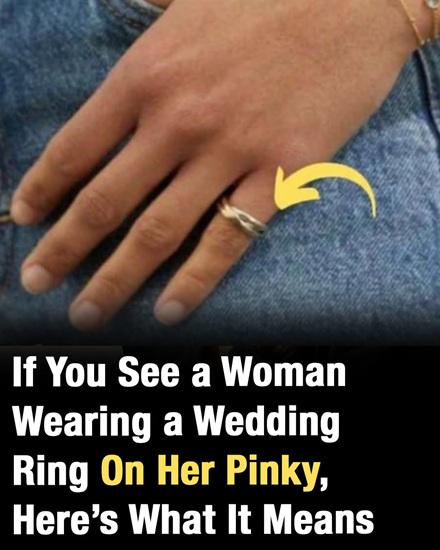
A ring worn on a particular finger can sometimes communicate something before a person says a single word. Wedding and engagement rings are the most familiar examples, although customs surrounding them vary between countries, cultures and individuals. Pinky rings have a much less universal meaning. They have appeared throughout history as fashion accessories, family or professional symbols and expressions of personal identity. More recently, one jewelry campaign gave the pinky ring another interpretation: a reminder of self-love and commitment to oneself.
It is important to begin with a qualification. Seeing someone wearing a ring on their little finger does not reveal their relationship status, personality or beliefs. Many people wear pinky rings simply because they like the appearance. Others may have inherited the jewelry, chosen the finger because the ring fits there, or attached a completely different personal meaning to it. There is no universal modern rule stating that every woman wearing a pinky ring is participating in a self-love movement.
The particular interpretation that attracted widespread online attention is associated with Fred + Far, a jewelry project founded by Melody Godfred and Dina Nur Satti. Godfred developed what became known as the Self Love Pinky Ring, presenting the jewelry as a symbol of choosing and valuing oneself. The idea emerged during a period when Godfred felt she needed to reconnect with her own identity rather than defining herself exclusively through responsibilities and relationships.
Godfred deliberately selected the pinky because it was not a finger on which she normally wore jewelry. In interviews discussing the concept, she compared the often-overlooked little finger with the way people can sometimes overlook themselves while focusing on work, relationships, family and other obligations. Putting a meaningful ring there transformed an otherwise unused space into a personal reminder.

The concept also deliberately borrowed from the symbolism associated with engagement rings. An engagement ring traditionally represents a commitment involving another person. Godfred’s pinky-ring idea adapted the concept by asking what it might look like to make a visible commitment to one’s own well-being. The message was not necessarily a rejection of romantic relationships or marriage. Godfred herself emphasized that a person could wear an engagement or wedding ring while also wearing a self-love pinky ring.
That distinction is important because online descriptions sometimes present the trend as though the pinky ring announces that a woman is single or opposed to relationships. That is not what the modern Fred + Far campaign originally meant. Its stated purpose centered on self-worth regardless of relationship status. Someone could be single, dating, married or in another relationship arrangement and still identify with the symbolism.
The original Self Love Pinky Ring also had a distinctive visual design. It featured an inverted triangular stone, with Fred + Far associating the shape with feminine symbolism. Different versions were produced using various materials and stones. However, participation in the broader idea did not require one particular piece of jewelry. For people who adopted the symbolism independently, an ordinary pinky ring could serve as a personal reminder just as effectively.
The campaign gained visibility partly because its message arrived during a period when conversations about self-care and personal well-being were becoming increasingly prominent online. Social media allowed people to share photographs of their rings alongside personal stories explaining what self-commitment meant to them. As a result, the jewelry became connected to individual accounts of confidence, recovery, changing priorities and personal growth.
Still, “self-love” can mean different things to different people. It does not necessarily mean believing that everything about oneself is perfect. In everyday use, the phrase can refer to setting reasonable boundaries, taking care of physical and emotional needs, recognizing one’s own value or refusing to base self-worth entirely on external approval. A ring cannot accomplish those things by itself, but some people find physical reminders useful for reinforcing personal intentions.
Jewelry has served similar symbolic functions for centuries. Rings can mark marriages, membership, authority, mourning, family heritage, professional achievement or simply fashion preferences. Their circular shape has also made them convenient symbols of continuity and commitment in many traditions. Yet the meaning of a ring is always dependent on context rather than determined exclusively by the finger on which it appears.
Pinky rings themselves have a particularly varied history. Men and women have worn them for fashion and social reasons across different periods. Signet rings, for example, have often been worn on the little finger, especially in Britain and parts of Europe. Historically, signet rings could carry family crests, initials or identifying marks and were sometimes connected to status or lineage.
Professional traditions have also used rings in distinctive ways. In Canada, for example, engineers have a long-standing tradition involving the Iron Ring, which is worn on the little finger of the working hand as a reminder of professional obligations. That custom has nothing to do with romance or the modern self-love campaign, illustrating why it is risky to assume that a pinky ring has only one meaning.
Another historical claim frequently repeated online concerns Victorian women. Articles sometimes state that women in the Victorian era wore rings on their left pinky fingers specifically to announce that they were unmarried and had no interest in marriage. There is some historical discussion of jewelry being used to communicate social or relationship information, but the simplified modern claim is difficult to establish as a universal Victorian custom.
Victorian jewelry culture was extraordinarily complex. Rings could communicate mourning, affection, remembrance, friendship, family connections and social status. Jewelry styles also changed throughout Queen Victoria’s long reign. It would therefore be misleading to suggest that every Victorian woman wearing a left-pinky ring was making one standardized declaration about remaining unmarried.
The broader historical point remains valid: jewelry has frequently carried social meaning beyond decoration. People have used objects worn on the body to express belonging, memory and personal commitments for generations. The modern self-love pinky ring fits comfortably within that much older human tendency, even though its specific message is contemporary.
Relationship symbolism also demonstrates how meanings vary geographically. In some countries, wedding rings are commonly worn on the left ring finger, while traditions elsewhere favor the right hand. Cultural, religious and family practices can influence these choices. Even something as apparently familiar as a wedding ring therefore cannot always be interpreted using one universal rule.
Fashion makes the situation even more flexible. Modern jewelry styling frequently involves stacking rings, wearing several across both hands or choosing different fingers simply to create a desired visual effect. A pinky ring may therefore carry no symbolic meaning whatsoever. Someone might wear it because it complements another piece of jewelry or because its size happens to fit that finger.
This is why context matters when discussing the Fred + Far idea. The campaign did not establish a new social code under which strangers could reliably determine a woman’s beliefs by looking at her hand. Instead, it offered people an optional symbol. The meaning exists because the wearer chooses to attach that meaning to the ring.
For some participants, the physical reminder can be meaningful precisely because it is visible throughout the day. Hands are constantly in view while people type, cook, drive, work or perform ordinary tasks. A small ring can therefore repeatedly bring attention back to an intention that might otherwise be forgotten during a busy schedule.
The symbolism also challenges the assumption that significant jewelry must always celebrate a relationship with another person. Engagement and wedding rings are culturally prominent examples of commitment jewelry, but people also purchase jewelry to mark graduations, birthdays, career achievements, recovery milestones and other personal events. A self-love ring belongs to that broader category of using an object to recognize something personally important.
At the same time, the concept should not be exaggerated into a psychological solution. Jewelry cannot replace professional support when someone is experiencing serious emotional or mental-health difficulties. Nor does buying an object automatically create confidence or healthy habits. The ring’s role is symbolic, and any deeper meaning comes from the actions and intentions of the person wearing it.
The idea can also be understood without buying anything. A person who likes the concept of making a commitment to personal well-being does not need a particular brand, gemstone or expensive piece of jewelry. An existing ring, another personal object or no object at all can represent the same intention. The commercial product helped popularize the message, but the underlying idea is independent of its price.
That perspective helps separate a genuine cultural trend from advertising. Fred + Far created and promoted a particular interpretation of pinky jewelry, and people responded to it. The existence of the campaign does not mean the company invented pinky rings themselves, nor does it mean everyone wearing one is familiar with the brand.
For people who intentionally adopt the symbolism, however, the message is straightforward. Instead of using a ring exclusively to represent commitment to another person, they use one to represent a promise to remember their own needs, boundaries and worth. It can coexist with romantic love rather than competing with it.
Godfred herself made that point when discussing why she continued wearing her engagement ring alongside her pinky ring. In her interpretation, caring about oneself can support healthier relationships with other people. The two pieces of jewelry therefore represented different commitments rather than opposing choices.
Perhaps that is why the concept attracted attention. The ring takes an object already strongly associated with commitment and changes the direction of that symbolism. Rather than asking, “Who has this person committed to?” it invites the wearer to consider what commitments they have made to themselves.
Still, strangers should avoid assuming they know the answer simply by seeing the jewelry. A woman with a pinky ring may be expressing self-love, wearing a family heirloom, following a professional tradition, making a fashion choice or attaching a meaning known only to her. Jewelry can communicate, but it does not always come with a public dictionary.
Ultimately, the modern self-love pinky ring is best understood as one possible meaning within a much larger history of symbolic jewelry. Fred + Far helped popularize the idea of wearing a ring on the little finger as a reminder to value oneself, and that message resonated with people who wanted a visible symbol of personal commitment.
The pinky ring therefore does not automatically reveal whether someone is married, single or anything else. Its significance depends on the person wearing it. For some, it is simply an attractive accessory. For others, it carries family or professional history. And for those who have embraced the modern self-love symbolism, that small ring can serve as a quiet reminder of a simple promise: while caring about other people, remember not to overlook yourself.
