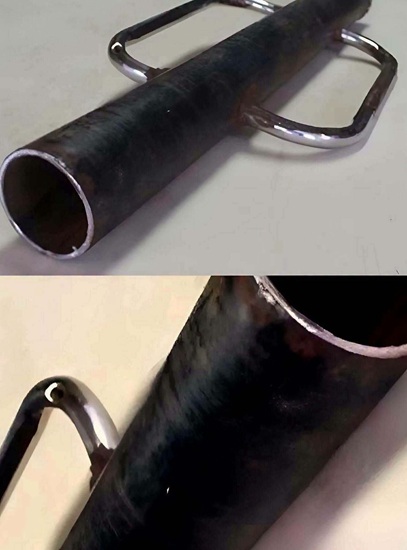
At first glance, the object looks like something that might have been recovered from a scrapyard or abandoned beside a construction site. It is a heavy steel cylinder with handles welded onto its sides, and there is little about its appearance that immediately explains its purpose. Without context, people might reasonably imagine that it is an old machine component, a homemade industrial tool, or even a discarded piece of military equipment.
Its rough construction is exactly what makes photographs of objects like this so effective at generating curiosity. The answer, however, is generally much more practical than the dramatic guesses suggest. Objects matching this basic design are commonly associated with manual post-driving equipment used in fencing, farming, landscaping, and construction. Often called a post driver, post pounder, or fence-post driver, the tool is designed to help drive posts into the ground through repeated downward impacts.
Instead of requiring a complicated engine or mechanical system, the traditional version relies largely on its own weight and the effort of the person operating it. Its simple appearance reflects the straightforward task it was designed to perform rather than any mysterious technology hidden inside.
The basic construction explains how the device works. A typical manual post driver consists of a heavy metal tube that is open at the bottom and closed or reinforced at the top. Handles are attached to opposite sides so the operator can lift the tool while maintaining control over it. The hollow portion is positioned over the top of a suitable fence post, usually a metal post designed to withstand repeated impacts. Once properly positioned, the operator raises the driver and brings it downward, allowing the weighted upper section to strike the top of the post.
Repeating this movement gradually forces the post deeper into the soil. The process uses a familiar principle: a heavy moving object transfers energy when it strikes another object. Because the driver surrounds the upper portion of the post, it can also help keep the impact relatively centered compared with striking a narrow post directly with a conventional hammer. The handles give the operator a more practical way to raise and lower a tool that can be quite heavy. No elaborate internal mechanism is necessary for the basic manual design to perform its job.
This helps explain why such an ordinary-looking device can be mistaken for something much more unusual when photographed without context. Remove the fence post, field, construction project, and person operating it, and viewers are left with little more than a thick piece of steel with handles. Human beings naturally try to interpret unfamiliar objects by comparing them with things they already recognize. A rugged metal cylinder may therefore inspire guesses involving machinery, military equipment, automotive components, or industrial scrap even when its actual function is comparatively simple.
Post drivers exist in different forms, so not every example will look identical. Traditional manual models are among the simplest, while powered equipment is available for jobs requiring greater speed or involving larger numbers of posts. Pneumatic, hydraulic, gasoline-powered, and machinery-mounted systems can reduce the amount of repetitive manual effort involved in substantial fencing or construction projects. The appropriate equipment depends on the post material, soil conditions, project size, accessibility of the site, and other practical considerations.
The tool’s importance becomes clearer when considering how many structures depend on securely installed posts. Agricultural fencing can be used to manage livestock, mark boundaries, protect crops, or divide sections of land. Posts also support many residential and commercial fences. Similar installation principles can appear in landscaping and other outdoor projects where posts or stakes need to be placed securely in soil. A post driver therefore performs a modest task that can contribute to much larger systems across farms, properties, and managed landscapes.
Manual versions are particularly interesting because their design is so economical. There are relatively few components compared with powered machinery, and the function is immediately understandable once the device is shown in use. The tube fits around the post, the handles allow controlled lifting, and the weight of the tool helps produce the downward impact. This combination illustrates a recurring theme in tool design: an effective device does not necessarily need to be technologically complicated if its shape and weight are well suited to the task.
That simplicity should not be confused with ease of operation. Repeatedly lifting and lowering a heavy steel driver can require substantial physical effort, especially when numerous posts must be installed. Soil conditions also matter. Ground that is compacted, rocky, unusually dry, or otherwise difficult can make installation considerably harder. Different projects may therefore require ground preparation, specialized posts, powered equipment, or alternative installation methods rather than relying entirely on a basic manual driver.
Safety is another important part of understanding the tool. A post driver is heavy equipment being moved repeatedly above a post, so careless handling can cause injury. Operators should follow the manufacturer’s instructions for the specific equipment they are using and use appropriate protective gear for the job. Hands should remain on the designated handles and away from impact or pinch areas. The work area should also be checked for relevant hazards, including underground utilities, before posts are installed.
There is an additional reason these objects attract attention online: their appearance provides very little visual evidence of scale or context. A close photograph can make a relatively ordinary farm or fencing tool look like an unidentified mechanical artifact. Without seeing a post passing through its open bottom, the hollow cylindrical construction does not necessarily reveal its function. Once that missing piece of information is supplied, however, the seemingly strange features begin to make sense.
The welded handles are perhaps the biggest clue. They are not merely decorative additions or convenient carrying grips. On a manual post driver, they provide the points where an operator can control the repeated vertical movement of the tool. The heavy cylindrical body is similarly functional because its mass contributes to the force delivered during each downward stroke. What initially looks crude is therefore a design in which nearly every visible feature relates directly to the work being performed.
Tools based on impact have existed in many forms throughout human history. Hammers are the most familiar example, but the underlying concept can be adapted to tasks where a standard hammer is inefficient or difficult to control. A post driver essentially applies that concept to a long vertical post. Instead of concentrating the operator’s effort through a handheld hammer head, the device surrounds the post and repeatedly delivers impact from directly above it.
For agricultural work, this can be especially useful because fencing often extends over considerable distances. Installing a fence may require many individual posts before wire, mesh, boards, or other fencing material can be attached. Each post must be positioned appropriately and installed securely enough for its intended purpose. The post driver addresses only one stage of that larger process, but that stage is fundamental. Without stable supports, the remainder of the fence cannot perform as intended.
The same principle applies outside agriculture. Property boundaries, gardens, temporary barriers, landscaping projects, and certain construction tasks can all involve posts or stakes. Equipment varies considerably depending on the application, and a lightweight stake is obviously different from a large structural post. Consequently, the term “post driver” covers a broader family of equipment rather than one universally standardized object. The heavy handled cylinder is simply one recognizable manual version.
Modern powered post drivers demonstrate how the original idea has been adapted for situations where productivity matters more than simplicity. Instead of requiring the operator to supply every lifting movement manually, powered systems generate repeated impacts mechanically. Larger machines can handle demanding projects that would be impractical with a small manual device. Nevertheless, the underlying objective remains essentially unchanged: applying controlled force along the post so that it enters the ground.
This distinction is useful when encountering photographs of unidentified tools online. Identifying an object responsibly requires more than finding something with a vaguely similar appearance. Dimensions, construction, openings, handles, markings, attachments, and the context in which the object was found can all affect identification. Two pieces of equipment may appear similar while serving completely different purposes. For that reason, an exact identification should not be presented as certain unless enough information is available to distinguish the object from comparable tools.
That caution is especially important with photographs that circulate without reliable information about their origin. A dramatic caption can easily encourage speculation that goes far beyond what an image actually demonstrates. An unfamiliar steel object does not become military equipment simply because it looks rugged, nor does unusual construction automatically imply a rare historical purpose. Examining ordinary industrial and agricultural tools is often a better starting point because many were designed for durability rather than visual elegance.
The post driver is a good example of how context transforms perception. Seen alone, it can resemble an unfinished cylinder from some larger machine. Place it over a metal fence post with an operator holding both handles, and the mystery largely disappears. Suddenly the width of the tube, the location of the handles, the reinforced upper section, and the substantial weight all have obvious functions. The object has not changed; only the viewer’s understanding has.
There is also a broader lesson here about viral “mystery object” photographs. Curiosity can be entertaining, but popularity is not evidence. Claims such as “nobody knows what this is” or “99% of people cannot identify it” are generally promotional language unless accompanied by actual survey data. Such wording should therefore not be treated as a measurable fact. A more accurate description is simply that an unfamiliar tool can be difficult to identify when photographed outside the environment in which it is normally used.
Understanding the object also highlights the often-overlooked engineering behind everyday work. Agricultural and construction tools do not always receive the attention given to sophisticated machines, yet they are designed around practical constraints such as durability, weight, cost, repairability, and ease of operation. A steel post driver can survive repeated impacts precisely because ruggedness is central to its function. Its appearance is secondary to its ability to withstand demanding physical work.
For someone encountering one for the first time, the transformation from mysterious object to recognizable tool can be surprisingly satisfying. The cylinder is hollow because it needs to fit over a post. The handles exist because the operator needs to lift and control it. The steel body is heavy because that weight assists in producing useful impact. What initially appears to be a collection of strange design choices becomes a coherent piece of equipment once its intended task is understood.
The most accurate conclusion, therefore, is far less sensational than some of the guesses an isolated photograph might inspire. A heavy steel cylinder with side handles and the appropriate hollow construction is characteristic of a manual post-driving tool used to install suitable posts into the ground. Variations exist, and an exact model cannot be established from a generic description alone. But the design itself represents a practical solution to a common problem encountered in fencing and related outdoor work.
Ultimately, the appeal of this mysterious-looking chunk of steel comes from the contrast between appearance and purpose. It may resemble industrial debris when removed from its working environment, yet the same features that make it look strange are what allow it to perform its job. Rather than hiding an extraordinary secret, the object demonstrates something more ordinary but equally interesting: how a simple, durable tool can turn human effort and gravity into a useful method for building fences, managing land, and completing countless practical projects.
