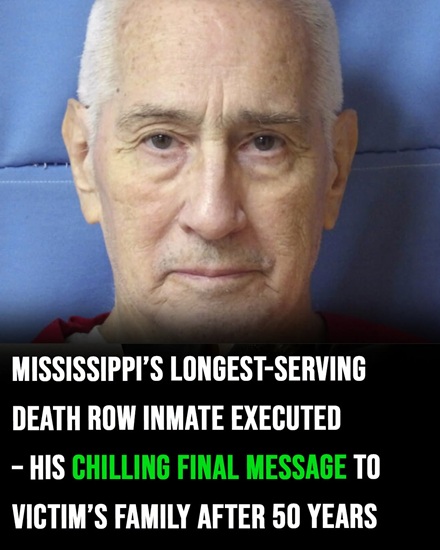
Nearly five decades after the kidnapping and murder of Edwina Marter, one of Mississippi’s longest-running death penalty cases reached its conclusion. Richard Gerald Jordan, a 79-year-old Vietnam War veteran who had spent almost half a century on death row, was executed by lethal injection on June 25, 2025, at the Mississippi State Penitentiary in Parchman. Prison officials pronounced him dead at 6:16 p.m. His execution followed decades of trials, overturned sentences, appeals and legal challenges that had made his case one of the most prolonged capital punishment cases in Mississippi history.
The case began in January 1976, when Jordan devised a plan to obtain money by kidnapping a relative of someone connected to a bank. According to court records and subsequent reporting, he contacted Gulf National Bank in Gulfport and learned the name of commercial loan officer Charles Marter. Jordan then located the Marter family home and arrived there while pretending to be a utility worker. Once inside, he abducted Charles Marter’s 37-year-old wife, Edwina, at gunpoint. Their three-year-old son was left unharmed at the family home.
Jordan forced Edwina to travel with him to an isolated area of DeSoto National Forest. There, she was killed by a single gunshot to the back of her head. Prosecutors characterized the killing as an execution-style shooting, while defense accounts maintained that Jordan fired as Edwina attempted to escape. After she was already dead, Jordan contacted Charles Marter and demanded $25,000, falsely leading him to believe that his wife remained alive and could be returned safely if the ransom was paid. Authorities subsequently captured Jordan, and he confessed to the kidnapping and killing.

The legal proceedings that followed would continue for decades. Jordan was convicted of capital murder and received a death sentence, but the case repeatedly returned to court as earlier convictions or sentences were overturned amid legal questions surrounding Mississippi’s death penalty system and other issues. Jordan ultimately went through four trials, with juries repeatedly finding him guilty and imposing death sentences. His 1998 death sentence eventually remained in place while his attorneys continued pursuing state and federal appeals.
Jordan’s military history also became part of the arguments made by those seeking clemency. He had served multiple combat tours during the Vietnam War and was reported to have experienced post-traumatic stress disorder. Supporters argued that his wartime experiences, mental health and behavior during decades in prison deserved consideration. His clemency petition included letters from people who described him as remorseful and said he had changed substantially during his incarceration. Opponents of his execution urged Mississippi officials to commute his punishment to imprisonment rather than carry out the death sentence.
For Edwina Marter’s family, however, the extraordinary amount of time that had passed was itself a source of frustration. Her son Eric was only 11 years old when his mother was murdered, while his younger brother Kevin was three. Eric later said that he believed the punishment should have been carried out decades earlier. He rejected arguments that Jordan’s circumstances excused what happened, emphasizing that his mother had been deliberately targeted as part of a plan to obtain money.
As the June 25 execution approached, Jordan’s lawyers continued seeking intervention from the courts. One major dispute concerned Mississippi’s three-drug lethal injection procedure. Jordan had been a lead plaintiff in litigation challenging the protocol, with attorneys arguing that the first drug used could leave a prisoner vulnerable to suffering from the drugs administered afterward. A federal judge allowed the execution to proceed while requiring officials to verify that Jordan was unconscious before continuing with the remaining drugs.
Jordan also sought relief from federal appellate courts and the U.S. Supreme Court. The 5th U.S. Circuit Court of Appeals declined to stop the execution, and the Supreme Court rejected his final requests on the afternoon of June 25. Mississippi Governor Tate Reeves had already declined Jordan’s request for clemency. Reeves cited the circumstances of Edwina Marter’s kidnapping and murder, Jordan’s admission of responsibility and the extensive judicial proceedings that had taken place over the decades.
During his final day, prison officials said Jordan spent time with relatives, attorneys and spiritual advisers. His requested final meal consisted of chicken tenders, French fries, strawberry ice cream and a root beer float. His wife Marsha, attorney Krissy Nobile and spiritual adviser Rev. Tim Murphy were among those who witnessed the execution. Outside the prison and elsewhere in Mississippi, opponents of capital punishment held vigils while the state prepared to carry out the sentence.
Shortly after 6 p.m., Jordan was given an opportunity to make a final statement. He thanked officials for what he described as a humane process and apologized to Edwina Marter’s family, asking for forgiveness. He also expressed gratitude toward his attorneys and his wife. Near the conclusion of his statement, Jordan told those close to him that he loved them and said, “I will see you on the other side, all of you.”
Officials then began Mississippi’s lethal injection procedure. After the first drug was administered, prison personnel confirmed that Jordan was unconscious before proceeding with the remaining drugs, in accordance with the federal court’s requirement. He was officially pronounced dead at 6:16 p.m. The execution ended a death-row incarceration that had lasted almost 49 years and brought one of Mississippi’s most enduring capital cases to a close.
Edwina Marter’s husband and sons did not personally attend the execution, according to reporting at the time. Afterward, family member Keith de Gruy delivered a statement on behalf of the family. Their message focused on Edwina and the consequences of losing her rather than celebrating Jordan’s death. They emphasized that no punishment could restore the wife, mother, sister and friend who had been taken from them in 1976.
The family also expressed frustration that Jordan had been able to spend almost five decades alive while pursuing repeated legal challenges. From their perspective, the lengthy process had prolonged a case that began with an irreversible loss. At the same time, the execution renewed the broader debate surrounding capital punishment, with Jordan’s supporters pointing to his military service, PTSD, remorse and decades of incarceration while the Marter family emphasized accountability for the kidnapping and murder.
What remains undisputed is the central tragedy at the heart of the case. Edwina Marter was 37 years old and the mother of two children when she was abducted from her home and killed as part of a ransom scheme. Her death permanently changed the lives of her husband, sons and extended family. Richard Gerald Jordan spent nearly half a century facing the consequences of that crime before Mississippi ultimately carried out his sentence.
Jordan’s death therefore ended the legal case, but it could not undo what happened in January 1976. For Edwina Marter’s relatives, the execution represented the completion of a judicial process that had lasted far longer than they ever expected. Nearly 49 years after the crime, Mississippi carried out the punishment repeatedly imposed by juries and upheld after decades of litigation, closing the final legal chapter in a case that had followed both families for generations.
