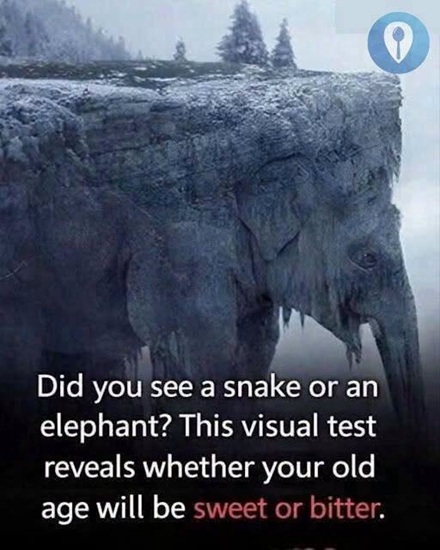
At first glance, an image containing both a snake and an elephant might seem like a simple visual puzzle. Some viewers may immediately focus on the long curved outline and confidently identify a snake, while others may recognize the larger form of an elephant almost instantly. Neither response needs to be considered incorrect if the illustration was intentionally designed to support both interpretations. What makes such an image interesting is not that it secretly reveals someone’s personality, but that the same visual information can sometimes support more than one reasonable perception.
Researchers have studied this broader phenomenon for many years using what are known as ambiguous or bistable images. The basic experience can feel surprisingly convincing. A person might look at the picture and wonder how anyone could possibly see something other than the animal that appeared obvious to them. Then someone points out a different outline, and suddenly the image seems to transform without physically changing at all. The lines, shadows, shapes, and contrast remain exactly where they were.
What changes is the viewer’s interpretation of those visual elements. Research on ambiguous figures has documented precisely this phenomenon: perception can alternate between different interpretations even though the stimulus itself remains unchanged. That is why a headline such as “The First Animal You See Could Reveal a Shocking Truth About How You Think” should be approached cautiously.
It is an effective curiosity-driven headline, but there is no established scientific rule saying that noticing a snake first means a person has one particular personality type while noticing an elephant proves another. Viral optical-illusion personality quizzes are generally better understood as entertainment than as validated psychological assessments. Recent coverage of similar online tests has likewise acknowledged that their personality interpretations are not scientifically rigorous.
What scientists can discuss with considerably more confidence is the way perception handles ambiguity. Human vision is not simply a camera recording every pixel and delivering an untouched picture to consciousness. The brain continuously organizes incoming visual information, distinguishes objects from backgrounds, groups related features, and tries to arrive at coherent interpretations. A large body of research in Gestalt psychology has examined processes such as perceptual grouping and figure-ground organization. These processes help explain why the same arrangement of lines and shapes can sometimes support surprisingly different interpretations.
Imagine looking at the animal image for only a fraction of a second. You do not normally inspect every curve individually before deciding what the picture contains. Recognition often feels nearly immediate. Your visual system processes multiple features rapidly and settles on an interpretation that makes sense of what is available. If the picture was intentionally constructed so that the features of two animals overlap, different parts of the drawing may support different interpretations. The result can be a visual experience in which one viewer confidently recognizes one animal while another confidently recognizes the second.
This phenomenon is often called bistable perception when a single ambiguous stimulus supports two distinct interpretations. Scientists have studied famous examples such as the Necker cube and other reversible figures. When people continue viewing these images, their perception may spontaneously switch between alternatives. Importantly, the physical image does not have to change for that reversal to occur. The change takes place in perceptual interpretation.
Attention can influence this process as well. Research has found that directing attention toward particular features can bias which interpretation of an ambiguous stimulus becomes dominant. That helps explain why telling someone where to look can suddenly make a previously invisible animal or object appear obvious. Once a viewer has identified the second interpretation, switching between the two may become much easier.
Suppose you initially see the snake. Its curved body may organize the image for you so effectively that the elephant seems almost impossible to find. Then a friend points toward what corresponds to the elephant’s head, trunk, or body. Suddenly those same lines reorganize into something entirely different. Nothing magical has happened. You have simply become aware of another plausible organization of the same visual information.
The opposite can happen to a person who sees the elephant first. Their perception may initially organize the large shapes into the body of a much bigger animal. The features suggesting a snake might blend into what they consider background detail. Once the snake is identified, however, those previously unimportant curves can become highly noticeable. This is one reason ambiguous illustrations can remain entertaining even after their trick has been explained.
Researchers also distinguish between purely bottom-up information coming from a stimulus and top-down influences associated with prior knowledge, expectations, or other forms of context. Studies of ambiguous perception indicate that top-down factors can affect which interpretation becomes available or dominant. That does not mean every person’s first impression contains a hidden psychological message. It simply means perception is an active process influenced by more than isolated visual features.
Prior experience can therefore matter in ordinary ways. Someone who has recently been thinking about elephants might recognize elephant-like features quickly. Another viewer who has been looking at photographs of snakes may be particularly sensitive to long, curved forms. Context surrounding an image can also influence interpretation. None of these possibilities justifies turning the result into a fixed personality label.
That distinction is important because online quizzes often make a considerable leap from perception to personality. A post might say, for example, that seeing the snake first proves someone is intuitive, suspicious, independent, or highly analytical. Another interpretation might say that elephant-first viewers are compassionate, loyal, patient, or emotionally intelligent. Those descriptions can sound believable because they are broad and generally relatable. But sounding personally meaningful is not the same as being scientifically validated.
A genuine psychological assessment requires far more than one ambiguous picture. Researchers evaluating personality measures normally care about questions such as reliability, validity, consistency, appropriate comparison groups, and whether the instrument actually measures the traits it claims to measure. An entertaining image shared online usually has not undergone that type of validation.
This does not mean optical-illusion quizzes have no value whatsoever. Their value simply lies somewhere different from what sensational headlines sometimes imply. They can encourage curiosity about perception. They can create conversations between friends. They can demonstrate how strongly two people can disagree about something they are literally viewing at the same time. They can also provide an accessible introduction to the science of how the brain organizes ambiguous information.
One particularly interesting feature of ambiguous images is the confidence viewers often experience. Someone can be absolutely certain that the image depicts a snake, while another observer looking at exactly the same stimulus is equally certain that an elephant is obvious. The disagreement does not necessarily mean one person has poor eyesight or lacks intelligence. Instead, the visual stimulus may genuinely permit more than one stable interpretation.
Scientists have shown that such perceptual interpretations can alternate over time. A viewer may see interpretation A for several seconds, suddenly switch to interpretation B, and eventually return to interpretation A. Researchers study these reversals because they provide a useful opportunity to investigate how conscious visual experience can change when the external stimulus remains constant.
That characteristic makes ambiguous images especially useful in perception research. In many experiments, changing what someone sees requires changing what is displayed on the screen. With an ambiguous figure, researchers can sometimes study changes in subjective perception while leaving the physical stimulus unchanged. This helps separate aspects of visual input from aspects of interpretation.
Eye movements may also contribute to how ambiguous stimuli are explored. Research and computational work on bistable perception has examined how shifts in visual attention and fixation can alter which features receive priority. Different viewers may naturally examine different parts of an image first, which can influence the interpretation that becomes immediately available.
Consider what happens when a person first looks near the center of an illustration. If the central features strongly resemble the head or body of one animal, recognition may quickly follow. Another viewer might begin near an edge containing the outline of a different animal. That difference in visual exploration could contribute to two different first impressions without requiring fundamentally different personalities.
The size and prominence of features can matter too. Strong contrast often attracts attention. Familiar shapes can be recognized quickly. Boundaries that appear continuous may be grouped together. Parts of a picture can also become either figure or background depending on how the viewer organizes them. These basic principles have a long history within research on visual organization.
Our brains perform this kind of organization constantly, not only when looking at optical illusions. In daily life, visual scenes contain enormous amounts of information. We identify people, vehicles, furniture, signs, animals, buildings, and other objects without consciously analyzing every individual contour. The efficiency of perception normally serves us extremely well.
Ambiguous images exploit that efficiency. Their creators deliberately arrange features so that more than one interpretation remains plausible. The visual system does what it normally does—attempts to organize the picture—but the construction prevents one interpretation from completely eliminating the other.
This is also why simply describing the hidden alternative can dramatically change someone’s experience. Before being told about the elephant, a viewer may see nothing but a snake. After hearing “look for an elephant,” the relevant features suddenly gain meaning. Research on top-down influence in ambiguous perception provides a scientific framework for understanding why expectations and contextual information can alter what becomes perceptually accessible.
Once both animals have been identified, the illusion can become even more interesting. You may intentionally try to switch your perception from snake to elephant and back again. Sometimes the switch happens immediately. At other times, one interpretation remains unusually dominant.
That variation does not need to be treated as a hidden personality test either. Bistable perception involves multiple interacting processes, including features of the stimulus, attention, perceptual history and potentially other neural mechanisms. Researchers continue studying these processes precisely because the phenomenon is more complicated than a simple one-to-one personality rule.
It is therefore more accurate to ask, “What can this image teach us about visual perception?” rather than, “What shocking truth does this animal reveal about your personality?” The first question can be explored using established research. The second implies a psychological certainty that the image cannot responsibly provide.
If you saw the snake first, the safest conclusion is wonderfully simple: you saw the snake first.
Perhaps certain lines attracted your attention immediately.
Perhaps that form was especially recognizable.
Perhaps your eyes landed on the part of the image that best supported that interpretation.
None of those possibilities establishes that you possess a specific hidden personality trait.
If you saw the elephant first, the same principle applies. Your visual system initially organized the ambiguous information into an elephant. That tells us something about your experience of this particular image at this particular moment, but it is not enough to diagnose your character, emotional style, intelligence, fears, relationships, or future behavior.
The difference between those claims is significant.
Visual perception is scientifically measurable.
A viral personality prediction based on one first impression is a much stronger claim and would require convincing evidence of its own.
Without that evidence, the responsible approach is to present any personality interpretation as entertainment rather than psychological fact.
There is also another reason people enjoy these images: discovering the alternative interpretation creates a satisfying moment of surprise. The experience can feel like something hidden has suddenly been revealed. The viewer may return to the image repeatedly, wondering how the second animal could have been invisible only moments earlier.
That reaction demonstrates how complete a perceptual interpretation can feel.
When the snake dominates perception, the elephant may effectively disappear as a meaningful object.
When the elephant becomes dominant, the reverse may happen.
The viewer now knows intellectually that both interpretations exist, but subjective perception can still favor one at a time.
This difference between knowing and seeing is one of the most fascinating aspects of ambiguous figures. You can know that a second interpretation exists while temporarily struggling to experience it visually. Eventually, a small shift in attention can bring it forward.
That experience has made reversible images valuable tools for scientists interested in conscious perception. Research reviews describe ambiguous figures as situations in which perception changes even while the sensory information remains stable.
Online versions simplify the phenomenon into phrases such as “your brain ignores what it doesn’t want to see.” That language can be misleading. The brain is not necessarily making a deliberate choice to reject one animal. Perceptual competition is not equivalent to conscious denial.
It is more accurate to say that multiple interpretations may compete for perceptual dominance.
At a particular moment, one becomes the experience that reaches awareness most clearly.
Later, the balance can change.
Calling that process “ignoring reality” would exaggerate what the evidence demonstrates.
Likewise, seeing different animals does not mean two viewers inhabit completely different realities in the broader philosophical sense. They are responding differently to a carefully constructed ambiguous stimulus.
Both interpretations may be intentionally supported by the same drawing.
The fascinating part is how naturally each interpretation can feel complete.
That is enough to make the illusion interesting without adding unsupported personality claims.
The popularity of these images also demonstrates the appeal of self-reflection. People naturally enjoy learning things about themselves. A quiz promising to reveal whether someone is analytical, compassionate, adventurous, cautious, romantic, independent, or creative can therefore attract attention quickly.
The descriptions often contain desirable or broadly recognizable traits.
Readers may find portions that seem surprisingly accurate.
That emotional reaction is real.
The scientific interpretation, however, still requires caution.
A person feeling that a description fits them does not establish that seeing a particular animal reliably predicts the trait.
If researchers wanted to validate such a claim, they would need a carefully designed study. Participants could be shown the same ambiguous image without being told what they were expected to see. Their first perceptions could be recorded under controlled conditions.
Researchers would then need independently validated personality measurements.
They could test whether seeing one animal was consistently associated with particular traits.
The result would need to be statistically meaningful and ideally replicated by independent researchers.
Without such evidence, claiming that the image “reveals” personality goes beyond what is known.
That does not make the image useless.
Quite the opposite.
Separated from unsupported psychological predictions, it becomes a clearer demonstration of something genuinely remarkable: the brain’s ability to create stable meaning from ambiguous visual information.
Two viewers can receive the same sensory input and initially organize it differently.
One viewer can even alternate between both interpretations while the picture remains unchanged.
Those are scientifically interesting observations by themselves.
The image can therefore be enjoyed as an experiment you perform on your own perception.
Look at it quickly and note the first animal you recognize.
Then spend several seconds searching for the alternative.
If you already see both, try focusing on only one.
Notice whether concentrating on particular contours helps your perception switch.
You may find that the image becomes more difficult to interpret in its original way once the second form has become obvious.
That experience can prompt useful questions.
Which visual feature captured your attention first?
Did someone telling you what to search for make the second animal easier to identify?
Does one interpretation remain more stable?
Can you intentionally switch between them?
Those questions stay close to what research on ambiguous perception actually examines.
They are also more interesting than attaching a generic personality label to either animal.
Another misconception worth avoiding is that rapid perception necessarily equals superior intelligence. Seeing both animals instantly does not, by itself, prove that someone is unusually intelligent. Likewise, taking longer to locate the hidden interpretation does not demonstrate low intelligence.
Visual ambiguity tasks can be affected by many variables.
The specific design of the image matters enormously.
Display size, contrast, viewing distance and familiarity can influence perception.
A single casual puzzle cannot responsibly produce a general intelligence score.
The same caution applies to claims about creativity. Some researchers have explored possible relationships between ambiguous perception, pareidolia and creative processes, but this remains a specific research topic rather than justification for saying that seeing one particular animal first proves someone is creative. One study, for example, examined pareidolia and divergent perception in relation to creativity, illustrating how carefully these relationships need to be studied rather than assumed from viral quizzes.
Similarly, first noticing a snake should not be interpreted as evidence that someone is fearful, suspicious, aggressive or untrusting. A snake is visually distinctive, and humans can recognize familiar animal forms rapidly.
Seeing an elephant first does not prove calmness, loyalty or wisdom either.
Those symbolic associations come from storytelling and culture rather than from the perceptual result itself.
They can be used in a playful quiz if clearly labeled as entertainment.
They should not be presented as psychological findings.
This distinction keeps the experience both enjoyable and accurate.
A reader can say, “I saw the snake first, and the playful description happens to sound like me.”
That is very different from saying, “Science proves I have these traits because I saw the snake.”
The first statement expresses personal amusement.
The second makes an empirical claim requiring evidence.
Responsible content should not blur those categories.
Ambiguous pictures also provide a useful reminder that confidence does not always guarantee a uniquely correct interpretation. When you initially see only one animal, you may feel absolutely certain there is nothing else in the picture.
A few seconds later, your perception may change completely.
This does not mean human perception is unreliable in every situation.
It means perception involves interpretation, and specially designed ambiguous images can exploit that process.
That lesson has applications beyond entertainment, although it should not be exaggerated.
People often receive incomplete information and quickly construct interpretations.
Recognizing that our first impressions can sometimes change may encourage curiosity and careful observation.
However, a visual illusion should not be used as proof that someone makes poor decisions or possesses a particular cognitive bias in everyday life.
The image simply demonstrates the visual phenomenon directly.
There is another subtle point in the phrase “the first thing you see.”
The result can change depending on when the test is taken.
If someone has previously encountered the image online, their memory could influence their next interpretation.
If the headline tells them beforehand that a snake is hidden in the picture, attention may be biased toward snake-like features.
If another person says “find the elephant,” the opposite may occur.
For a genuine scientific experiment, these contextual influences would need to be controlled.
This is one reason social-media quizzes should not be confused with laboratory assessments.
People encounter them under wildly different conditions.
One person looks at a small phone screen.
Another sees a large monitor.
Someone else has already read the answer in the comments.
Another viewer spends ten seconds studying the image before answering.
Under those circumstances, treating the first response as a precise psychological measurement would be unreasonable.
But as an informal perception demonstration, the picture can still work perfectly well.
Its purpose can simply be to make people notice something unusual about their own visual experience.
The strongest scientifically responsible version of the message is therefore less sensational but more fascinating.
Your brain does not passively reproduce everything entering your eyes.
It organizes visual information into meaningful objects.
When that information supports multiple interpretations, perception can become unstable or alternate between them.
Researchers have documented this phenomenon extensively.
So, what did you see first?
Perhaps it was the snake.
Perhaps it was the elephant.
Maybe you noticed both almost simultaneously.
Any of those responses can make the illusion enjoyable.
None needs to define who you are.
If you want to use the image for self-reflection, the safest approach is to treat any personality interpretation as a playful prompt rather than a conclusion.
You might ask yourself why one animal seemed obvious or whether another person’s explanation changed your perception.
Those questions invite curiosity without claiming more than the image can demonstrate.
And perhaps that is the genuinely surprising truth behind the puzzle.
The interesting part is not that an animal secretly exposes your personality.
It is that a motionless collection of shapes can produce two convincing experiences in the same mind.
Your perception can change dramatically while the outside image stays exactly the same.
That phenomenon is real, measurable and scientifically interesting.
The snake does not prove that you are analytical.
The elephant does not prove that you are compassionate.
Neither choice predicts your future.
Instead, the illusion gives you a small window into the active process of visual perception—a process that normally happens so quickly and efficiently that we barely notice it.
For a few seconds, an ambiguous picture makes that invisible work visible.
And that is more than enough reason to take another look.
