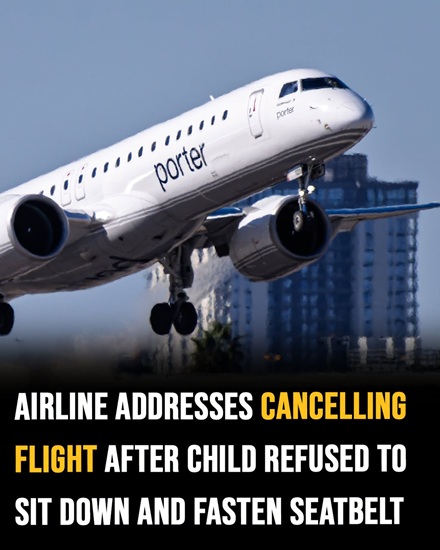
Passengers aboard a late-night Porter Airlines flight from Victoria to Toronto faced an unexpected overnight disruption after a young child could not remain seated with a seatbelt secured before takeoff. The August 6 incident occurred after the aircraft had already left the gate at Victoria International Airport and begun taxiing for its scheduled flight to Toronto Pearson International Airport. According to Porter Airlines, the child was standing on the seat and would not remain secured by the seatbelt despite efforts by both the accompanying parent and members of the cabin crew.
Because everyone must be appropriately secured for takeoff, the flight crew determined that the aircraft could not safely depart. The incident has subsequently generated considerable discussion, particularly because different descriptions of the child’s behavior have created very different impressions of what happened. Some online reactions characterized the child as unruly or suggested that the situation was simply a prolonged tantrum. At least one passenger who witnessed the incident, however, strongly disagreed with that interpretation.
He described behavior that appeared to him to be driven by fear rather than deliberate misbehavior. That distinction is important because the child’s motivation cannot be established simply from the fact that the required seatbelt could not remain secured. What is clear from the airline’s account is that the aircraft had already pushed back from the terminal when the problem became serious enough to prevent departure. Porter said the child was standing in the seat and would not remain secured.
Attempts by the parent and crew to resolve the situation were unsuccessful. Aviation safety requirements meant the aircraft could not simply continue toward the runway and take off while one passenger remained unsecured.The flight therefore returned to the terminal. That decision might sound as though it should have resulted in only a short delay, but the timing of the flight created another problem. Returning to the gate, addressing the situation involving the child and parent, handling their baggage and completing the necessary procedures consumed valuable time late at night.
Victoria International Airport had a scheduled airfield closure approaching, meaning the crew was operating within a limited window in which the aircraft could still depart. Passenger Hillary Hertzberg later described how slowly the situation appeared to unfold from inside the cabin. According to her account, passengers had been aboard for close to an hour by the time the child and accompanying parent finally left the aircraft at approximately 11:30 p.m. What had initially appeared to be an unusual delay was therefore becoming a much larger travel problem for everyone aboard.
Removing passengers from an aircraft is not necessarily as simple as opening a door and asking them to leave. Checked baggage associated with passengers who will no longer travel may need to be located and removed, while airline personnel must follow operational and administrative procedures before the aircraft can depart again. Those steps consumed additional time.
Porter spokesperson Brad Cicero explained that the process of removing the parent and child, retrieving their baggage and completing the required paperwork meant the flight could no longer depart before Victoria’s scheduled airfield closure at 12:30 a.m. With that deadline reached, the airline canceled the overnight departure.
The result was frustrating for passengers who had expected to wake up in Toronto.
Instead, everyone had to disembark in Victoria.
Porter later apologized for the disruption and said affected passengers were able to leave on a flight the following day. For travelers with connections, appointments, work obligations or other plans in Toronto, however, an overnight cancellation could obviously create consequences extending beyond the hours spent waiting aboard the aircraft.
The airline’s explanation focused on the central safety requirement rather than assigning motives to the child. An aircraft cannot safely begin takeoff while a passenger who is required to be seated remains standing or otherwise unsecured. Seatbelts are especially important during taxi, takeoff, landing and periods of turbulence because sudden acceleration or movement can cause an unsecured passenger to be injured.
The more complicated question became why the child would not remain in the seat.
Passenger Aryeh Kozuch, who was traveling to Toronto, later told The Canadian Press that his impression differed substantially from some of the harsher descriptions circulating afterward. He initially assumed that an announcement about a disruptive passenger referred to an adult. When he realized a child was involved, he observed behavior that he interpreted as fear.
According to Kozuch, the child repeatedly tried to hide beneath the seat. When efforts were made to secure the child, the youngster would reportedly slide underneath rather than remain seated. To Kozuch, that did not resemble a child deliberately running around the cabin or creating disruption for entertainment.
He believed the child appeared frightened.
That observation does not establish a medical or psychological explanation for the behavior, and it would be inappropriate to diagnose the child based on a passenger’s description. Young children can become distressed for many reasons, particularly in unfamiliar environments. What Kozuch’s account does establish is that at least one eyewitness believed the situation was more complicated than the phrase “unruly toddler” might suggest.
Aircraft cabins can be overwhelming environments for some young children. There are unfamiliar sounds, large numbers of strangers, restricted movement, unusual seating arrangements and the prospect of sensations associated with takeoff. A late-night flight can also coincide with a child’s normal sleeping hours. None of those possibilities can be confirmed as the reason for this particular child’s reaction, but they demonstrate why observers should be cautious about claiming to know exactly what the child was feeling.
Kozuch acknowledged that there was substantial frustration among passengers.
That reaction is understandable.
People had purchased tickets for a transcontinental overnight flight and instead found themselves returning to the terminal before eventually learning that the flight would not depart until the following day. Some may have faced missed connections or disrupted plans. Understanding why passengers were frustrated does not require assuming that the child intentionally caused the cancellation.
Much of the online debate consequently shifted toward the accompanying parent.
Some commenters argued that a parent should physically ensure a child remains seated and buckled when aviation safety is involved. From their perspective, fastening a seatbelt during takeoff is not something that can be negotiated because the rule exists to protect the child and other people aboard the aircraft.
Others focused less on the initial difficulty and more on the amount of time the situation reportedly continued.
Several social-media users argued that once it became apparent the child could not remain safely secured, the parent should have voluntarily left the aircraft sooner rather than allowing the delay to continue. Those comments reflected frustration about the eventual consequences for the other passengers.
They remain opinions.
The available reporting does not establish everything that was said between the parent, crew members and child during that period. It therefore would not be responsible to conclude from outside the aircraft that the parent deliberately kept everyone waiting or simply refused to parent the child.
Kozuch offered a more sympathetic perspective. He questioned whether physically forcing an obviously distressed child into a seatbelt in front of an entire cabin would necessarily have been a reasonable solution. His comments highlighted the difficult position of trying to satisfy an unavoidable aviation safety requirement while dealing with a child who appeared, in his view, genuinely frightened.
What was not negotiable was the safety requirement itself.
Regardless of the reason for the child’s behavior, the aircraft could not take off until the passenger was properly secured. The crew ultimately returned to the terminal rather than compromising that requirement. From an operational perspective, that was the central decision behind everything that followed.
The later cancellation resulted from timing.
Had the same incident happened much earlier in the day, the aircraft might theoretically have had more time to return to the terminal, resolve the issue and depart again. On this particular night, however, the scheduled 12:30 a.m. airfield closure created a firm operational limitation. Once the process extended too close to that deadline, departure was no longer possible.
That sequence is important because saying simply that a child “canceled a flight” leaves out several intermediate factors.
The child could not remain safely secured.
The crew returned the aircraft to the terminal.
The parent and child left the aircraft.
Their baggage had to be addressed and necessary procedures completed.
By then, the scheduled airport closure prevented the aircraft from departing.
Together, those circumstances produced the cancellation.
The incident also demonstrates why flight crews sometimes make decisions that passengers find extremely frustrating. Cabin-safety requirements cannot simply be waived because complying with them creates a delay. An unsecured passenger can be seriously injured during sudden aircraft movement, and young children are not exempt from the laws of physics.
At the same time, following safety requirements does not require publicly humiliating the child involved.
The youngster has not been publicly identified in reliable reporting, and there is little public benefit in attempting to identify the family. The relevant issue is what occurred aboard the flight and why the crew was unable to depart, not the personal identity of a young child who may have been experiencing significant distress.
There is also a difference between describing observable behavior and assigning character.
Saying that a child was standing rather than remaining secured describes what the airline reported.
Calling that child selfish, badly behaved or intentionally disruptive makes assumptions about motivation.
Those assumptions are particularly difficult to justify when an eyewitness described the youngster hiding under the seat and appearing terrified.
Likewise, the parent’s decisions can reasonably be discussed without turning speculation into fact. Passengers were entitled to be frustrated by the long delay and cancellation. Some may believe the family should have left sooner. But without a complete account of the conversations taking place inside the cabin, claims about exactly why the process lasted as long as it did remain interpretations rather than established facts.
The airline has apologized for the disruption.
Porter said passengers were able to depart the following day, but the incident still meant an unexpected night in Victoria for travelers who had planned to fly directly to Toronto. As of the reporting surrounding the incident, Porter had not publicly provided a comprehensive explanation of whether every passenger would receive compensation for expenses associated with the cancellation.
Compensation questions can depend on the circumstances of a cancellation and applicable passenger-protection rules. Determining eligibility requires more than knowing that a flight was canceled, because the cause and whether it was within an airline’s control can affect what obligations apply. Travelers seeking information about their particular booking would therefore need to rely on the airline and applicable official passenger-rights guidance.
The broader story is ultimately less sensational than some online descriptions suggest.
A young passenger could not remain safely seated and secured.
The crew could not legally and safely proceed with takeoff under those circumstances.
Efforts to resolve the situation took enough time that the flight missed the operating window before Victoria’s scheduled airfield closure.
The flight was canceled and passengers traveled the next day.
What remains uncertain is exactly what the child was experiencing emotionally. One eyewitness believed fear was the central issue, while frustrated observers interpreted the behavior differently. Without further reliable information, neither strangers online nor news reports can definitively determine the child’s state of mind.
That distinction matters.
It is possible to recognize that an entire plane of passengers experienced a serious inconvenience while also recognizing that a young child may have been overwhelmed or frightened. Those ideas are not mutually exclusive.
It is equally possible to support the crew’s safety decision without turning the incident into a judgment about a child’s character.
For passengers aboard the August 6 flight, the practical consequence was undeniable: their overnight journey to Toronto did not happen as planned. For the crew, however, the immediate issue was equally straightforward. Until every required passenger was safely secured, the aircraft could not take off.
The episode therefore offers a useful reminder about how quickly a seemingly small cabin problem can become an operational problem affecting an entire flight. A seatbelt issue led to a return to the terminal, which led to additional procedures, which collided with a scheduled airport closure and ultimately resulted in cancellation.
Passengers were understandably disappointed.
The airline apologized.
And a young child became the center of an unexpectedly large public debate.
But describing the incident accurately requires resisting the easiest label. The confirmed issue was not simply that an “unruly toddler” decided to misbehave. The confirmed issue was that a child could not remain seated with the required seatbelt secured, attempts to resolve the situation were unsuccessful, and the crew determined that the aircraft could not safely take off.
Everything beyond that—including why the child behaved that way and how the parent should have responded—requires more caution.
In the end, the safety requirement was clear even if the human circumstances behind it were not. The flight could not leave with an unsecured passenger, regardless of age. Returning to the terminal was therefore necessary once the problem could not be resolved.
What passengers experienced afterward was an unfortunate chain reaction involving time, airport operating restrictions and required procedures. What the child experienced is known far less clearly.
That is why the most accurate account leaves room for both realities: the cancellation caused genuine disruption for a plane full of travelers, while the young child at the center of the incident may have been experiencing genuine distress rather than deliberately trying to disrupt anyone’s journey.
