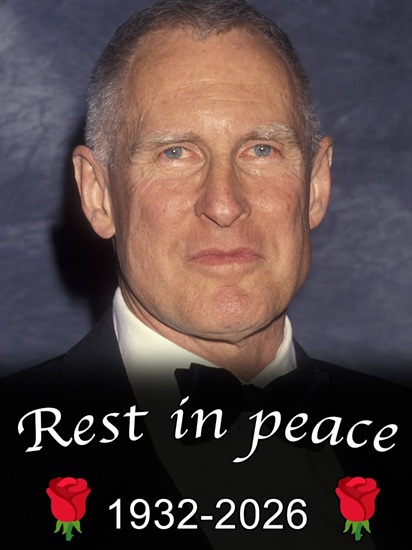
Veteran stage and screen actor Jon Cypher, whose career stretched across more than five decades and included memorable appearances on Broadway, television and film, has died at the age of 94. Cypher died on August 3, 2026, at his home in Central Point, Oregon, according to his obituary. His wife of 40 years, author Carol Rosin, was reportedly by his side. A specific cause of death was not disclosed. For generations of television viewers, Cypher remained especially recognizable as Chief of Police Fletcher Daniels on the acclaimed NBC drama Hill Street Blues, although his body of work extended far beyond that celebrated role.
Born in New York City on January 13, 1932, Cypher pursued acting long before television audiences came to know his face. He graduated from Brooklyn College in 1953 and subsequently developed his craft through stage work, including performances at Denver’s Elitch Theatre. That theatrical foundation would remain an important part of his professional life. Cypher ultimately appeared in numerous Broadway productions while simultaneously building an unusually varied screen career.
His stage credits included productions such as The Night of the Iguana, Man of La Mancha and The Great White Hope, demonstrating a versatility that allowed him to move between classical theater, musicals, television dramas and mainstream Hollywood productions. His first major television opportunity was extraordinary. In 1957, Cypher was cast as Prince Christopher opposite Julie Andrews in Rodgers and Hammerstein’s Cinderella, which was created specifically for television and broadcast live by CBS on March 31 of that year.

The production became a landmark event in early television history. Estimates place its American audience at approximately 107 million viewers, an enormous figure for the era. Indiana University’s Televised Opera and Musical Comedy Database likewise records the production as a live color broadcast and identifies Cypher as Prince Charming alongside Andrews, Edie Adams, Howard Lindsay, Dorothy Stickney, Ilka Chase, Kaye Ballard and Alice Ghostley.
That remarkable debut opened the door to a career that would continue for decades. Cypher became a familiar presence on American television, appearing in programs across several genres and eras. His credits included Bonanza, Mannix, Dynasty, Knots Landing, The Rockford Files, Murder, She Wrote, Walker, Texas Ranger, JAG and Law & Order. He also worked extensively in daytime and serialized television, with appearances connected to programs including As the World Turns, General Hospital and Santa Barbara. His ability to shift between authoritative figures, dramatic characters and lighter roles helped make him a dependable character actor across changing generations of television.
For many viewers, however, Fletcher Daniels on Hill Street Blues remains the role most closely associated with Cypher. The influential police drama became one of television’s defining ensemble series, and Cypher’s recurring presence as the ambitious police chief placed him inside one of the medium’s most respected productions. Later audiences also knew him as General Marcus Craig on the CBS sitcom Major Dad. His work was not limited to television. In 1987, he portrayed Man-At-Arms in the live-action fantasy film Masters of the Universe, another performance that developed a lasting following among fans of the franchise.
Cypher’s film credits also included Valdez Is Coming, Spontaneous Combustion and other productions, while animation audiences heard him as Spellbinder in Batman Beyond. His interests extended beyond acting as well. Accounts of his life describe his enthusiasm for singing opera, including performing in multiple languages. In 2019, he published If You’re Not Depressed, You Oughta Be in Therapy, a collection incorporating 99 limericks and observations on life. Together, those pursuits reflected a performer whose creative interests continued well beyond the roles for which television audiences knew him.

Cypher also spoke candidly about the uncertainty that accompanies an acting career. In a 2014 interview, he described acting as a difficult profession in which performers repeatedly face judgment from critics and audiences. His advice to younger actors emphasized resilience and the ability to recover from disappointment. When asked what had helped sustain his exceptionally long career, he jokingly answered, “Poverty.” Behind the humor was a straightforward philosophy: for a working actor, performing was simply what one continued doing for as long as circumstances and ability allowed.
Details released after his death also revealed how Cypher wanted his final arrangements handled. Reports said he was to receive a natural burial at the Forest Conservation Burial Ground in Ashland, Oregon. Rather than a conventional burial emphasizing elaborate materials, the arrangements called for him to be placed beneath tall trees in a meadow and wrapped in a completely natural, biodegradable shroud. The choice was described as fulfilling his wish to return to nature. It offered a notably simple conclusion to the life of a performer whose professional world had included Broadway stages, television studios, film sets and millions of viewers.
Cypher’s legacy cannot be reduced to a single character. Some audiences will remember the young Prince opposite Julie Andrews in the historic 1957 Cinderella. Others will immediately picture Fletcher Daniels on Hill Street Blues, General Craig on Major Dad, or Man-At-Arms in Masters of the Universe. His career connected several distinct eras of American entertainment, from live television’s formative years to prestige network dramas, sitcoms, feature films and animation. More than half a century of steady work demonstrated the persistence he later described when discussing the realities of his profession.
Jon Cypher died after leaving behind an extensive record of performances across stage and screen. His final arrangements reflected a personal wish for simplicity and a return to the natural world, while his professional legacy remains preserved through the productions in which he appeared. From a television broadcast watched by an extraordinary audience in 1957 to memorable roles decades later, Cypher built the kind of long, varied career achieved by relatively few performers. He was 94.
