Nadia had always thought of her grandmother’s garden as something far more meaningful than an ordinary yard. Every section had a story, and Grandma Penny could explain why nearly every flower, herb, or shrub had been planted. When Nadia was still a child, Penny once handed her a small green watering can and walked her through the beds behind the lake house. The peonies had been planted around the time Nadia was born, while the lavender marked Penny’s recovery from a difficult surgery.
The roses beside the porch celebrated her wedding anniversary, and the white daisies remembered Nadia’s first school recital. To Penny, the garden was not decoration. It was a living record of the family’s history. One afternoon, Nadia asked how her grandmother managed to remember every detail. Penny knelt beside her and explained that flowers could hold memories differently from photographs. A photograph preserved a single moment, but a garden showed that somebody had continued caring after that moment had passed. Every season required work, patience, and attention.
Plants needed to be watered, trimmed, protected, and sometimes replanted after difficult weather. Years later, Nadia would understand those words far more deeply than she had as a child. When Penny died, she left the lake house to Nadia. Along with the paperwork was a short handwritten note that read, “Keep it lived in.” Nadia treated those words almost like a promise. She repaired anything that became unsafe or damaged, but she avoided changing the character of the house. The yellow kitchen cabinets stayed, Penny’s handmade cushions remained, and the old cooking tools were kept in their familiar places. Most importantly, Nadia continued caring for the garden every Saturday she could.
Her husband, Zac, understood why the property mattered so much to her. He knew that changing the garden would feel very different from replacing an ordinary piece of landscaping. His sister, Kelsey, however, had never really understood Nadia’s attachment to the place. That difference became important only two days before Kelsey’s wedding, when she arrived unexpectedly with a wedding planner, fabric samples, and terrible news. The restaurant where her ceremony and reception were supposed to take place had suffered major water damage. With almost no time left, she needed another venue immediately.
Nadia initially felt genuinely sorry for her. Guests had already booked travel, vendors had been paid, and months of planning were suddenly in danger of collapsing. Kelsey said she had called hotels, restaurants, and event spaces throughout the area, but nothing suitable was available on such short notice. Then she opened her wedding binder and showed Nadia a photograph of Penny’s lake house. To Kelsey, the solution seemed obvious. The property had a lake, a lawn, and a beautiful view, so she believed it could easily serve as a wedding location.
Nadia was hesitant from the beginning. The lake house was a family property, not a commercial event venue, and she worried about both the house and the garden. Kelsey insisted that the setup would be simple: tables, chairs, a temporary dance floor, and floral decorations. The mention of flowers immediately caught Nadia’s attention. She agreed to consider the wedding only if one condition was treated as absolute. The existing garden could not be touched.
Nadia carefully explained the rules. No flowers could be cut from the garden, no plants could be moved, and no borders could be altered. Heavy furniture could not be dragged across the softest areas of the lawn. Everything brought to the property had to be removed after the celebration, and nothing inside Penny’s house could be permanently changed. Kelsey agreed to all of it, although she seemed impatient with the discussion. Eventually, Nadia gave permission because she did not want Kelsey’s entire wedding to collapse when she had a possible way to help.
Then, on the morning of the wedding, an unexpected family emergency changed Nadia’s plans. Her aunt suddenly collapsed at home and had to be taken to the hospital because doctors were concerned about a possible heart problem. Nadia and Zac immediately left to be with her. They called Kelsey from the hospital parking lot and explained that they would not be able to attend the ceremony. Kelsey asked Nadia to send the access code for the lake house so the vendors could continue setting up. Before sending it, Nadia reminded her again that the garden rules still applied.
Kelsey replied that she remembered everything, although she made a sarcastic remark about Nadia’s “sacred flowers.” Zac heard the comment and was visibly annoyed, but a nurse called them inside before the conversation could continue. Fortunately, Nadia’s aunt eventually stabilized. By the time they were able to leave the hospital, however, both Nadia and Zac were exhausted. Instead of driving another two hours to the lake house that night, they decided to return the following morning. Nadia still hoped the wedding had gone well.
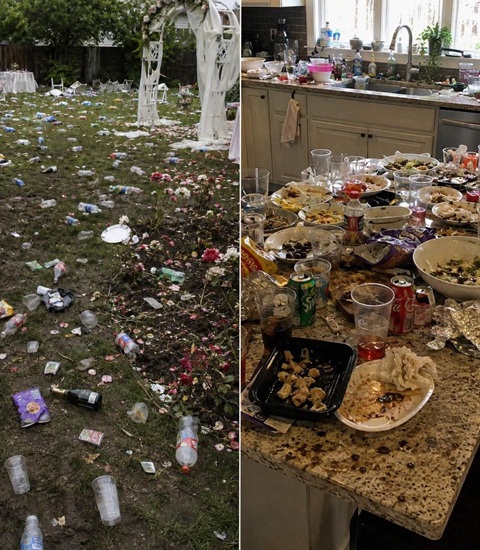
That hope disappeared almost as soon as they reached the property. One of Penny’s handmade cushions was lying face down near the driveway after being left outside overnight. Rain had soaked the fabric completely. Nadia stopped before even opening the gate because she immediately sensed that something was wrong. Then she looked toward the lawn. The entire yard was covered with evidence from the reception.
Plastic cups, bottles, disposable plates, decorations, napkins, and pieces of confetti were scattered across the grass. Some of the lighter debris had blown toward the lake and was floating near the shoreline. Deep tracks cut across areas of the lawn where heavy tables had apparently been dragged. Mud covered the porch, and dirty footprints continued through the kitchen. The property looked as though everyone had simply left when the party ended. But the mess was not what upset Nadia most.
Near the water stood the wedding arch. It had been decorated with flowers from Penny’s garden. The anniversary roses had been cut down almost completely. Large clumps of lavender had been pulled out of the soil. The white daisies connected with Nadia’s childhood recital were tied upside down with ribbons. Several peonies had been uprooted entirely, with exposed roots still attached to wire and decorative fabric.
Nadia realized immediately that this was not accidental damage from guests stepping into the flower beds. Someone had deliberately harvested the garden for wedding decorations. Zac stood beside her in disbelief. He reminded Nadia that he had personally told his sister not to touch any of the plants. Inside the house, they found additional problems. Cushions were stained, dishes were piled everywhere, and Penny’s rocking chair had been moved onto the damp porch, where one of its legs had cracked.
Nadia called Kelsey. Her sister-in-law answered while preparing to leave for her honeymoon and sounded annoyed that Nadia was already raising the issue. When Nadia asked what had happened to the garden, Kelsey admitted that the flowers had been used for the wedding arch. She explained that they needed fresh flowers and believed the garden offered the easiest solution. Nadia reminded her that the one rule she had repeated several times was that the garden could not be touched. Kelsey responded that it had been her wedding and that she had done what she thought was necessary to make it beautiful.
When Nadia asked her to come back and help restore the property, Kelsey laughed. She said the damage amounted to dirt and flowers and insisted that flowers would simply grow again. According to her, Nadia owned the property, so cleaning it was now Nadia’s responsibility. Then she ended the call. For several seconds, Nadia stood in silence with the phone still in her hand. Normally, Zac might have tried to delay the argument and encourage everyone to calm down.
This time, he did something different. He looked at the damaged garden, then at his grandmother-in-law’s soaked cushion, and asked Nadia what she needed. She told him she wanted Penny’s garden map. Grandma Penny had kept detailed records of the property, including the location and history of almost every important plant. The map was stored inside the house along with an old cedar box filled with seed packets, wooden labels, twine, and gardening notes. Together, Nadia and Zac spread the large handwritten map across the dining table.
The notes brought back memories almost immediately. The peonies were labeled with the year of Nadia’s birth. The lavender section contained a note about Penny finally feeling healthy again after surgery. The daisies referenced Nadia’s school recital, and other areas mentioned anniversaries, graduations, storms, difficult summers, and family gatherings. The garden had been documented far more carefully than Kelsey could ever have imagined. Nadia decided to compare the map with the actual damage outside.
She and Zac spent hours going through every flower bed. They documented uprooted plants, broken borders, crushed sections, and areas that would need to be replanted. By the time they finished, they counted exactly 286 plants that had been removed or seriously damaged. That number gave Nadia an idea. Kelsey had insisted that the flowers would simply grow back. Nadia decided she would give her the opportunity to prove it.
Using Penny’s old seed box, Nadia prepared 286 numbered packets. Each number corresponded with the original garden map. Some packets contained seeds, while others represented replacement roots or plants that would need to be purchased and replanted. She placed a laminated copy of the map at the bottom of the cedar box. On top, she added a small plaque that read “RESTORATION KIT.” She did not include an angry letter.
The package arrived the following afternoon. Kelsey called almost immediately and demanded to know what Nadia had sent her. She described the contents as numbered packets of dirt and wanted an explanation. Nadia calmly told her that the box contained everything connected with the plants Kelsey had said would simply grow back. When Kelsey realized there were 286 entries, she was shocked. She immediately suggested paying a professional landscaper to replace everything.
Nadia refused. The problem was not simply the cost of buying new flowers. She explained that the garden represented family memories rather than decorative landscaping. The roses commemorated Penny’s marriage, the lavender represented her recovery, the daisies remembered Nadia’s childhood, and the peonies marked Nadia’s arrival in the family. By taking the plants for a wedding arch, Kelsey had removed pieces of a living family record. For the first time, Kelsey stopped arguing for a moment.
She admitted that she had not understood what the plants represented. Nadia told her that not knowing explained why she had been careless, but it did not erase the damage. She proposed a simple arrangement: Kelsey could come to the lake house every Saturday and help restore the garden until the work was finished. Kelsey initially refused and said she had no intention of spending her weekends gardening. Nadia did not threaten her or demand money. She simply said the choice was hers.
The following Saturday, a car pulled into the driveway. Kelsey stepped out wearing expensive sunglasses, spotless sneakers, and new gardening gloves with the tags still attached. She complained that the situation was humiliating. Nadia handed her packet number one and pointed toward the lavender bed. Kelsey asked where she was supposed to put it. Nadia told her that Penny’s map contained the exact measurements.
Kelsey was surprised by how precise everything was. She had assumed that a garden was simply a place where flowers were planted wherever they looked attractive. Instead, Penny had designed the beds carefully over decades. Even the spacing carried meaning. An elderly neighbor eventually wandered over carrying lemonade and recognized what they were doing. She had known Penny for years and remembered many of the stories connected to the garden.
When Kelsey complained that she was there only because Nadia had insisted, the neighbor smiled. She explained that Penny had always believed gardens belonged to people who kept showing up. Kelsey rolled her eyes and returned to work. Within ten minutes, she complained about breaking a nail. By lunchtime, her shoes were muddy and she was exhausted. She proudly asked how many plants she had finished.
Nadia checked the list. Eight. Kelsey stared at her in disbelief when she realized 278 remained. Still, she returned the next weekend. This time she wore old jeans and shoes she did not mind getting dirty. Something had already begun to change.
During the second Saturday, Kelsey started asking questions. She wondered why one flower bed curved around an old wooden bench. Nadia explained that Penny and her husband used to sit there every year on their anniversary. Another section contained bee balm planted after a particularly difficult summer. Kelsey asked why Penny would plant flowers because of a difficult year. Nadia told her that Penny believed the family needed something cheerful.
Each week, more stories emerged. Neighbors remembered roses surviving storms, herbs being used for homemade soup, and lilies planted after graduations. The garden slowly became something different in Kelsey’s mind. Instead of seeing individual plants, she began seeing moments and people attached to them. Her complaints became less frequent. Eventually, she stopped making jokes about the work altogether.
One afternoon, Kelsey stood near the wedding arch that had started everything. She admitted that on her wedding day she had believed it looked beautiful. Now she understood that she had created that beauty by taking something meaningful from somewhere else without permission. Nadia did not respond immediately. She did not need to. Kelsey had finally reached the conclusion herself.
After several weeks, only one packet remained. It was number 286, a replacement peony. Kelsey carefully measured the planting depth twice before placing it in the soil. She covered the roots gently and pressed the earth around them. There was no complaining, rushing, or audience. When she finished, she asked whether those really were the flowers connected with Nadia’s birth.
Nadia nodded. Kelsey looked around the garden and said she had originally thought she was simply cutting flowers that would grow back. She had not understood that the plants were connected to people and memories. For the first time since the wedding, Nadia believed that the apology was genuine. It was not because Kelsey had finally found the right words. It was because she had spent weeks showing up.
Zac also realized that he owed Nadia an apology. For years, he had often asked her to be the reasonable person whenever conflict involved his sister. He admitted that this had not really been keeping the peace. Instead, it had placed the burden on the person least likely to create a confrontation. Kelsey apologized as well, and the three of them quietly packed away the gardening tools.
By the following spring, Penny’s garden was coming back to life. Not every flower returned in exactly the same shade or position, but the original shape of the garden had reappeared. Lavender lined the path again, roses climbed beside the porch, and young peonies pushed through the soil. One Saturday, Nadia arrived and discovered Kelsey already there. She was kneeling beside the peonies and pulling small weeds before Nadia had even unlocked the shed.
A little girl staying at a neighboring cottage wandered toward one of the flowers and reached out to touch it. Kelsey gently stopped her. The child asked why she had to be careful. Kelsey smiled and explained that somebody had loved that flower long before they did. From the porch, Nadia heard the words and remembered Penny’s lesson from many years earlier.
Photographs could preserve a moment, but a garden did something different. It proved that someone had returned afterward and continued caring. For Nadia, the restored garden no longer felt like something frozen in the past. It now carried another memory as well: the story of how something damaged through carelessness had been rebuilt through patience, responsibility, and repeated effort.
Grandma Penny had been right all along. The flowers remembered more than celebrations and milestones. They also remembered who came back after things went wrong.
