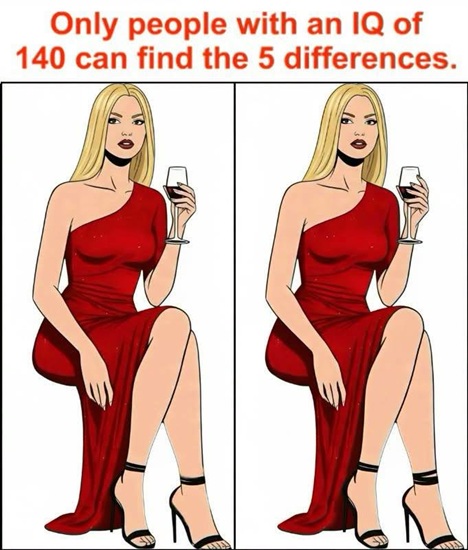
At first glance, a spot-the-difference puzzle seems incredibly simple. Two pictures are placed next to each other, and the goal is to identify a small number of details that have been changed. Yet anyone who has spent several minutes searching for one stubborn final difference knows that these puzzles can be surprisingly challenging. The images may appear almost identical, while small changes in clothing, objects, shapes, colors, or positioning remain difficult to notice.
Rather than being a genuine intelligence test, however, this type of puzzle is primarily an entertaining challenge involving visual attention, comparison, and concentration. One important point should be clarified before beginning. Claims such as “only people with an IQ of 140 can solve this puzzle” should not be interpreted as scientifically validated IQ measurements. A person’s performance on a single online visual puzzle cannot establish their intelligence quotient.
Formal intelligence assessments are designed and evaluated using standardized procedures and typically measure several cognitive abilities. A recreational spot-the-difference image does not provide enough information to make that kind of determination. The IQ language commonly attached to these puzzles is better understood as a playful challenge rather than a scientific conclusion.
That does not mean solving the puzzle requires no mental effort. Finding subtle differences involves directing attention toward specific parts of an image and repeatedly comparing visual information. Instead of examining the entire picture simultaneously, successful players often concentrate on individual areas. They might begin with the subject’s face, move toward clothing and accessories, examine nearby objects, and finally inspect the background. Breaking a complicated image into smaller sections can make subtle changes easier to detect.
Human vision is extremely effective at recognizing complete scenes quickly. We can often understand the general meaning of an image almost immediately without consciously examining every individual feature. That efficiency is extremely useful in everyday life, but it can make visual puzzles challenging. When two pictures share the same overall composition, the brain may rapidly classify them as essentially identical. The puzzle asks the viewer to do the opposite: ignore the obvious similarities and deliberately search for tiny inconsistencies.
This phenomenon is related to broader research into visual attention and what psychologists describe as change blindness. People can sometimes fail to notice surprisingly significant changes in a visual scene, particularly when their attention is directed somewhere else or when the change occurs alongside a visual interruption. This does not mean the brain is defective or “lazy.” Instead, perception involves selecting and prioritizing information rather than processing every visible detail with equal intensity at every moment.
Spot-the-difference puzzles take advantage of this characteristic in a harmless and entertaining way. The first few differences may be relatively noticeable, while later ones can require much more careful inspection. A missing accessory, altered line, changed color, slightly different shape, or repositioned object can remain unnoticed even after several comparisons. Once someone finally discovers it, the difference may suddenly seem obvious, creating the familiar feeling of wondering how it remained hidden for so long.
A systematic strategy can make the challenge easier. Instead of allowing your eyes to move randomly between the two pictures, imagine dividing each image into several sections. Compare the upper-left area of both pictures before moving to the upper-right section. Continue downward until the entire scene has been inspected. This reduces the amount of visual information you are trying to compare at one time and makes it less likely that a small area will accidentally be skipped.
Another useful technique is to focus on boundaries and distinctive features. Hairlines, jewelry, fingers, shoes, clothing edges, furniture, glasses, buttons, shadows, patterns and small background objects are common locations for puzzle differences. Designers can alter these details without dramatically changing the overall appearance of the scene. Looking specifically at recognizable features may therefore be more effective than repeatedly staring at both complete images.
Taking a short break can sometimes help as well. After staring at similar images for an extended period, attention can become less effective and details may begin to blend together. Looking elsewhere briefly before returning to the puzzle can make the pictures feel somewhat fresh again. This is not a guarantee that the missing difference will immediately become visible, but it may prevent endless repetitive scanning of exactly the same locations.
The appeal of these puzzles also extends beyond solving them individually. They naturally encourage friendly competition because several people can examine the same image and compare what they notice. One person might immediately detect a difference that everyone else overlooked, while another may discover an entirely different detail first. The experience demonstrates that attention can be distributed differently from one viewer to another without requiring assumptions about who is more intelligent overall.
This is also why dramatic claims about “geniuses” and specific IQ scores should be treated cautiously. Someone who fails to locate all five differences has not failed an intelligence examination. Performance can be influenced by screen size, image quality, eyesight, distraction, familiarity with visual puzzles, available time and simple chance. Someone viewing a compressed image on a small phone may have a considerably different experience from someone examining a larger, high-resolution version on a computer monitor.
Similarly, finding every difference quickly does not prove that someone has an IQ of 140. It may indicate that the person was particularly attentive to the relevant visual details, recognized the puzzle’s design patterns, or simply happened to look at the altered locations early. These are perfectly worthwhile skills to exercise, but they should not be transformed into unsupported scientific conclusions about intelligence.
What makes the format so effective is the combination of simplicity and uncertainty. The rules can be understood almost instantly: compare two pictures and locate five changes. No specialist knowledge is required, and players can begin immediately. Yet knowing that another difference remains somewhere in the picture creates a strong incentive to continue searching. The challenge remains accessible while still offering enough difficulty to keep people engaged.
The satisfaction of discovering a hidden difference is another important part of the experience. After repeatedly comparing two areas, noticing a tiny alteration can produce an immediate sense of accomplishment. Finding the final difference is particularly rewarding because it completes a task that initially appeared easier than it actually was. That feeling helps explain why visual puzzles have remained popular across newspapers, puzzle books, websites and social-media platforms.
There is also no need to race against an arbitrary ten-second countdown unless that makes the game more enjoyable. A timer can add excitement, but it does not transform the puzzle into a scientifically meaningful cognitive assessment. Some people enjoy solving these challenges quickly, while others prefer carefully examining every section until they are confident they have found everything. Both approaches are perfectly valid ways of enjoying the activity.
For anyone struggling with the final difference, the best approach is usually patience rather than frantic scanning. Return to the beginning and compare one small section at a time. Look at shapes before colors, inspect accessories and clothing details, and pay attention to objects near the edges of the image. Try to remember which areas have already been checked so that attention can move toward unexplored sections.
Ultimately, a five-difference puzzle should be treated for what it is: an entertaining visual challenge rather than a diagnosis of intelligence. It can encourage concentration, careful observation and systematic comparison while offering a quick break from everyday routines. Finding all five differences may certainly be satisfying, and finding them quickly can be impressive, but neither success nor difficulty defines a person’s overall intellectual ability.
So examine the two pictures carefully and see what catches your attention. Look beyond the most obvious features, compare small details, and resist assuming that matching areas are completely identical. Whether you discover every difference immediately or need several attempts, the enjoyment comes from the search itself. And if one final detail keeps escaping your attention, that does not say anything definitive about your IQ—it simply means the puzzle has succeeded in being difficult enough to keep you looking.
