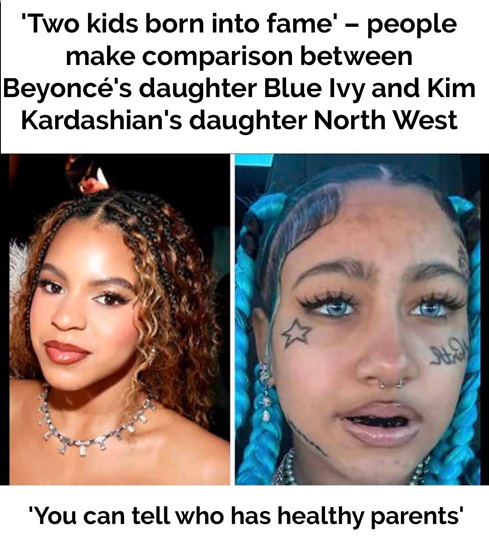
Children of major celebrities often grow up under a level of public attention that most young people never experience. Their clothes, hairstyles, public appearances and even ordinary moments can quickly become subjects of discussion among millions of strangers online. That reality has followed Blue Ivy Carter, the daughter of Beyoncé and Jay-Z, and North West, the daughter of Kim Kardashian and Ye, formerly known as Kanye West.
Both have famous parents and have appeared publicly from an early age, but their personalities and styles have developed in noticeably different ways. Those differences recently became the basis of a viral social-media comparison that sparked a much larger debate about parenting, family structure and the way people discuss children online. The viral discussion placed images of Blue Ivy and North side by side and attempted to draw conclusions about their upbringing based largely on their appearances.
One widely circulated post argued that the girls represented different outcomes associated with different family situations. The comparison quickly attracted attention, but many viewers objected to the premise. They argued that photographs and short videos provide almost no reliable basis for judging a child’s home life, emotional well-being or relationship with their parents. More importantly, critics noted that the comparison involved two young people who did not choose to become subjects of an online debate about parenting.
Part of the controversy centered on images showing North with blue elements in her hair, face markings, a dark dental accessory and piercings. The appearance generated considerable commentary when it first appeared online. However, reports at the time made clear that important elements of the look were temporary. North had displayed fake face tattoos and a faux septum piercing, while Kim Kardashian later explained that North and her friends enjoyed experimenting with costumes and different looks during the Halloween season. North herself reportedly regarded the controversy as unnecessary because the accessories were not permanent.

That context significantly changes how the photographs should be interpreted. A costume or temporary fashion experiment cannot reasonably provide a complete picture of someone’s personality, family environment or future. Young people frequently experiment with clothing, hairstyles and fictional personas, particularly around Halloween.
Some social-media users therefore criticized the viral comparison for presenting North’s dramatic appearance without sufficient explanation. Others emphasized that Blue Ivy and North are different individuals with different interests, personalities and approaches to fashion. Their appearances do not need to match simply because they were both born into internationally famous families.
The debate also expanded into criticism of Kim Kardashian’s parenting, with some commenters attempting to connect North’s appearance to her parents’ divorce. That argument prompted considerable pushback. Family structure alone does not establish whether a child is being raised successfully, and photographs certainly cannot demonstrate the quality of parenting occurring privately.
Commenters challenging the viral narrative pointed out that children can thrive in many different family arrangements. Reducing a young person’s character to whether their parents remain married oversimplifies complicated family relationships and places an unfair burden on children whose parents have separated.
There is another issue at the center of the controversy: both girls are minors. Discussions about celebrity culture can easily shift from commenting on famous adults to scrutinizing their children. Several people participating in the debate reminded others that young people should be allowed to experiment with fashion and appearance without every choice being interpreted as evidence of a deeper personal problem.
North’s public style has repeatedly attracted attention because she has shown an interest in distinctive clothing, colored hair and unconventional accessories. Recent coverage has continued to describe her fashion as highly individual and experimental. Blue Ivy has followed a different public path.
She has increasingly appeared alongside Beyoncé and has developed experience as a performer, including appearances connected with her mother’s work. Her public presentation is often different from North’s, but that distinction does not establish that one girl has been raised better than the other. Comparing two children as though they represent competing parenting philosophies risks turning normal differences in personality into a judgment about their families. It can also encourage audiences to treat isolated photographs as evidence of circumstances they cannot actually observe.
The controversy illustrates a broader problem with viral social-media posts. A striking photograph combined with a provocative caption can spread much faster than the context behind it. Once millions of people encounter the simplified version, assumptions can quickly become repeated as though they were established facts. In this case, knowing that North’s tattoos and some piercings were fake is essential context. Kardashian publicly described the appearance as part of the girls’ enthusiasm for costumes and explained that North did not understand why the temporary look had become such a major controversy.
Ultimately, Blue Ivy Carter and North West should not have to serve as symbols in an online argument about which famous family has the better parenting style. They are two different young people growing up under unusually intense public scrutiny. Their clothing, hairstyles and creative choices may naturally be different, just as those of other children are.
Adults can discuss celebrity parenting and social-media exposure without insulting children or making unsupported claims about their emotional health. The viral comparison is therefore less revealing about either girl than it is about how quickly social media can transform a few images into sweeping conclusions about people whose private lives the audience does not actually know.
