I was seven months pregnant when I lost Adam, the man I had planned to marry. His death left behind a future we had already started building in our minds but never got to live together. Six weeks before our wedding, he was killed in a crash, and suddenly every plan we had made disappeared. What remained was our unborn daughter, Lily, and the responsibility of raising her in a world where her father would exist only through photographs, stories, and the memories I could preserve. For the first several years, it was just the two of us.
I learned how to be exhausted and grateful at the same time. Lily grew up asking about Adam in the simple, direct way children ask questions adults sometimes struggle to answer. I kept photographs of him around the house and told her what I remembered: the way he laughed, the music he loved, the terrible jokes he repeated even when nobody laughed, and the way he had once spoken about becoming a father.
Then Tony entered our lives. He was the maintenance worker at our apartment complex who first appeared at our door because the kitchen sink was leaking. He returned several times for ordinary repairs, and eventually conversations became friendship. Tony never behaved as though he wanted to replace Adam. That mattered to me more than anything else. He simply showed up, again and again, without demanding a place that did not yet belong to him.
He attended Lily’s school events, learned how to braid her hair badly enough that she laughed every morning, and sat outside her bedroom when nightmares woke her. When Tony and I eventually married, Lily surprised him during the reception by calling him “Dad.” He froze, knelt beside her, and cried. Later, when nobody was watching, he admitted that being trusted by her meant more than anything else that had happened that day.
For a while, life finally seemed as though it might be settling into something gentle. Then Lily became sick. At first, the symptoms seemed disconnected. She was unusually tired, bruised more easily than before, and gradually lost the energy that had once carried her through entire afternoons without stopping. After appointments and testing, we received a diagnosis that changed everything.
In this fictional story, Lily was diagnosed with leukemia. The next two years were dominated by treatment, hospital visits, medication schedules, blood tests, and long stretches of uncertainty. There were periods when we allowed ourselves to believe the treatment was working, followed by setbacks that made us afraid to hope too strongly. Tony remained beside her through all of it, learning the names of her medications, memorizing which foods she could tolerate, and sleeping in uncomfortable chairs rather than leave her alone.
As Lily approached ten, her doctors eventually told us that the available treatments were no longer helping in the way everyone had hoped. The conversation that followed was one I would have done anything to avoid. Her doctor explained that the focus needed to shift toward comfort and quality of life. When Tony and I eventually told Lily that the doctors could not make her illness disappear, she listened more calmly than either of us expected.
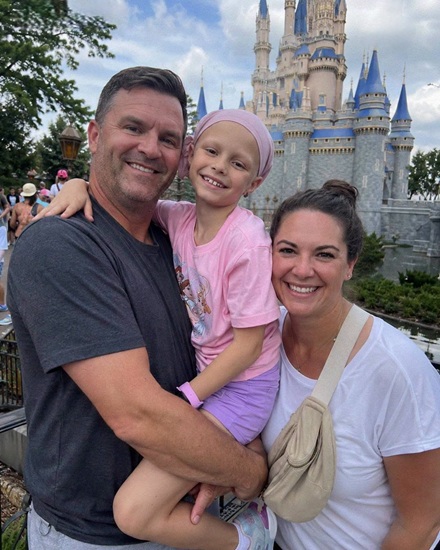
Then she told us what she wanted. She wanted to see Cinderella’s castle. After a pause, she added one more wish: she wanted to put her feet in the ocean. We had almost no money left. Medical bills had consumed much of what we had, but Tony refused to let those two wishes remain impossible. I sold a gold bracelet that had belonged to my mother, and Tony accepted every additional shift he could manage.
He also took small weekend jobs whenever someone needed repairs. We received help from people who knew what we were facing. Travel points reduced some expenses, and a local charity helped with part of the trip. Eventually, we managed to arrange several days in Florida. For five days, Lily seemed lighter than she had in years.
She had breakfast with costumed characters, stood smiling in front of the castle she had talked about for months, and used an adaptive beach wheelchair that allowed us to bring her close enough for the waves to touch her feet. She laughed when the first cold wave reached her toes. Tony laughed too. I watched both of them and tried not to think about how badly I wanted time to stop.
On the final morning, Lily remained asleep in our hotel room while Tony went outside to organize the rental car. I walked downstairs to check out. I expected nothing more complicated than signing the final paperwork. Instead, the hotel manager hesitated. In this fictional story, her name was Denise. She pulled a sealed envelope from behind the front desk and placed it in front of me.
“There’s something I think you need to know,” she said. Inside was documentation showing that several expenses we believed had been covered anonymously had actually been paid by someone named Robert. I recognized the name immediately. Robert was Adam’s father. Lily’s biological grandfather. I had not spoken with him in sixteen years.
The last period we shared had been filled with grief, anger, and accusations after Adam died. Both families were devastated, and instead of supporting one another, we slowly became enemies. Letters were exchanged. Things were said that should never have been said. Eventually, communication stopped completely. I believed Robert wanted nothing to do with us, and apparently, he believed exactly the same thing about me.
Denise told me Robert was waiting outside. For several seconds, I could barely process what she meant. Then anger arrived, not toward Robert, but toward Tony. I walked outside and found my husband beside the rental car. He saw the envelope in my hand and immediately understood.
“You contacted him?” I asked.
Tony nodded. He explained that while searching through our old documents for Lily’s travel paperwork, he had discovered several letters connected to Adam’s family. One of them contained Robert’s phone number and a final request asking to be contacted if Lily ever wanted to know him. Tony had called.
He told Robert that Lily was seriously ill. He told him about the trip. And without telling me, he allowed Robert to help financially. I told Tony he had no right to make that decision behind my back. He did not argue. He explained that he had not promised Robert any meeting with Lily and had only allowed him to contribute directly toward some expenses through the hotel and travel arrangements.
Tony insisted that Robert had been told he could not meet Lily unless I agreed. “I thought we had time to decide,” Tony said. “Then I realized we might not.” I understood why he had done it, but that did not make keeping the secret acceptable. Before we could continue arguing, Denise approached. Lily had awakened upstairs and asked where everyone had gone.
A short time later, all three of us were back in the room. This time, Tony and I told her everything. We explained that Adam’s father was downstairs. I showed Lily an old photograph of Adam when he was around her age. She studied it for a long time, then smiled and said he had her eyes.
I asked whether she wanted to meet Robert. Lily did not hesitate. “Yes,” she said. Robert entered the room several minutes later. He did not bring expensive gifts. He carried a small wooden music box that had belonged to Adam when he was young.
Robert sat beside Lily and began telling her stories. Not dramatic stories, but ordinary ones. He told her that Adam hated tying his shoes, that he once tried to keep a frog in the bathtub, that he loved pancakes, and that he refused to admit when he was frightened. Lily listened to every word.
For years, I had told her about Adam as the man I loved. Robert could tell her about the boy he had raised. Those stories gave Lily a version of her father I had never been able to provide. Eventually, she asked Robert why he had stayed away.
He looked at me before answering. “Because grown-ups can be foolish when they are hurting.” That answer was more generous than either of us deserved. Within the fictional story, we were able to extend the trip by one additional day after making sure Lily was comfortable enough for the change.
Robert covered the additional hotel and travel costs. More importantly, he stayed. That afternoon, we returned to the beach. Tony pushed Lily’s chair from one side while Robert walked beside him. For a moment, I watched the man who had raised Adam and the man who had raised Adam’s daughter moving together toward the water.
There was something both painful and beautiful about it. Lily laughed when the waves reached her feet again. Robert cried quietly. Later, she asked a member of the hotel staff to take a photograph. At first, everyone stood too far apart.
Lily noticed. “No,” she said. “Closer.” We moved together. Robert on one side, Tony on the other, and me behind Lily. I asked her why she wanted us so close. She smiled and said, “Because I want everyone who came for me in the same picture.”
That photograph became one of the most important things I carried home. It did not erase sixteen years of separation. It did not solve every problem between Robert and me. And it certainly did not erase the fact that Tony had made a major decision behind my back.
After the trip, Tony and I had difficult conversations about trust and boundaries. I told him that good intentions did not automatically justify secrecy. He agreed. I also admitted something harder: had Tony asked me before calling Robert, I probably would have said no.
And Lily might have lost the opportunity to hear stories about her father directly from the person who had known him first. That truth did not make Tony entirely right. It simply made the situation complicated. The trip had started as an attempt to fulfill two wishes: see the castle and touch the ocean.
Instead, Lily received something else. She met her biological grandfather. She heard stories about Adam that had been missing from her childhood. And for one afternoon, she sat on a beach surrounded by people whose lives had all been connected through her.
Years of anger between adults could not be undone in one day. But one day could still matter. That was the lesson I carried home. Reconciliation does not always repair the past. Sometimes it simply prevents the future from containing one more regret.
Tony should have told me what he was doing. Robert and I should have found a way to speak years earlier. None of us could change those mistakes. But when Lily asked us to stand close together for the photograph, we did.
For that moment, there were no old letters, no arguments, and no years of silence. There was only a ten-year-old girl smiling toward the camera while everyone who loved her stood close enough to fit inside the same frame.
