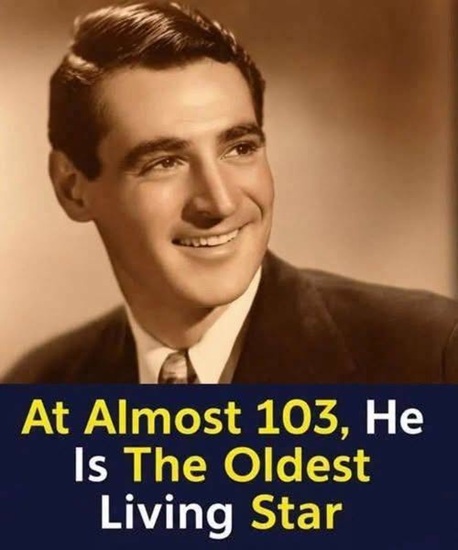
Few industries preserve their history as visibly as film and television. Performances recorded decades ago can still introduce new audiences to actors and entertainers whose careers began before modern television, streaming services or digital filmmaking existed. In 2026, several extraordinary entertainment figures have reached or surpassed their 100th birthdays. Their longevity is remarkable, but claims that they are “defying biological limits” or ignoring doctors’ orders should not be made without evidence.
Their documented careers are impressive enough without adding unsupported health claims. One particularly remarkable surviving figure from Hollywood’s Golden Age is Eva Marie Saint, who celebrated her 102nd birthday on July 4, 2026. Born in 1924, Saint built a career spanning more than seven decades and became the oldest living Academy Award winner. Her longevity provides an extraordinary connection to an era when Hollywood’s classical studio system still shaped American filmmaking and stars such as Marlon Brando, Cary Grant and Alfred Hitchcock were producing some of their most celebrated work.
Saint made an unforgettable feature-film debut opposite Marlon Brando in Elia Kazan’s 1954 drama On the Waterfront. Her performance as Edie Doyle earned her the Academy Award for Best Supporting Actress. Winning an Oscar for a first major movie performance immediately established her as an important screen talent, but it was only the beginning of a career that would extend through radically different periods of American entertainment.
Five years later, Saint appeared opposite Cary Grant in Alfred Hitchcock’s North by Northwest, playing the sophisticated and mysterious Eve Kendall. The film became one of Hitchcock’s most enduring works and remains a landmark of suspense cinema. Saint subsequently worked alongside other major performers and continued appearing across film and television, eventually earning a Primetime Emmy as well as her Academy Award.
At 102, Saint represents an increasingly rare direct connection with the Hollywood of the 1950s. Yet reports about her current life are considerably less dramatic than claims that she is desperately fighting against age. She has largely remained away from the intense public spotlight. Recent reporting has described her enjoying walks, following baseball and spending time with loved ones—ordinary pleasures accompanying an extraordinary lifespan.
Another remarkable milestone arrived only days before Saint’s 102nd birthday. Mel Brooks turned 100 on June 28, 2026, joining the relatively small group of major entertainment figures who have lived for a century. Born Melvin Kaminsky in Brooklyn in 1926, Brooks has spent much of his adult life making audiences laugh through television writing, recordings, movies, Broadway productions and countless public appearances.
Brooks’ life began far from Hollywood glamour. He served in the U.S. Army during World War II before developing his entertainment career. After performing in the Borscht Belt, he became part of the writing staff for Sid Caesar and established himself among an influential generation of comedy writers. His friendship and creative partnership with Carl Reiner subsequently produced the famous “2000 Year Old Man” routine.
His career as a filmmaker produced an extraordinary collection of comedies. The Producers, Blazing Saddles, Young Frankenstein, High Anxiety and Spaceballs are among the titles most closely associated with Brooks. His comedy frequently relied on parody, absurdity and an eagerness to challenge convention. Over the decades, his work moved from television writers’ rooms to cinema screens and eventually to Broadway.
Brooks also belongs to the exclusive group of entertainers who have won an Emmy, Grammy, Oscar and Tony—the collection commonly known as an EGOT. Reaching 100 did not erase his interest in comedy or his connection with the entertainment world. Around his centennial, renewed attention was directed toward his career, archives and enormous influence on generations of comedians and filmmakers.
His life and work were also examined in the documentary Mel Brooks: The 99 Year Old Man!, directed by Judd Apatow and Michael Bonfiglio. Brooks has continued participating in entertainment-related activities at an age when retirement would hardly be surprising. He contributed to Eddie Murphy’s American Film Institute tribute and arranged for his professional archives to become part of the National Comedy Center’s collection.
Dick Van Dyke represents another extraordinary centennial story. The beloved performer celebrated his 100th birthday on December 13, 2025. Generations know him from The Dick Van Dyke Show, Mary Poppins, Chitty Chitty Bang Bang and many other television, film and stage appearances. His ability to combine comedy, acting, singing and physical performance made him one of the most distinctive entertainers of his generation.
Van Dyke’s television work alone secured an enduring place in entertainment history. The Dick Van Dyke Show, which originally ran during the 1960s, helped define an era of American situation comedy. His portrayal of television writer Rob Petrie combined verbal humor with physical comedy, while his partnership with Mary Tyler Moore became one of classic television’s best-remembered pairings.
His film career expanded his audience internationally. As Bert in Disney’s Mary Poppins, Van Dyke sang and danced alongside Julie Andrews in a movie that became a family classic. Chitty Chitty Bang Bang followed several years later, further establishing his association with musical entertainment. Decades later, he returned to the world of Mary Poppins with an appearance in the 2018 sequel Mary Poppins Returns.
Van Dyke has remained unusually visible in advanced age, which has helped generate widespread fascination with his longevity. But his life should not be framed as a race against an imminent death. Being 100 naturally brings physical changes and health considerations, yet age alone does not justify claiming that someone’s condition is rapidly deteriorating. Accurate reporting distinguishes celebration of longevity from speculation about private medical circumstances.
Another major centennial figure is Lee Grant, who turned 100 on October 31, 2025. Her career contains not only acclaimed performances but also an important chapter of Hollywood history. Grant endured years of professional consequences after being blacklisted during the anti-communist era before successfully rebuilding her career. She later won an Academy Award and expanded her work into directing.
Grant’s career illustrates how surviving a century can mean witnessing enormous transformations far beyond technology. She experienced an industry affected by political pressures, changing social expectations and evolving opportunities for women. Her eventual return to prominent work after years of professional exclusion made her career about far more than longevity.
The centenarian entertainment world extends beyond Hollywood actors. Natural historian and broadcaster David Attenborough celebrated his 100th birthday on May 8, 2026. His work has introduced generations to wildlife and environmental science through documentaries produced across an astonishing period of technological development. Even as he approached his centenary, his connection to nature programming continued.
Attenborough’s career provides a particularly vivid example of how broadcasting changed during one person’s professional lifetime. He began working in television when the medium itself was comparatively young. Decades later, audiences could watch nature documentaries featuring ultra-high-definition photography, drones and sophisticated underwater technology unimaginable when his career began.
The original text also names June Lockhart, but an important correction is necessary. Lockhart is not currently among the surviving centenarian entertainers. The beloved actress died peacefully of natural causes in Santa Monica on October 23, 2025, at age 100, according to her family spokesman. Any current article describing her as still alive would therefore be inaccurate.
Lockhart nevertheless deserves recognition when discussing this remarkable generation. She became particularly famous for playing Ruth Martin, the mother on Lassie, and later Maureen Robinson in the science-fiction series Lost in Space. She also appeared in Petticoat Junction, General Hospital and numerous other productions during a career extending across stage, film and television.
Her death at 100 illustrates why accuracy is especially important when discussing extremely elderly public figures. Articles and social-media posts created only months earlier can quickly become outdated. Rather than describing surviving stars collectively as though they share the same circumstances, each person’s current status should be independently verified.
What connects these entertainers is not a secret formula for immortality. There is no scientifically established lifestyle shared by Van Dyke, Brooks, Saint, Grant and Attenborough that guarantees reaching 100. Genetics, environment, healthcare, socioeconomic circumstances, lifestyle and chance can all influence longevity. Their individual comments about humor, relationships, activity or purpose can be interesting, but they should not be converted into universal medical advice.
Their careers nevertheless provide an extraordinary way of understanding the history of entertainment. These individuals began working when radio remained enormously influential, television was developing into a mass medium and movies were distributed on physical film. They subsequently witnessed color television, home video, cable, DVDs, digital filmmaking and finally streaming.
The cultural changes have been equally dramatic. Styles of comedy evolved. Hollywood’s studio system declined. Television expanded from a handful of channels into an enormous international ecosystem. The boundaries between cinema, television and online entertainment became increasingly blurred.
Yet work created during these entertainers’ early careers remains accessible.
A teenager can watch North by Northwest today and see Eva Marie Saint exactly as audiences saw her in 1959. Families can discover Dick Van Dyke dancing in Mary Poppins. New comedy fans can encounter Young Frankenstein or Blazing Saddles decades after their original releases.
That is perhaps the most extraordinary aspect of artistic longevity.
A performer ages.
The recorded performance does not.
Reaching 100 does not mean these figures have somehow defeated aging, nor should their stories be presented as though tragedy is necessarily imminent. Instead, their lives demonstrate how long an artistic influence can endure. Some remain professionally active, while others have chosen quieter lives. Both choices deserve respect.
Eva Marie Saint at 102, Mel Brooks at 100, Dick Van Dyke at 100 and Lee Grant at 100 each represent different chapters of entertainment history. David Attenborough’s centenary adds another extraordinary broadcasting career to that group. June Lockhart, who reached 100 before her death in 2025, belongs historically alongside them even though she is no longer living.
Their longevity naturally encourages reflection about aging, but their value should never be reduced simply to the number beside their names. These are artists whose work influenced generations long before their 100th birthdays became headlines.
They remind audiences of something more meaningful than the inevitability of growing older.
Creative work can travel far beyond the circumstances in which it was originally produced. A joke written seventy years ago can still generate laughter. A performance filmed in black and white can still move an audience watching on a smartphone. A song, character or television episode can connect people who were born generations apart.
No one knows exactly how much time any individual has left, whether that person is 30 or 102. For that reason, claims that “time is rapidly running out” for specific elderly celebrities are both unnecessary and impossible to establish without medical information.
What can be celebrated is already remarkable.
Some of the people who helped shape twentieth-century entertainment lived long enough to see an entirely different media world emerge around them. Their careers crossed technologies, generations and cultural eras that once seemed impossible to connect.
And even when the performers themselves are eventually gone, their work will remain.
