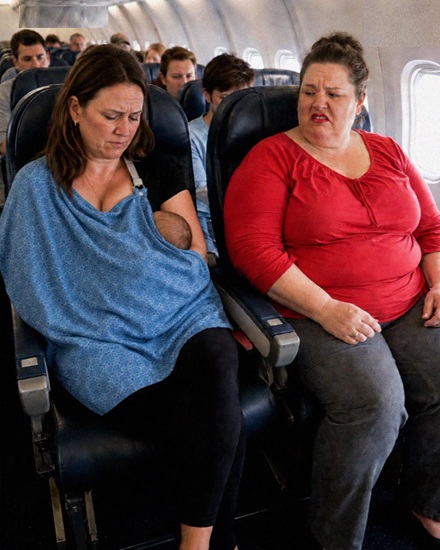
One month after burying my husband, Mark, I boarded a six-hour flight with our two children and hoped the trip might give us a little room to breathe. My mother had invited us to stay with her for several weeks, and although I did not feel ready to travel, I knew remaining inside the same silent house was becoming unbearable. Louise was eight, old enough to understand that her father was gone but still young enough to expect him to appear in familiar places. Noah was only five months old and still reacted whenever he heard a man’s voice nearby.
Grief had turned the simplest routines into reminders of everything we had lost. Mark had been thirty-seven when cancer took him after nine exhausting months. Before his illness, he was the person who remembered passports, carried the heavier bags and somehow made every stressful situation feel manageable. Now I checked our documents repeatedly because I was terrified I would forget something important. Louise quietly held Noah’s bottle while I packed, taking on little responsibilities nobody had asked her to carry.
When she saw me place one of Mark’s old sweaters inside my bag, she did not ask why. Instead, she put her favorite stuffed rabbit beside it. The flight was completely full, and our assigned seats separated Louise from me by one row. I sat in the aisle with Noah against my chest while Louise settled just behind us. She reached through the space between the seats and squeezed my shoulder before takeoff. “I can see you,” she whispered. I smiled and reminded her that she could call me if she genuinely needed something. For one brief moment, the situation felt manageable.
Then the woman sitting beside me looked at Noah.
She introduced herself later as Evelyn, but at first all I knew was that she appeared irritated before the aircraft had even moved. She glanced at the baby, then at me, and warned that she did not want to spend the flight listening to him cry. I told her calmly that I would do my best, although I could not promise that a five-month-old would remain completely silent for six hours. Louise leaned forward and said that her brother was usually quiet. Evelyn ignored her.
For nearly two hours, Noah slept peacefully.
I stared through the window and tried not to think about Mark. Clouds stretched beneath us like an endless white landscape, and for a few minutes I allowed myself to imagine that grief had stayed behind at the airport. Then Noah woke and began crying. I checked his diaper, rocked him and offered his pacifier, but nothing helped.
He was hungry.
I arranged a nursing cover and began feeding him.
Evelyn reacted immediately.
She complained that she should not have to sit beside someone feeding a baby and suggested that I take Noah into the bathroom. My embarrassment quickly gave way to frustration. I told her that an airplane restroom was not an appropriate place to feed an infant and that Noah had every right to eat when he was hungry. His crying had already stopped, yet Evelyn continued criticizing me.
That was when Louise appeared beside our row.
“Mom, take my seat,” she said. “I can sit here.”
I initially refused because I did not want my daughter feeling responsible for protecting me. But Noah was settling, and moving one row forward would give me a little space. Louise sat beside Evelyn while I took her seat.
Before I moved, she whispered something strange.
“She dropped something.”
I asked what she meant, but Louise said she would explain later.
A few minutes afterward, I noticed her bending toward the floor. She picked up a small photograph that had fallen beside Evelyn’s shoe. At the same time, Louise’s tablet was displaying a photograph of me holding Noah with Louise leaning against my shoulder.
She placed the two images side by side.
Evelyn suddenly stood.
Her reaction was so sharp that several passengers turned around.
A flight attendant approached, and Evelyn demanded to know where Louise had gotten the photograph. Louise calmly explained that it had fallen onto the floor.
Then she asked a question.
“Would you want someone speaking to your daughter the way you spoke to my mom?”
Evelyn looked at the photograph.
The woman in it was her daughter, Jenna.
The baby was her grandson.
For the first time since we had boarded the aircraft, Evelyn seemed to lose every argument she had prepared.
She sat down slowly.
“No,” she finally whispered. “I would not want anyone to talk to Jenna like that.”
Louise closed her tablet.
“Then don’t.”
The simplicity of the answer seemed to affect Evelyn more than anger ever could have.
When I returned to my original seat after Noah finished eating, Evelyn was still holding the photograph. She apologized and told me she had never met her grandson, despite being invited several times.
I asked why.
Her answer surprised me.
She disapproved of many of her daughter’s choices.
Where Jenna lived. Her partner’s job. Her schedule. Even the fact that she sometimes fed her baby during family gatherings instead of leaving the room.
Evelyn admitted that she was flying to visit Jenna for the first time and had spent much of the journey planning everything she intended to criticize.
I looked down at Noah.
Then I told her about Mark.
“My husband died a month ago,” I said. “I’m learning how to do ordinary things without him. You looked at me for a few minutes and decided you knew what kind of mother I was.”
Her eyes filled with tears.
She apologized again.
I told her that an apology mattered only if she understood what needed to change.
For several minutes she said nothing.
Then she took out her phone.
“I need to write to Jenna.”
She asked what she should say.
I refused to write the message for her.
Instead, I suggested that she admit what she had done without defending it, explain what she wanted to change and allow Jenna to decide what happened next.
Evelyn began typing.
She acknowledged that she had judged her daughter from a distance and had been preparing to arrive with criticism instead of support. She wrote that she wanted to meet her grandson and asked what Jenna actually needed from her.
Then she pressed send.
About ten minutes later, her phone buzzed.
Jenna had replied.
She was still willing to let Evelyn visit, but only if her mother truly meant what she had written.
Evelyn read the message repeatedly.
I could see the relief on her face, but also something more serious.
Responsibility.
Apologies could be made quickly.
Change would have to survive everything that came afterward.
After landing, we walked toward baggage claim. My mother was waiting near one of the carousels, but before I reached her, I saw Evelyn stop.
A younger woman stood several feet away holding a baby.
It was Jenna.
Evelyn did not rush toward her.
Instead, she asked whether she could hug her.
Jenna hesitated, then nodded.
The embrace lasted only a few seconds.
Evelyn did not immediately reach for the baby. She simply stood beside her daughter and listened.
I could not hear their conversation.
I did not need to.
They walked toward baggage claim together.
It was not a perfect reconciliation.
It was only a beginning.
Several weeks later, while the children and I were still staying with my mother, a card arrived.
Inside was a photograph.
Evelyn was sitting beside Jenna on a sofa while holding her grandson. Jenna rested one hand gently against the baby’s back.
Underneath, Evelyn had written a short message.
She said she was learning to listen before correcting and to ask before offering help.
She thanked us for interrupting the person she had been becoming.
Louise pinned the photograph to my mother’s kitchen notice board.
I asked why she wanted to keep it.
She looked at me thoughtfully.
“Because sometimes speaking up doesn’t just stop someone from being mean,” she said. “Sometimes it changes what they do next.”
I thought about Mark.
He had always told Louise that courage was not the absence of fear.
It was deciding what mattered more than fear.
On that flight, my daughter had not only defended me.
She had reminded a stranger that compassion should not depend on whether the person being judged happens to be someone you love.
And somehow, in the middle of our own grief, that small act gave another family a chance to begin again.
