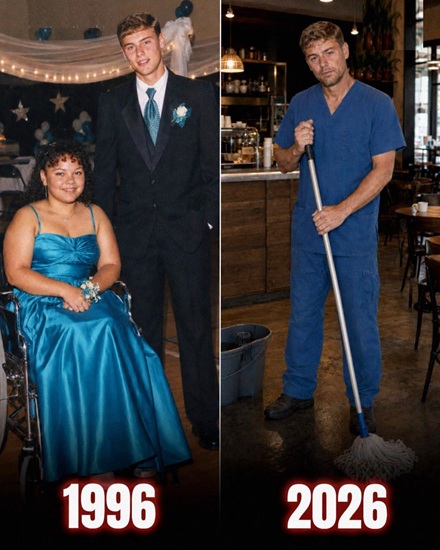
Six months before my high school prom, my life changed in a way I never could have imagined. I was seventeen, worried about ordinary things like grades, dresses, friendships and whether the boy I liked would notice me. Then a serious car crash left me facing injuries, rehabilitation and an uncertain future. My legs had been badly hurt, my spine was damaged, and suddenly conversations about school were replaced by conversations about mobility, recovery and what I might or might not be able to do again.
By the time prom arrived, I had little interest in going. I had spent months learning how to navigate a world that suddenly felt different. I hated the attention my wheelchair attracted and felt uncomfortable whenever people stared. My mother, however, refused to let fear make every decision for me. She reminded me that I still had the right to be part of the life happening around me, even if that life no longer looked exactly the way I had expected.
So I went.
The school gym had been transformed with lights, decorations and music. Everyone looked excited and nervous at the same time. Friends came over to tell me I looked beautiful, posed for photographs and tried to make conversation. Then, one by one, they returned to the dance floor. I smiled and pretended that sitting near the wall did not bother me.
That was when Marcus walked across the room.
We had known each other at school, but not particularly well. He stopped in front of me and asked if I wanted to dance.
I laughed because I thought he was joking.
“I can’t dance,” I told him.
Marcus looked at me for a second and said something I never forgot.
“Then we’ll figure out what dancing looks like.”
Before I could talk myself out of it, he guided my wheelchair onto the dance floor. I immediately became aware of everyone around us, but Marcus seemed completely unconcerned. He took my hands, moved with the music and slowly turned my chair in a circle. When he saw me laughing, he spun me again.
For the first time since the accident, I was not thinking about what my body could no longer do.
I was simply having fun.
When the song ended, Marcus brought me back toward the table. I asked why he had done it.
“Because nobody else asked,” he said.
That answer stayed with me.
Soon after graduation, my family moved so I could continue rehabilitation closer to specialists. Life became filled with physical therapy, appointments and surgeries. Marcus and I lost contact, and eventually high school became something I remembered rather than something I expected to return to.
Recovery was slow.
Over the following years, I learned to transfer independently, stand with support and eventually walk limited distances. I learned that recovery was not a straight line. Some days felt like victories, while others reminded me how much work remained.
The accident also changed the way I saw buildings and public spaces.
I began noticing doors that were too narrow, ramps hidden around the back of buildings and bathrooms that technically met requirements but were still difficult to use. Eventually, that frustration led me toward architecture and accessible design.
College took longer than I had originally planned, but I finished.
I worked for several firms before eventually starting my own company. Over time, we became known for designing spaces that did more than satisfy basic accessibility requirements. I wanted buildings to feel welcoming rather than simply compliant.
Decades passed.
Then, when I was nearly fifty, I walked into a café near one of our construction sites and accidentally spilled coffee across the counter.
A man working nearby immediately came over to help.
He wore a café apron over faded medical scrubs and walked with a noticeable limp. He cleaned the floor, found napkins and asked the cashier to replace my coffee.
When he looked up, something about his eyes stopped me.
He seemed to recognize something too.
“You look familiar,” he said.
I stared at him.
So did he.
The next afternoon, I returned to the café.
When he approached my table, I finally said what had been running through my mind all night.
“Thirty years ago, you asked a girl in a wheelchair to dance at prom.”
He froze.
Then he whispered my name.
“Emily?”
It was Marcus.
We sat together for nearly an hour.
His life had taken a completely different path from mine. Shortly after graduation, his mother became seriously ill. His father was no longer around, and Marcus abandoned many of his plans so he could work and help support her.
He moved between jobs for years.
Warehouses, delivery work, maintenance, medical support roles and café shifts became part of his life. Somewhere along the way, he badly injured his knee. He kept working anyway, and eventually the problem became chronic.
I asked whether he had ever received proper treatment.
He shrugged.
“There was always something more important to pay for.”
That answer stayed with me.
Over the following weeks, I kept returning to the café.
We talked gradually, without trying to recreate high school. Marcus told me about his mother, his work and how exhausted he had become. I told him about rehabilitation, architecture and how my frustration with inaccessible buildings had eventually shaped my career.
When I offered to help him financially, he immediately refused.
So I stopped offering charity and offered him work instead.
My company was developing an adaptive recreation center, and we needed community consultants who understood disability from lived experience.
Marcus initially laughed.
“I’m not an architect.”
“I know,” I told him. “That’s exactly why I need you.”
He finally agreed to attend one meeting.
During that meeting, one of our designers asked what we were overlooking.
Marcus studied the plans for several minutes.
“You’ve made everything technically accessible,” he finally said. “But you haven’t made everything welcoming.”
Everyone went quiet.
He pointed to one entrance.
“If someone in a wheelchair has to go around the building and enter near the loading area, you’ve told them exactly where you think they belong.”
He was right.
That one meeting became another.
Then another.
Eventually, consulting became regular work.
Marcus also began receiving treatment for his knee. Nothing could erase years of damage, but therapy reduced his pain and improved his mobility. For the first time in years, he allowed himself to imagine that his situation did not have to remain exactly the same forever.
Months later, I found an old photograph from prom.
Marcus and I were smiling on the dance floor, his hands holding mine while my wheelchair was turned slightly toward the camera.
I brought it to work.
He stared at it for a long time.
“You kept this?”
“Of course.”
Then he told me something I had never known.
He had tried to find me after graduation.
By the time he learned my family had moved, his mother’s illness had taken over his life. Years passed, then decades.
“I thought you forgot me,” I said.
Marcus shook his head.
“You were the one person I always wondered about.”
Our friendship slowly became something more.
There was no dramatic moment where everything suddenly became perfect. We were two adults carrying decades of experiences, disappointments and scars.
But we understood something about each other.
We both knew what it felt like when life changed without asking permission.
Marcus eventually became an important part of our adaptive recreation program. He worked with coaches, advised designers and spoke with teenagers recovering from serious injuries.
He never promised them that everything would return to normal.
Instead, he reminded them that their identities were larger than whatever they had lost.
Months later, our new community center finally opened.
Music played through the main hall while families explored the building.
Marcus walked toward me.
He stopped exactly the way he had thirty years earlier and held out his hand.
“Would you like to dance?”
This time I didn’t hesitate.
I took his hand and smiled.
“We already know how.”
