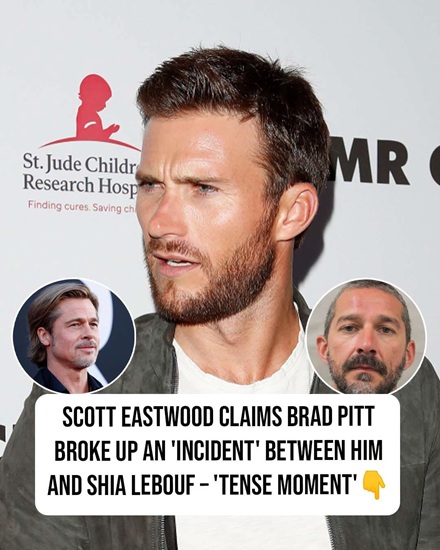
More than a decade after Fury arrived in theaters, Scott Eastwood has revisited one of the most uncomfortable moments he remembers from the making of the World War II drama. During an August 3, 2026 appearance on Armchair Expert with Dax Shepard, Eastwood discussed the confrontation he had with co-star Shia LaBeouf while filming David Ayer’s movie. The disagreement became heated enough that Brad Pitt ultimately intervened. Importantly, the strongest descriptions of LaBeouf in the recent coverage are Eastwood’s own characterizations and should be understood as his personal assessment rather than independent diagnoses or established facts about LaBeouf.
Released in 2014, Fury follows an American Sherman tank crew operating in Nazi Germany during the closing weeks of World War II. Pitt played tank commander Don “Wardaddy” Collier, while LaBeouf portrayed Boyd “Bible” Swan. Logan Lerman, Michael Peña and Jon Bernthal played the other principal members of the tank crew, while Eastwood appeared as Sergeant Miles. Director David Ayer sought an intense atmosphere for the production, and Pitt later described how the actors’ demanding preparation helped create a strong attachment not only to one another but also to the tank itself.
Eastwood said in his recent interview that LaBeouf’s approach to acting immediately struck him as unusually intense. He recalled hearing or observing extreme behavior associated with LaBeouf’s preparation, including reports that the actor removed a tooth and injured himself. Those stories about LaBeouf’s physical commitment to Fury have circulated for years, but Eastwood’s comments represent his recollection of the experience. He explained that his reaction at the time was essentially to keep his distance because he believed an actor could achieve a strong performance without adopting the same methods.

Whatever differences existed between their approaches to acting, they eventually became impossible to ignore during one particular scene. Eastwood’s character was chewing tobacco and spitting on the back of the Sherman tank. According to both Eastwood’s account and Pitt’s much earlier recollection, LaBeouf objected to what Eastwood was doing. The crucial detail was that Eastwood was not improvising the behavior simply to provoke his colleagues. The action was included in the screenplay, something that apparently was not understood by Pitt and LaBeouf while the scene was being filmed.
Eastwood recalled losing patience as the disagreement escalated. During his 2026 podcast appearance, he described threatening to fight LaBeouf after feeling that the situation had gone too far. According to Eastwood, LaBeouf responded confrontationally, and other people moved in as the exchange appeared increasingly likely to become physical. Pitt was among those who intervened and helped separate the actors before the situation developed further. Eastwood had actually discussed the same confrontation publicly years earlier, so the basic story itself is not a new allegation.
In fact, Eastwood spoke about the incident around the time Fury was released. In a 2014 interview with British GQ, he described LaBeouf as difficult to work with and said they had nearly gotten into a physical fight. His account then contained the same central details: Eastwood was chewing tobacco during a scene, LaBeouf objected to him spitting on the tank, the disagreement escalated, and Pitt eventually intervened. The new Armchair Expert conversation therefore provides additional context to an incident Eastwood has been discussing publicly for more than a decade.
Pitt also described what happened in a 2014 British GQ interview, and his version provides an important additional perspective. Pitt said he was actually the first person to become irritated with Eastwood. After the actors had undergone extensive preparation together, Pitt said they had developed a powerful sense that the Sherman tank was their shared home. Seeing Eastwood spit tobacco on it therefore struck Pitt as disrespectful, and he confronted him while cameras were rolling. LaBeouf noticed the situation and, according to Pitt, reacted similarly.

That shared reaction helps explain why the disagreement escalated so quickly. Pitt recalled that LaBeouf began exchanging words with Eastwood after seeing what was happening. Eventually, Pitt found himself intervening once the confrontation moved beyond the scene itself. Yet the story took an ironic turn after filming ended for the day. When the actors checked the screenplay, Pitt said they discovered that Eastwood’s character was explicitly supposed to be chewing tobacco and spitting it onto the back of the tank. Eastwood had therefore simply been carrying out the scripted action.
Pitt acknowledged the misunderstanding with humor when discussing it years ago. Rather than portraying himself as unquestionably correct, he conceded that he and LaBeouf had misunderstood the situation. That admission is important because it prevents the confrontation from being reduced to a simple story in which one actor deliberately disrespected his colleagues. From Pitt’s account, he and LaBeouf had become so immersed in their relationship with the tank that they reacted emotionally before realizing Eastwood was following the screenplay.
Eastwood nevertheless remains critical of his experience working with LaBeouf. During the 2026 conversation, he used highly charged language while discussing his former co-star and suggested that LaBeouf was personally troubled. He also made a broader comment that the film business can attract “psychopaths.” Those words should be attributed specifically to Eastwood rather than presented as an objective medical or psychological description of LaBeouf. Eastwood simultaneously acknowledged something important: regardless of his opinion of LaBeouf’s behavior, he considers him a compelling performer.
That distinction between professional admiration and personal conflict appears repeatedly in Eastwood’s comments. He may strongly disagree with the way LaBeouf approached the production, but he has also recognized the intensity LaBeouf brought to his performance. In Fury, LaBeouf’s Boyd Swan is the deeply religious gunner nicknamed “Bible,” and his performance became one of the movie’s memorable elements. Eastwood’s comments illustrate how actors can hold conflicting views about colleagues: appreciating the finished performance does not necessarily mean enjoying the process that produced it.
The confrontation also offers a revealing glimpse into the unusual working conditions surrounding Fury. Pitt’s recollection suggests that the cast’s preparation created exactly the kind of attachment the filmmakers wanted. The actors began thinking about the tank as their home rather than simply as a movie prop. That immersion contributed to the authenticity they were trying to achieve on screen, but in this case it also helped transform a scripted action into a genuine misunderstanding between performers.
Eastwood has continued working steadily since Fury, while the film remains one of the projects that connected him with several major actors early in his career. Looking back now, his memories include both admiration for Pitt and frustration over his encounter with LaBeouf. The fact that Pitt independently discussed the same episode in 2014 provides unusually strong confirmation that the confrontation happened, even though the participants naturally remember some of its details from different perspectives.
More than anything, the story demonstrates how quickly intense preparation and misunderstanding can collide on a film set. Eastwood was performing an action written for his character. Pitt and LaBeouf interpreted that action as disrespect toward something they had become emotionally attached to during production. Words were exchanged, tempers rose, and Pitt eventually helped prevent the confrontation from progressing further. Only afterward did the script clarify what had happened.
More than a decade later, all three perspectives leave an unexpectedly humorous detail at the center of an otherwise tense story: Eastwood had been following directions all along. Pitt himself recognized that fact after checking the screenplay. What began as genuine anger over the treatment of the crew’s tank ultimately turned out to be a misunderstanding created partly by how deeply the actors had immersed themselves in the world of Fury. Eastwood’s latest retelling adds sharper personal opinions, but the core incident has been publicly documented since the film’s original release.
