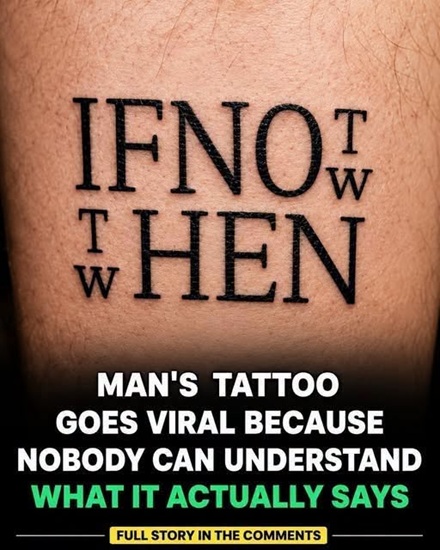
A wave of online confusion swept across social media when a single blurry photograph began circulating and instantly turned into a global puzzle. What appeared at first glance to be a simple tattoo quickly became the center of intense debate, drawing attention from thousands of users who attempted. Often unsuccessfully—to decipher the message hidden within the distorted lines of ink. The more people looked at it, the more complicated it seemed to become.
The tattoo, located along a man’s forearm, was originally intended to represent a meaningful motivational quote. According to the general idea behind it, it was supposed to serve as a permanent reminder of personal growth and decision-making. However, due to the design layout and spacing issues, the final result appeared heavily compressed and visually unclear, making the text extremely difficult to interpret.
When the image first appeared online, it spread rapidly across multiple platforms. Users began zooming in, cropping sections, and attempting to isolate individual letters. Despite these efforts, no consensus emerged. Instead, the image became a source of endless speculation, with each viewer interpreting something slightly different from the next.
Some users insisted they could identify fragments of words, while others argued that the entire tattoo might be meaningless or improperly executed lettering. The disagreement only fueled further attention, transforming the image into a kind of digital puzzle that people felt compelled to solve, even when they were no longer sure what they were looking for.
As discussion intensified, the tattoo began to take on a symbolic quality. It was no longer just body art; it became an example of how visual communication can fail when design and execution do not align properly. Many commenters noted that what was intended to be inspirational now appeared chaotic, almost like a visual distortion of a simple message.
Eventually, after extensive online discussion, a widely accepted interpretation emerged: the tattoo was meant to read “If not now, then when.” This phrase, commonly associated with motivation and self-improvement, is often used to encourage immediate action and discourage procrastination. However, even after this explanation surfaced, many viewers still struggled to visually confirm the phrase within the ink.
That contrast between intended meaning and perceived confusion became the focal point of the entire discussion. The situation highlighted how easily communication can break down when presentation overshadows clarity. What was supposed to be a simple and powerful statement had, instead, become an unintentionally complex visual challenge.
As the conversation continued, users began to reflect on why the tattoo had generated such strong reactions. Part of the fascination came from the universal nature of the problem: most people have experienced misunderstandings, miscommunications, or outcomes that did not match their original intention. The tattoo became a visual metaphor for that experience.
In many ways, the image also revealed how collective interpretation works online. Once a piece of content gains attention, it often evolves beyond its original meaning. People project their own assumptions onto it, shaping it into something that reflects shared curiosity, frustration, or humor rather than objective truth.
The man at the center of the viral image unintentionally became part of a much larger conversation about perception. While his personal intention may have been clear to him, the public response demonstrated how easily meaning can shift once it enters a wider audience. What feels obvious to one person may appear entirely different to another.
As more time passed, the intensity of the debate began to fade, but the image remained memorable. It was no longer just about decoding words; it had become a reference point for discussions about clarity, design, and interpretation. People continued sharing it not only for entertainment, but also as an example of how small details can dramatically change understanding.
Beyond the humor and confusion, some observers pointed out a deeper reflection embedded in the situation. The tattoo served as an unintentional reminder that intentions do not always translate perfectly into outcomes. Ideas that seem simple in thought can become complicated when expressed visually or practically.
The situation also illustrated how easily the internet can amplify small imperfections into global talking points. What might have gone unnoticed in everyday life became, instead, a widely discussed phenomenon simply because it was shared in the right place at the right time.
In the end, the tattoo remained unchanged, but its meaning evolved far beyond its original purpose. It became less about the words themselves and more about the experience of trying to understand them. The confusion it caused was temporary, but the discussion it sparked highlighted something more lasting about communication and perception.
Ultimately, the image serves as a reminder that clarity is not always guaranteed, even when intentions are strong. Messages can become distorted, interpretations can vary, and meaning can shift depending on who is looking. And sometimes, the gap between what is meant and what is seen becomes the most interesting part of the story.
