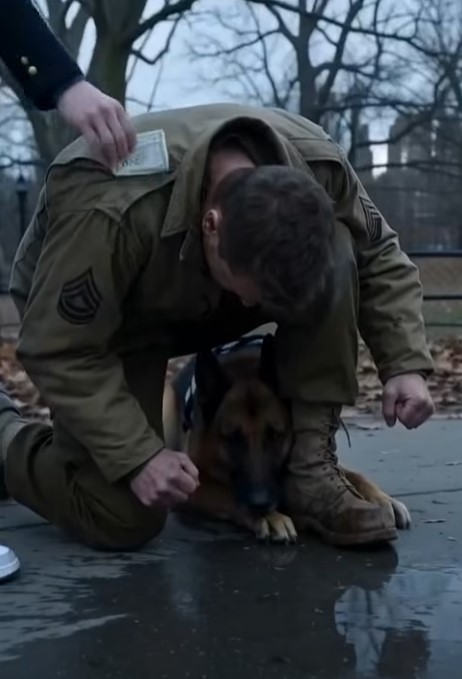
A quiet Sunday morning in a local city park reportedly became the starting point of a chain of events that would later connect to a high-profile federal courtroom case. The park was calm, with early walkers, joggers, and families enjoying the open space. Among them sat Arthur Caldwell, a decorated military veteran and federal judge, spending a rare moment of rest near a small pond with his service dog, Buster. Dressed casually and blending in with the surroundings, he did not attract attention from those passing by.
To most observers, Caldwell appeared to be an ordinary retiree enjoying a peaceful morning outdoors. Few would have recognized the weight of responsibility he carried in his professional life. His presence in the park reflected a brief escape from the demands of the federal judiciary, where he regularly handled complex and serious legal matters. Beside him, however, was Buster, a trained German Shepherd who played an important role in his daily life and emotional stability.
Buster was more than a companion. The service dog had been trained to assist Caldwell with symptoms related to combat-related trauma from his military service. Over time, the bond between them had grown strong, built on trust, routine, and mutual reliance. For Caldwell, the dog represented both emotional support and a stabilizing presence during difficult periods in his life.
The peaceful setting reportedly changed when a group of teenagers walked through the area. As they passed near the bench where Caldwell was seated, one of them began making comments that escalated into mocking behavior. The situation quickly shifted from verbal remarks to something more serious and concerning.
According to the account, one of the teenagers suddenly kicked Buster while the dog was resting beside the bench. The act caused immediate distress to the animal, which quickly moved back toward its owner. Caldwell, although visibly angered, chose not to respond with aggression. Drawing on both his military background and judicial discipline, he restrained himself and focused on ensuring the safety of his service dog.
Before the group left the area, Caldwell reportedly caught a clear view of the teenager responsible for the act. That brief moment of recognition would later become significant in a way he did not immediately anticipate. At that time, however, his priority remained the condition of Buster and ensuring the dog was not seriously injured.
Shortly after the incident, Caldwell took Buster to a veterinary clinic for examination. Medical professionals reportedly identified bruising consistent with physical impact but found no fractures or life-threatening injuries. While the diagnosis was reassuring, the emotional impact on both the dog and its owner was more difficult to measure.
Buster’s role in Caldwell’s life extended beyond companionship. The service animal had been instrumental in helping him manage long-term psychological effects related to his military service. Their relationship had developed over years of shared experience, making the incident in the park particularly distressing for Caldwell on a personal level.
Later that same day, Caldwell reportedly reviewed documents related to an upcoming federal sentencing case involving businessman Marcus Vance. The case was already under public attention due to the severity of the charges, which included financial crimes such as fraud and corruption. The sentencing hearing was scheduled for the following morning in federal court.
While reviewing materials, Caldwell reportedly made a connection between the teenager from the park and a name appearing in case-related documents. The individual was identified as Tyler Vance, the son of the defendant in the upcoming sentencing hearing. This realization added an unexpected dimension to what had initially seemed like an unrelated incident.
Background records available within the case file reportedly contained references to prior behavioral concerns involving Tyler Vance. These included allegations of misconduct and repeated behavioral issues that had not resulted in significant legal consequences. The documentation suggested a pattern of behavior that raised questions about consistency in accountability.
At the same time, the defense strategy in the upcoming hearing presented Tyler in a highly positive light. Legal arguments emphasized strong character traits, academic potential, and the importance of family support. Photographs and written statements portrayed a stable and supportive family environment, intended to influence sentencing considerations.
The following morning, the federal courthouse was filled with attorneys, reporters, court officials, and members of the public. The sentencing hearing for Marcus Vance was expected to conclude a lengthy legal process involving multiple charges and extensive financial investigations. The atmosphere inside the courtroom reflected the seriousness of the proceedings.
During the hearing, the prosecution outlined the extent of the financial crimes, describing significant harm to individuals and businesses affected by the defendant’s actions. Victims reportedly provided statements detailing financial losses and personal hardship resulting from the case. The prosecution emphasized accountability and the broader consequences of white-collar crime.
In response, the defense focused heavily on mitigating factors, including community involvement, past contributions, and family responsibilities. A central part of their argument was the portrayal of Marcus Vance as a father whose presence was essential to his son’s development and future stability. Tyler was repeatedly described as a well-behaved and promising young individual.
As the proceedings continued, the judge addressed the issue of character evidence presented during the defense. It was at this point that Caldwell reportedly referenced the incident from the previous day in the park. He described the interaction involving the teenager and the service dog, noting the behavior he personally witnessed.
The courtroom reportedly reacted with visible surprise as the connection between the individual in court and the teenager from the park was revealed. This moment introduced a contradiction between the defense’s positive portrayal of character and the behavior described by the judge. The situation added new complexity to the evaluation of character evidence.
Further discussion in court reportedly included additional background records that suggested a pattern of behavioral concerns. These references challenged the defense narrative and raised questions about the consistency of the character assessment presented during the hearing. The court considered all available information before reaching a final decision.
After reviewing the evidence and hearing all arguments, the judge delivered the sentencing decision. Marcus Vance was sentenced to twenty years in federal prison, reflecting the seriousness of the offenses and their impact on victims. The ruling concluded a significant phase of the legal proceedings.
Following the sentencing, the court also addressed the separate issue involving the attack on Buster. Because the dog was a registered service animal, the incident was subject to review under applicable laws regarding animal protection and interference with service animals. The matter was referred for further investigation.
After the proceedings, Caldwell returned home where Buster continued recovering from the earlier injuries. The service dog showed signs of improvement, and the bond between the two remained strong. The conclusion of the case marked the end of a difficult period for both of them.
The events, as described, highlight how quickly unrelated moments can intersect in unexpected ways. A brief incident in a public park ultimately became connected to a much larger legal proceeding, demonstrating how behavior, accountability, and evidence can converge in the judicial system. The story also emphasizes the importance of responsibility and the consequences of actions, regardless of background or status.
