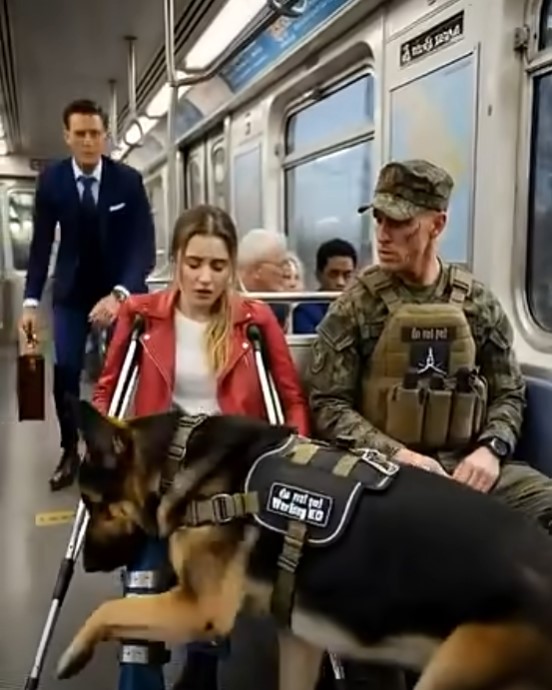
A crowded train journey can often feel routine, filled with familiar sounds, repeated stops, and passengers focused on their own daily routines. However, even in the most ordinary settings, unexpected moments can create meaningful human connections that stay in memory long after the journey ends. This story reflects such a situation, where chance seating, a service animal, and simple conversation transformed an everyday commute into a memorable experience. The journey begins with a woman traveling on a busy afternoon train.
She is dealing with physical challenges that make mobility more difficult, requiring extra effort and patience as she navigates crowded spaces. The train is filled with commuters returning from work, families heading home, and travelers carrying the weight of their own long days. Finding a seat is not easy, and every available space becomes valuable in such a packed environment.
After moving carefully through the narrow aisle and observing her surroundings, she finally finds the last open seat. It is located beside a passenger accompanied by a trained service dog. The seat offers immediate relief after standing and walking through a crowded carriage, allowing her to rest and regain comfort for the remainder of the journey. The moment of sitting down feels like a small but important pause in an otherwise exhausting day.
The service dog beside her is calm and attentive, showing the discipline typical of professionally trained assistance animals. While service dogs are usually focused on their handlers, it is not uncommon for them to remain aware of their surroundings, especially in close proximity to passengers who may appear unwell, stressed, or in need of assistance. The animal’s behavior reflects quiet awareness rather than distraction.
As the train continues forward, a natural conversation begins between the passengers. Introductions are exchanged politely, and the presence of the service dog becomes a gentle bridge for communication. The handler explains the role of the dog and how it assists in daily life, while also engaging in light conversation about travel and everyday experiences. These simple exchanges create a calm and respectful atmosphere within the crowded train car.
The woman also shares aspects of her daily challenges, particularly the importance of adapting to physical limitations while maintaining independence. Such conversations often help people find common ground, even among strangers, by revealing shared understanding of resilience and routine difficulties. The interaction remains respectful, with no disruption to other passengers, many of whom continue observing quietly or focusing on their own journeys.
During the ride, an unexpected delay occurs as the train temporarily stops between stations. Announcements inform passengers that the interruption is due to operational reasons, though no further details are immediately provided. In such moments, uncertainty often spreads through the carriage, and passengers react in different ways—some checking their phones, others waiting quietly, and a few expressing mild frustration at the delay.
For individuals already managing physical or emotional strain, delays can sometimes feel more stressful. However, the presence of calm elements within the environment can help ease tension. In this situation, the service dog remains composed and steady, providing a quiet sense of stability. Trained assistance animals are often known for their ability to remain calm in unpredictable environments, which can have a reassuring effect on nearby passengers as well.
As time passes, the atmosphere inside the train gradually stabilizes. The conversation between passengers continues intermittently, helping to pass the time and reduce focus on the delay. The service dog remains close to its handler, occasionally shifting position but maintaining a calm and controlled presence. These small details contribute to a sense of normalcy despite the interruption in travel.
Eventually, the train resumes its journey, and the delay comes to an end. Passengers settle back into their seats, relieved that movement has continued. The remainder of the trip proceeds without further incident, returning to the familiar rhythm of travel stops, announcements, and changing scenery outside the windows. What began as an uncertain pause becomes just another part of the journey.
As the destination approaches, the passengers prepare to disembark. The brief interaction that occurred during the ride leaves a subtle impression—one that is not dramatic or life-changing in a sudden way, but rather quietly meaningful. The presence of kindness, conversation, and calm behavior during a stressful moment becomes the most memorable part of the experience.
After leaving the train, the memory of the journey remains present in thought. Small interactions between strangers often have a lasting impact precisely because they are unexpected and unplanned. The combination of shared space, brief conversation, and the calming presence of a trained service animal highlights how everyday environments can sometimes produce moments of comfort and connection.
In the broader sense, experiences like this remind us that public spaces are filled with opportunities for understanding and empathy. Whether through conversation or simple observation, people can find reassurance in the behavior and presence of others. Service animals in particular often play an important role in creating stability not only for their handlers but also in influencing the emotional tone of the environment around them.
Over time, such memories often resurface during similar experiences. The next time a crowded train or busy commute occurs, a person may recall moments of unexpected calm or kindness from previous journeys. These reflections reinforce the idea that even brief encounters can have a lasting emotional effect.
Ultimately, this type of story emphasizes the quiet importance of human connection in everyday life. Not every meaningful moment is dramatic or planned; sometimes it is simply the result of shared space, mutual respect, and the calming presence of an animal trained to support and protect. In that sense, even an ordinary train ride can become something worth remembering.
