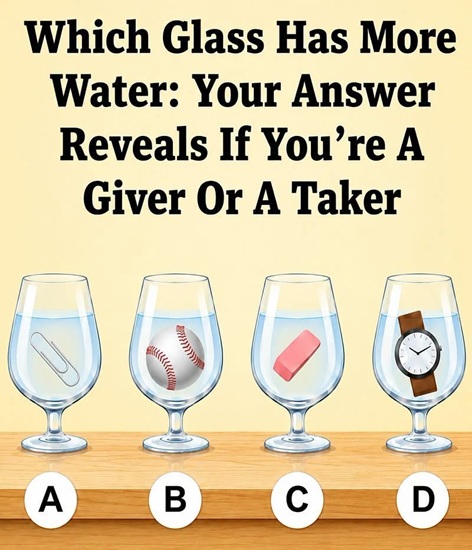
At first glance, this looks like a straightforward visual puzzle designed for children, but in reality, it has confused thousands of people online. Four identical glasses are placed side by side, each filled with water up to the same visible level. Inside each glass is a different object, and the challenge is to determine which glass actually contains the most water. What makes this puzzle so interesting is that the answer is not based on what we immediately see, but on how we interpret space, volume, and physical displacement.
The four glasses are labeled A, B, C, and D. Each glass appears to be filled equally, but each contains a different object submerged in the water. Glass A contains a small paperclip, Glass B contains a large baseball, Glass C holds a standard eraser, and Glass D contains a wristwatch. At first glance, the human brain assumes that identical water levels must mean identical amounts of water, but this assumption is where the illusion begins.
This type of puzzle works because the human brain is naturally designed to process visual information quickly. Instead of analyzing physical laws in detail, we rely on pattern recognition and instinct. When we see four glasses filled to the same level, our brain immediately categorizes them as equal. However, this is a shortcut that ignores an important scientific principle: displacement.
Displacement refers to the idea that when an object is placed into a liquid, it pushes aside a volume of that liquid equal to its own size. In a closed container, this means the object takes up space that would otherwise be filled with water. As a result, the actual amount of water in each glass depends not only on the visible water level, but also on how much space the submerged object occupies.

If we apply this principle to the puzzle, the situation becomes much clearer. Although all four glasses appear equally full, the objects inside them are not the same size. The baseball in Glass B is significantly larger than the other objects, meaning it displaces the most water. The wristwatch in Glass D and the eraser in Glass C also take up a noticeable amount of space, reducing the volume of water in their respective glasses.
Glass A, however, contains only a small paperclip. Compared to the other objects, it occupies a minimal amount of space inside the glass. Because it displaces the least water, Glass A must contain the largest volume of actual water among the four. Even though all the glasses appear visually identical in fullness, the internal volume tells a completely different story.
This puzzle is a strong example of how perception and reality can differ. What we see with our eyes is not always an accurate representation of what is physically true. The brain simplifies information to make quick judgments, but this efficiency sometimes leads to errors. Optical illusions and logic puzzles like this expose those gaps in perception.
The reason puzzles like this become so popular online is because they challenge confidence. Most people answer quickly without hesitation, only to realize later that their assumption was incorrect. This creates a moment of surprise that encourages deeper thinking and discussion. It also demonstrates how easily the mind can be influenced by visual cues rather than logical analysis.
Beyond the scientific explanation, these puzzles are often used as a way to explore personality traits in a fun and informal manner. While not scientifically accurate, these interpretations add an entertaining layer to the experience. For example, someone who chooses Glass A might be described as detail-oriented and analytical, someone who pays attention to small but important factors that others might overlook.
A person who chooses Glass B might be seen as confident and fast-thinking, relying on instinct and overall impression rather than detailed analysis. While this can lead to quick decision-making, it may also result in missing subtle but important details. Those who choose Glass C may represent balanced thinkers who consider both logic and intuition before making a conclusion.
Meanwhile, individuals who select Glass D might be interpreted as symbolic or reflective thinkers who look beyond the obvious and try to find deeper meaning in what they observe. These interpretations are not scientific, but they help make the puzzle more engaging and relatable for a wider audience.
What makes this illusion particularly powerful is its simplicity. There are no complex equations or hidden tricks—just a basic misunderstanding of how volume and space interact. Yet despite its simplicity, it reveals something important about human cognition: we often trust what we see more than what we calculate.
In real-world situations, this same principle applies far beyond puzzles. In business, education, and everyday decision-making, people frequently rely on first impressions. However, deeper analysis often reveals hidden factors that completely change the outcome. Just like the paperclip in Glass A, small details can significantly influence the bigger picture.
This puzzle serves as a reminder to slow down and question initial assumptions. When faced with a situation that seems obvious, it is often worth asking what is not immediately visible. What factors are being overlooked? What hidden variables might be influencing the result?
Ultimately, the glass puzzle is more than just a visual trick—it is a lesson in critical thinking. It teaches us that reality is not always defined by appearance and that careful observation often leads to better understanding. The smallest object in the glass, the paperclip, becomes the key to unlocking the correct answer, showing how even minor details can completely change the truth of a situation.
In the end, puzzles like this encourage a shift in thinking from instinct to analysis. They remind us that what appears equal on the surface may hide important differences beneath. And in both puzzles and life, the ability to look beyond appearances is often the most valuable skill of all.
